

2-day work session adds staff, student camps, spending at school campuses
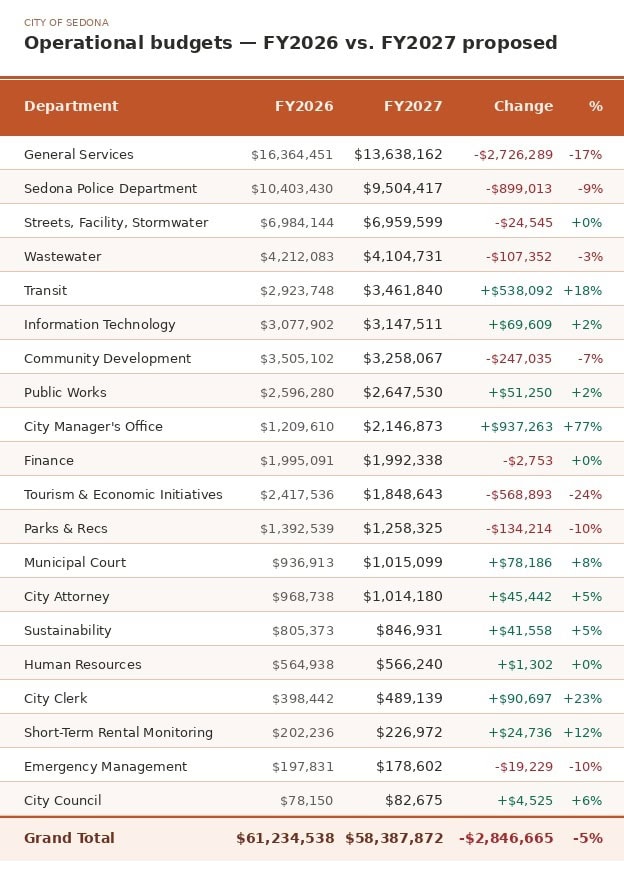
Sedona City Council entered its two-day budget work session on April 22 with City Manager Anette Spickard’s proposed $94.7 million budget for fiscal year 2026-27, and emerged at the end of the day on Thursday, April 23, with a preliminary figure of $95,983,959.
However, that estimate does not include a decision packet being put together by the Public Works Department to potentially provide maintenance to the tennis court and all the athletic fields at Sedona Red Rock High School.
Among the tentative additions to that figure are two new parks and recreation positions, a full-time janitor and a full-time recreation coordinator for after-school programs, a new part-time court specialist and converting the current part-time bike coordinator into a full-time role, a change backed by Spickard, though not by the Citizen Budget Work Group — which tentatively is an increase of four full-time equivalent employees of the city, “in a year where we had given original direction for no FTEs,” Councilwoman Kathy Kinsella said.
The potential school support funding, meanwhile, is fast-tracked and did not go before the CBWG.
Council members had expressed a lack of appetite for new staff in FY27 during their December retreat, and called for more justification following FY26’s staffing increase.
School Fields
Public Works entered the work session with a $1,827,834 million proposal to assume full landscaping duties across both Sedona Red Rock High School and West Sedona School, a price tag Councilwoman Charlotte Hosseini called “staggering.”
Council ultimately narrowed the request, directing staff to return with a refined cost estimate focused on the tennis courts and athletic fields at the high school.
The condition of SRRHS fields has been a sore subject for the school district. In 2023, the Scorpion Booster Club paid $8,493 to repair the baseball field after gopher holes raised concerns about injuries, a fix the club noted was not in SOCSD’s budget.
The problem wasn’t limited to baseball. After years without a football program, Sedona-Oak Creek School District Superintendent Tom Swaninger, Ed.D, said that he hoped the Scorpion’s first scrimmage this fall would send the community home energized.
“There was a potential for all of those community members to walk back into their neighborhood and say, ‘How cool was this? Football is back, I love living in Sedona,'” Swaninger said. “Do you know what the phone calls I received afterwards? ‘What’s going on with that baseball field?’ It’s not just about a ball field. It is about the pride of our community and the pride of our public schools. Until we become, in every way, shape and form, a premier school district, we are going to fall short as a community.”
Councilman Derek Pfaff shared an anecdote about the high school practice field: “it was pockmarked, it had gopher holes.”
The SOCSD Governing Board voted in March to accept a $10 million offer for the shuttered Big Park Community School property from buyers Basil and Mimi Maher, above its $9.5 million April 2025 appraisal — with the proceeds restricted to capital expenses.
Swaninger has stressed security improvements on its campuses are the biggest priority for those funds.
“The capital needs throughout our district likely exceed that $10 million, so the support that we would have from the municipality would mean that we would able to be able to either spend it in other areas or use it for a fiscally responsible emergency fund for later use,” Swaninger later said.
Swaninger said that it was too early to give SOCSD’s full list of capital needs.
“We have some meetings set up to evaluate that and create some priorities,” he said. “We’ve had early discussions, but we’d like it to be based on a little bit more hard evidence.”
“Two other ideas came up which included city assistance with development of a mentoring program and potential marketing of Sedona schools by the city in its tourism program,” Hosseini and Councilwoman Melissa Dunn wrote in an April 21 memo. SCS also raised the idea of cross-marketing with the city.
After-School Camps
A new after-school extracurricular camp program could start as early as the beginning of instruction this fall following unanimous direction from City Council.
“I hope that we call this phase one,” Vice Mayor Brian Fultz said. “If we’re trying to help families in our community, it’s not just after school — it’s weekends, it’s holidays, it’s more coverage during the summer.”
The city-run program would offer at least 12 days per month for kindergarten through fifth graders, with activities ranging from sports to arts, tentatively capped at $25 per day. It would require a full-time recreation coordinator at $92,188 and a full-time custodian at $82,836, supplies at $13,500, and has an estimated annual cost of $214,775.
Security
Council discussed but took no action on a proposal to fund an outside school security consultant at a one-time cost of $76,000, with an ongoing cost of $5,000 annually, beyond the assessments the Sedona Police Department currently conducts on campuses.
“We didn’t leave the Sedona Charter School out intentionally when this was brought to us last week, when we were working quickly, it was just between the two schools to go talk to,” SPD Chief Stephanie Foley said. “So of course, we would include them.”
Sedona Charter School
Council signaled support for a $23,000 climbing structure for Sedona Charter School’s playground, which would be open to the public outside school hours. Council also expressed interest in funding repairs to the school’s performance stage lighting, though no cost estimate is yet available.
Fultz recused himself from the discussion on this item because his wife, Amy Fultz, is SCS’ executive director.
The tentative budget will come before the council for approval on Tuesday, May 26, with final approval currently scheduled for Tuesday, June 23.


