

Legally speaking, there are no licensing requirements or government agency that grants or revokes the job title of “journalist.” In common parlance, a journalist works for a newspaper, broadcast or digital media outlet that disseminates news and information to the public.
Individual journalists and media outlets should present fair, unbiased and balanced news to the public and present both or multiple sides of an issue or argument for readers.
A media outlet’s editorial or opinionated arm, i.e., the published commentary on that news, may and often does have a bent toward the publication’s viewpoint, be it liberal, conservative, progressive, libertarian, socialist, nationalist or, in our case, hyperlocal.
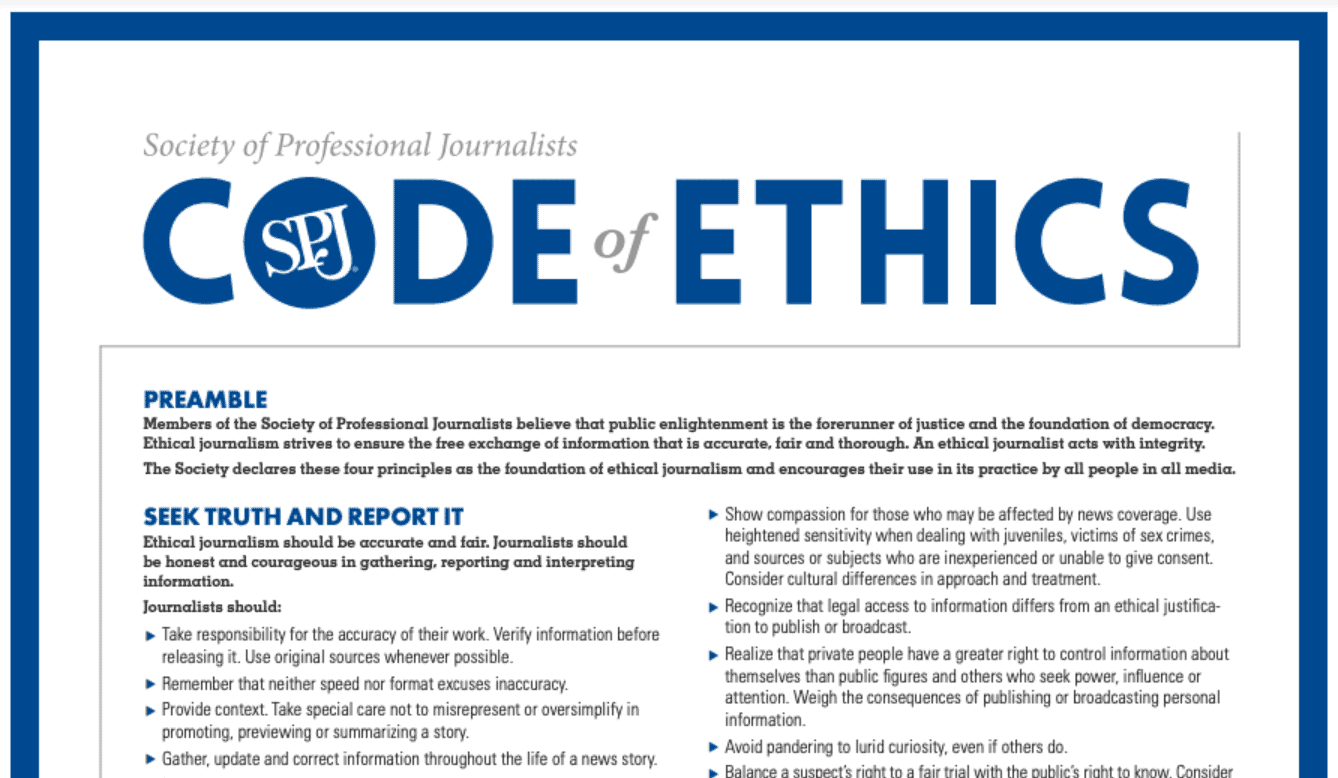
Journalists can be wholly independent, running on stand-alone platforms with thousands of paying subscribers, but there is a still a bright line between being a journalist and a partisan pundit, commentator or mere writer, and that comes down to adhering to a set of principles and ethics to which journalists subscribe. If someone claims to be a journalist and doesn’t write for an established and trusted media outlet, there’s a checklist: The Society of Professional Journalists’ Code of Ethics.
Journalism students learn this as college freshmen and its the first page I review with every new hire.
“Ethical journalism strives to ensure the free exchange of information that is accurate, fair and thorough. An ethical journalist acts with integrity” declares four main principles as the foundation of ethical journalism and encourages their use in its practice by all people in all media. The whole code is online, but here are some key excerpts:
“Seek truth and report it. Ethical journalism should be accurate and fair. Journalists should be honest and courageous in gathering, reporting and interpreting information. Journalists should:
“Take responsibility for the accuracy of their work. Verify information before releasing it. Use original sources whenever possible; Remember that neither speed nor format excuses inaccuracy; provide context. Take special care not to misrepresent or oversimplify in promoting, previewing or summarizing a story; gather, update and correct information throughout the life of a news story; be cautious when making promises, but keep the promises they make; identify sources clearly.
“Avoid undercover or other surreptitious methods of gathering information unless traditional, open methods will not yield information vital to the public.
“Give voice to the voiceless; support the open and civil exchange of views, even views they find repugnant; recognize a special obligation to serve as watchdogs over public affairs and government. Seek to ensure that the public’s business is conducted in the open, and that public records are open to all; provide access to source material when it is relevant and appropriate; boldly tell the story of the diversity and magnitude of the human experience.
“Label advocacy and commentary; never deliberately distort facts or context, including visual information … never plagiarize. Always attribute.
“Minimize Harm. Ethical journalism treats sources, subjects, colleagues and members of the public as human beings deserving of respect.
“Pursuit of the news is not a license for arrogance or undue intrusiveness; show compassion for those who may be affected by news coverage.
“Recognize that legal access to information differs from an ethical justification to publish or broadcast; realize that private people have a greater right to control information about themselves than public figures and others who seek power, influence or attention … avoid pandering to lurid curiosity, even if others do.
“The highest and primary obligation of ethical journalism is to serve the public … avoid conflicts of interest, real or perceived. Disclose unavoidable conflicts; refuse gifts, favors, fees, free travel and special treatment.
“Distinguish news from advertising and shun hybrids that blur the lines between the two. Prominently label sponsored content.
“Be accountable and transparent … explain ethical choices and processes to audiences. Encourage a civil dialogue with the public about journalistic practices, coverage and news content; respond quickly to questions about accuracy, clarity and fairness; acknowledge mistakes and correct them promptly and prominently. Explain corrections and clarifications carefully and clearly; expose unethical conduct in journalism, including within their organizations. Abide by the same high standards they expect of others.”
At the core, the journalist and the media outlet should strive to be fair so readers, listeners or views get an honest and true picture of a news event or issue. The journalist should not be the center of any news story — which is something I wrote in an op-ed in Editor & Publisher magazine several years ago — and if they unfortunately are, should have an unaffiliated reporter or staffer write that story so, again, readers are presented with a fair and accurate picture of the event that put the journalist into the news story.
Online rage-bait intended not to inform but just to generate revenue through monetization of clicks isn’t journalism and the creators aren’t “journalists” by any stretch. They’re just grifters. Be smarter news consumers and know the difference.


