

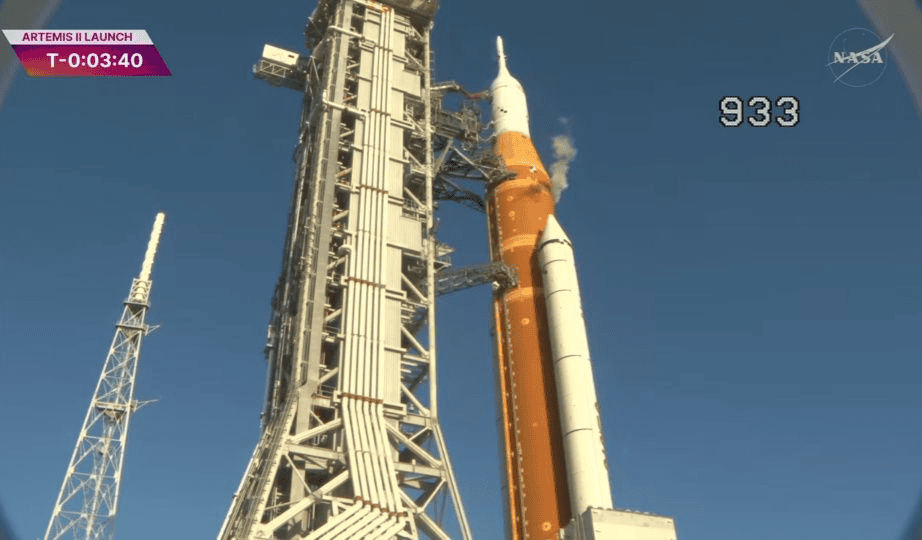
As I write this on the morning of Wednesday, April 1, NASA is go for a launch on the Artemis II mission, that will send four astronauts around the Moon for the first time since December 1972.
Barring a last-minute scrub or low-earth problem that could send the mission back to Earth, the crew is set to launch a few hours after we go to press, just as this edition is rolling off the press.
According to NASA tradition, there is only one appropriate prayer for a safe NASA mission, uttered by Alan Bartlett Shepard Jr. for the Freedom 7 mission on May 5, 1961 — called the “Shepard’s Prayer” or “The Astronaut’s Prayer” and that is: “Dear Lord, please don’t let me f*** up.”
Here’s to hoping.
[Editor’s note: The Artemis II launch was a success. See the footage below]
The Artemis II Launch at 3:35 p.m. Arizona time on Wednesday, April 1

Late in the evening on Tuesday, Nov. 16, 2022, or just after 1 a.m. on the East Coast, the unmanned Artemis I mission began as the Space Launch System rocket lifted off from Launch Complex 39B at the Kennedy Space Center in Cape Canaveral, Florida, sending the Orion lander into low Earth orbit for a first pass toward Earth’s Moon.
Artemis I paved the way for this manned mission to orbit the Moon on Artemis II, an Artemis III test mission and finally a manned landing in Artemis IV to return humans to the surface of the Moon in 2028 some 56 years after the Moon felt human touch — the feet of astronaut Eugene Cernan.
Back in 2022, I woke up my then-4-year-old daughter Athena to watch the launch. She could barely keep her eyes open at the late hour, but we sang a little song together that she learned from Miss Marsha Hansen, host of storytime at the Sedona library: “Zoom, zoom, zoom, we’re going to the Moon.”
In the other room, Athena’s newborn twin siblings slept soundly. Her sister is named Artemis. Their brother Odysseus has many middle names, but the last one is Orion. Their names are entirely coincidental, based on my love of Greek mythology, but serendipitous given their connection the new NASA missions. We watch YouTube videos related to science and space, and my son in particular loves watching rocket launches, knowing that they are skyscrapers sent into Earth-orbit atop giant explosions of fire and sound.
Artemis II will follow all the same steps, but have astronauts aboard. The mission is commanded by NASA astronaut Reid Wiseman and piloted by NASA astronaut Victor Glover with two mission specialists: Christina Koch from NASA and Jeremy Hansen from the Canadian Space Agency. This mission is similar to yet far different than what we saw in the 1960s and 1970: Glover is the first African-American, Koch the first woman, and Hansen the first non-American to both leave low-Earth orbit and to travel around the Moon.
Unlike the Apollo missions, which were solely an American project at the height of the Cold War, every human on Earth can see ourselves reflected in one or more of these four explorers as they leave the politics of Earth behind to circle another celestial body in our solar system. Because of the geometry as they circle the Moon, the four will travel further from Earth than any other living* human.
Life as we know it is destined to explore and expand, from the first microscopic living creatures to leave salty tide pools for the open ocean, the first seed to plant itself on dry land, the first human to leave our only tribe to found a second one, the first hunter to set foot on a new continent — exploration is coded into our DNA.
The solar system is cold, dark and indifferent to our existence, but it is our destiny to leave the cradle of Earth and expand to the worlds beyond. Some 106 billion humans from 10,000 human civilizations over the last 100,000 years have dreamed of the Moon, but only in the last 60 years have we mastered the geometry and overcome the gravity to touch the surface of the Moon and bring some of it home.
Artemis II sends around the Moon while Artemis III will land us there again as we plan future missions for a permanent base that will serve as a launching point to Mars and the Asteroid Belt and moons of the gas giants beyond.
President John F. Kennedy’s promise in 1961 was more than just math and politics but a proclamation of human achievement, the culmination of what we could do with our knowledge and a fulfillment of the urge to explore and ancestral yearning to touch the Moon.
While all this sounds amazing, for kids, especially my son, it will be a really cool giant rocket using a controlled explosion to send a skysraper into space. That alone will be really, really cool. Of course, that’s why we’re going to space. Not for the dead men who dreamed of what we see today, nor for ourselves who witnessed the launch, but for our children, and theirs, and theirs, for whom space beyond the thin blue shield of Earth’s horizon is not our boundary but our beginning.
When we are dust and memory, they will be exploring far beyond the Moon that once seemed so far away.
Christopher Fox Graham
Managing Editor
- The sole caveat is that some the ashes of Clyde Tombaugh, the Flagstaff astronomer who discovered Pluto from Lowell Observatory in 1930, are aboard the New Horizons probe, which is now out beyond the orbit of Pluto in the Kuiper Belt, about 5.8 billion miles from Earth.
Live footage from the Artemis II mission


