

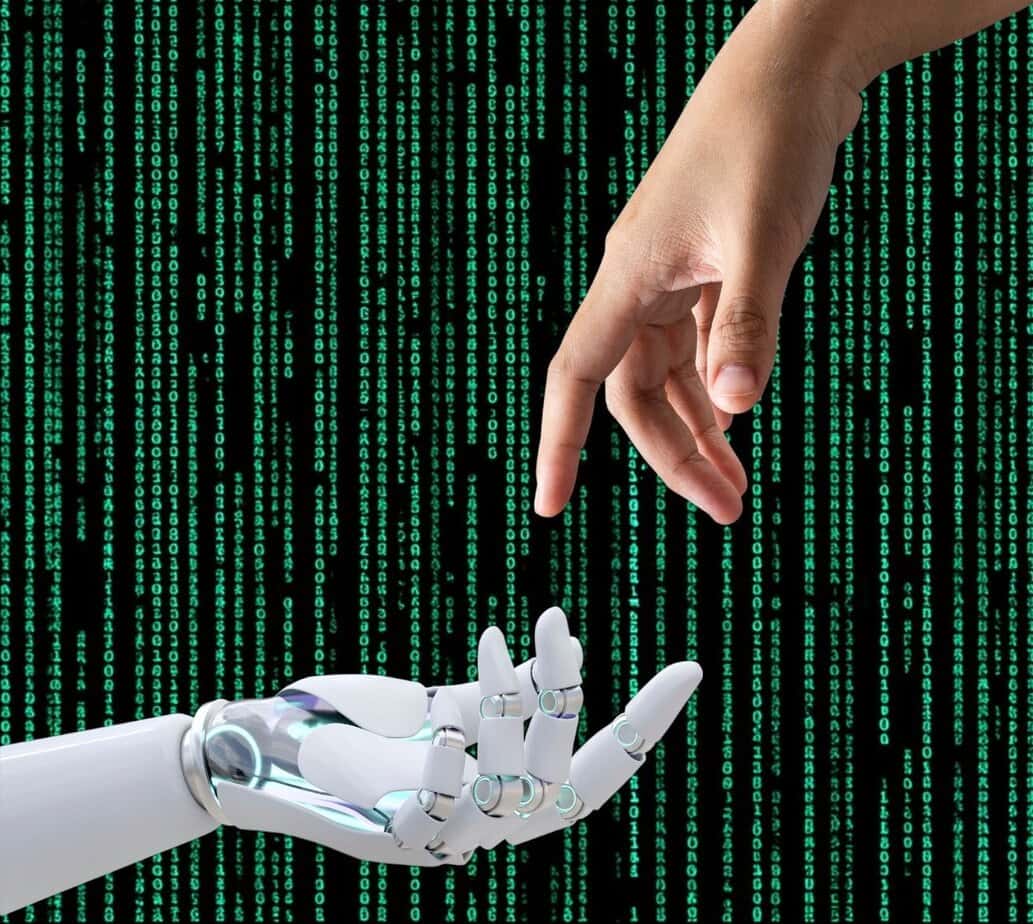
The digital tools we called “artificial intelligence” are becoming ubiquitous elements of our online life. First emerging to speed up online searches, they’re used by websites as customer service chatbots, for making images and videos for compiling and analyzing data sets.
None of these tools are true artificial intelligence akin to what we see in the movies or television shows — thinking machines capable of independent thought outside their programming, to which we, in our anthropomorphic bias, ascribe far too much “humanness” to, much the same way we think our computer is “acting up” when it takes too long to open a program or download a file we need on a deadline. “Artificial intelligence” is a misnomer, but as it is the parlance for this type of digital creation, it’s the term I’ll use for the rest of this editorial.
Some images created by AI tools are truly amazing and it’s wondrous that something like an image generator can take a written prompt and create something pleasing to the eye, even in the same style as an image we’ve uploaded. But these images are mere data points of colorized pixels. Through billions of computations predicated on trillions of past computations, an AI can produce an image or make an image into a moving picture that imitates what can be created by an actor on film or a human computer programmer.
AI tools have greatly helped us analyze data and present that data for our news reporting. Even so, AI searches and tools are beset with the same problems that a normal online search suffers from: Inaccurate or outdated explanations, links to websites or web pages that were later amended or corrected and biased pushed to the top of a search platform not because it’s the most accurate result but because it has the most hits in previous online searches.
Most users accept the initial results at face value without going one step further to verify that information. Humans are still necessary to fact-check what AI produces. We should realize that AI tools are just that, and not some profound next step of human evolution or machine-human discourse, at least not yet and probably not for a long while.
One user in Sedona has generated lots of online traffic by posting videos of himself “conversing” with a chatbot, asking it questions about spirituality and consciousness, mistaking the chatbot’s predictable answers gleaned from data as some sagacity akin to a guru.
It’s certainly entertaining, but really no different or “wiser” that what one would get speaking to a priest, rabbi, minister, philosophy student or screenwriter with institutional knowledge and a desire to provide insight to a spiritual seeker. The key difference being that a human understands the implications while a chatbot is taking data input, processing it and producing data output.
Another local user employs chatbots to write commentary on local news events under a series of pseudonyms to generate content on the user’s website to create the illusion of more engagement than really exists.
On the other side, online posters will respond on social media not with their own thoughts and insight, but with direct quotes from Open AI’s ChatGPT, Anthropic’s Claude or Grok, created by “X,” commonly and formerly known as Twitter. But like all tools, they are only as good as the user and only as wise as the prompts human operators input.
Posting these summations as “facts” or “truth” in an of themselves, is a fallacy known as “appeal to authority” or argumentum ad verecundiam. Simply because a chatbot summarizes argumentation or statements that seem definitive, it does not by itself make it true, no matter how authoritative-sounding the language is.
One user recently used a chatbot to argue that the findings of a recent court ruling meant something far different that the reading of the actual court opinion stated. A close reading revealed that error, very clearly and definitively. Court rulings are written by judges with nuance and word choices that AI chatbots can read but not understand but which a human mind easily can.
A chatbot doesn’t know “why” a person picked one word over another, but a human author and reader does, and the “why” is often what really carries the meaning. The mistakes were not in the chatbot — it was simply providing the user with what he wanted to read and repost.
One could argue that a human mind is no different than a very complex computer, but there are two key differences:
- even the most advanced supercomputers are still nowhere near as complex as a human brain and
- human synaptic connections in our brains are randomly connected, which leads to neurons unexpectedly participating in thoughts or, in a word, creativity.
English has 795,606 total words and 1,578,939 definitions on which a Large Language Model can train, but a human brain has 86 billion neurons forming 100 trillion connections.
Until AI begins making connections at that scale and with our biological randomness, true AI won’t exist and we’ll merely have the illusion of thought from our computer tools.


