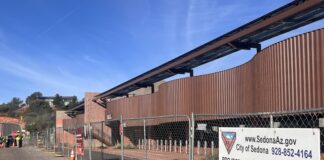



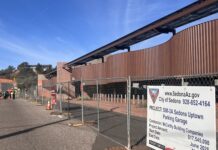











The Sedona City Council will soon be mailing out to registered voters within city limits a survey about what to do with the Western Gateway property, which includes the Sedona Cultural Park and the Georgia Frontiere Performing Arts Pavilion. The city partnered with Phoenix-based HighGround Inc. to draft the survey questions.
We highly encourage everyone who gets the survey take it, and do so as soon as they receive it. Questions 1 and 3 are pretty straightforward and Question 2 involves ranking some proposed components. Overall, the survey should only take a few minutes.
The city of Sedona and Sedona City Council initially said when purchasing the 41-acre park for more than $23 million in December 2022 that the city had no official plans. The later stated goal was to use the site for more housing options and the city started a master planning process in the summer of 2024 for potential housing development. Residents agreed with “housing” as a top interest in the first survey completed in October 2024, so that option was omitted from a second survey in January 2025.
As we previously opined, that second survey had some leading questions to seemingly discourage residents from supporting a recreation center or amphitheater, but adding “that [it] could result in increased taxes.” Other city projects like road improvements, shared-use paths, park additions or new programs are often included in surveys or discussed at Sedona City Council meetings, but rarely do such community decisions include the addendum, “this may increase taxes” — a factor either already understood or considered just the cost of doing municipal business Whether such projects do or don’t, that’s generally not really a make-or-break decision about whether to add a slide or shade structure for kids at a park or a new bike path through a residential neighborhood.
The questions in the new survey, as we currently understand them, will just be straight questions to give council a clearer idea about what may happen at the Western Gateway. There is also a proposed ballot measure from residents that could upend plans for housing, but that will likely be decided by voters sometime this election cycle.
The park was proposed in the late 1990s with land acquired by a nonprofit in 1998. The 5,500-seat amphitheater opened in 2000. While more recent residents may assume the park closed due to actions or inaction by the Sedona City Council, complaints about noise from neighbors or opposition from residents, none of these are true in regards to the Sedona Cultural Park.
- The city of Sedona never owned it, never operated it and had nothing to do with its closure.
- Complaints from neighbors were mild and mostly inconsequential. The Georgia Frontiere pavilion was intentionally built into natural bowl, projecting sound upward rather than to toward any neighborhood, and the inverse square law means that any sound spillover was below the city threshold for noise complaints, with shows ending well before the nighttime sound restrictions went into effect.
- Residents at the time were either in favor or indifferent, but there was no real “opposition.”
- Ticket sales for concerts were down in the early 2000s, especially after the Sept. 11 attacks of 2001, though the Sedona Cultural Park saw an uptick in annual attendance in 2002 and 2003. But it was a costly project and in debt on opening day.
Eager to get any acts to perform, the nonprofit signed contracts with artists coming through Arizona without clauses preventing the acts from also performing elsewhere in the same time period, meaning bands, musicians and performers would play a show in Sedona immediately after or immediately before playing another show in Flagstaff or the Phoenix area.
Fans who didn’t want to come to Sedona for the gig would buy tickets more locally, hurting the overall audience numbers in Sedona and there just weren’t enough residents and visitors in Sedona to generate revenue needed to recoop those costs.

J. Kat Woronowicz/Larson Newspapers

Ryan Van Benthuysen/Larson Newspapers
The nonprofit that owned and ran park was still falling short of paying back the loan by summer 2003 and owed $3.8 million to the National Bank of Arizona with a major balloon payment coming due in summer 2004 that the nonprofit would be unable to pay. It closed the park in September 2003, canceled the final shows in October and eventually filed for bankruptcy.
Overall ticket sales have increased by 214% since 2001 and venues have seen a 370% increase in gross revenue, when adjusted for inflation, driven by stadium-scale, long-term tours and an overall increase in ticket prices so better management and the economic environment could make a revamp finally viable, especially without a big loan to repay.
The question on both the survey and possibly on the ballot is whether Sedona wants the existing venue incorporated, a smaller venue, something different artistically and culturally, housing, commercial space, a recreation center or some combination thereof. So when you get your survey, take it, and remember to vote in both 2026 elections and have your say in the future of the property.
Christopher Fox Graham
Managing Editor
Concert ticket sales by year, adjusted for inflation, from 2000 to 2026
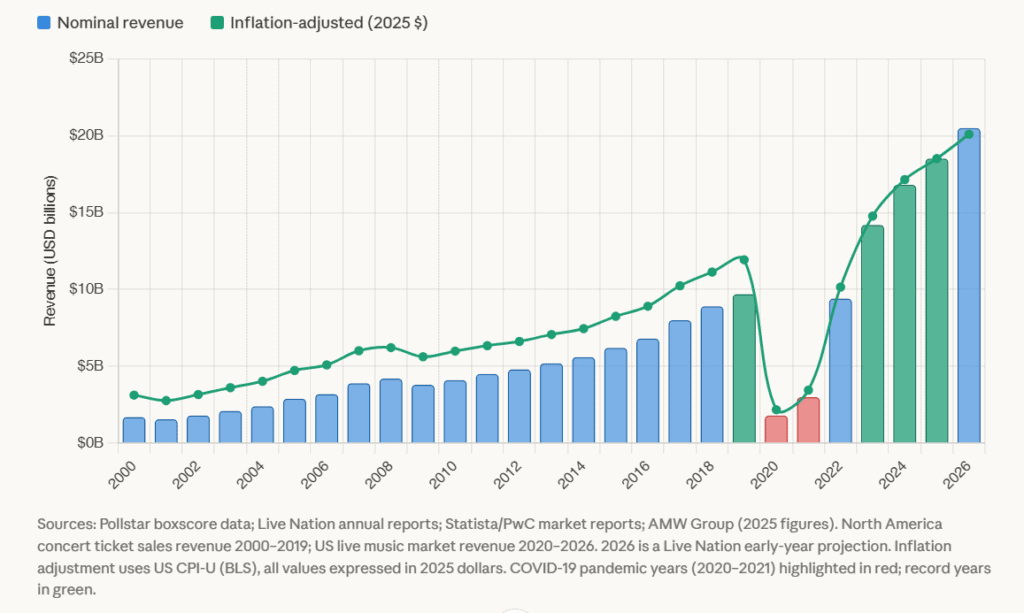
The long boom, 2000–2019: Pollstar estimated $1.7 billion worth of major concert tickets were sold in 2000, a figure that would grow nearly sixfold by 2019. Even adjusted for inflation, real growth was massive — driven by artists increasingly leaning on touring as recorded music revenues collapsed. Live Nation alone grew revenue from $3.2 billion to $11.5 billion between 2005 and 2019.
The COVID collapse, 2020 and 2021: Live music revenue crashed to a record low in 2020, reaching just $7.32 billion globally as concerts were wiped out entirely. The bars are shown in red.
The post-pandemic explosion, since 2022: The recovery has been stunning. The US live music market reached $18.51 billion in 2025, with the global market at $35.2 billion. Live Nation reported record fan attendance of 159 million globally in 2025, as revenue surged to $25.2 billion.
The green line (inflation-adjusted) vs. the blue bars (nominal) shows how much of recent “record” revenue is real vs. just price growth. The average concert ticket price in the US is $144 in 2025, a 31% increase over the past five years — well above general inflation.
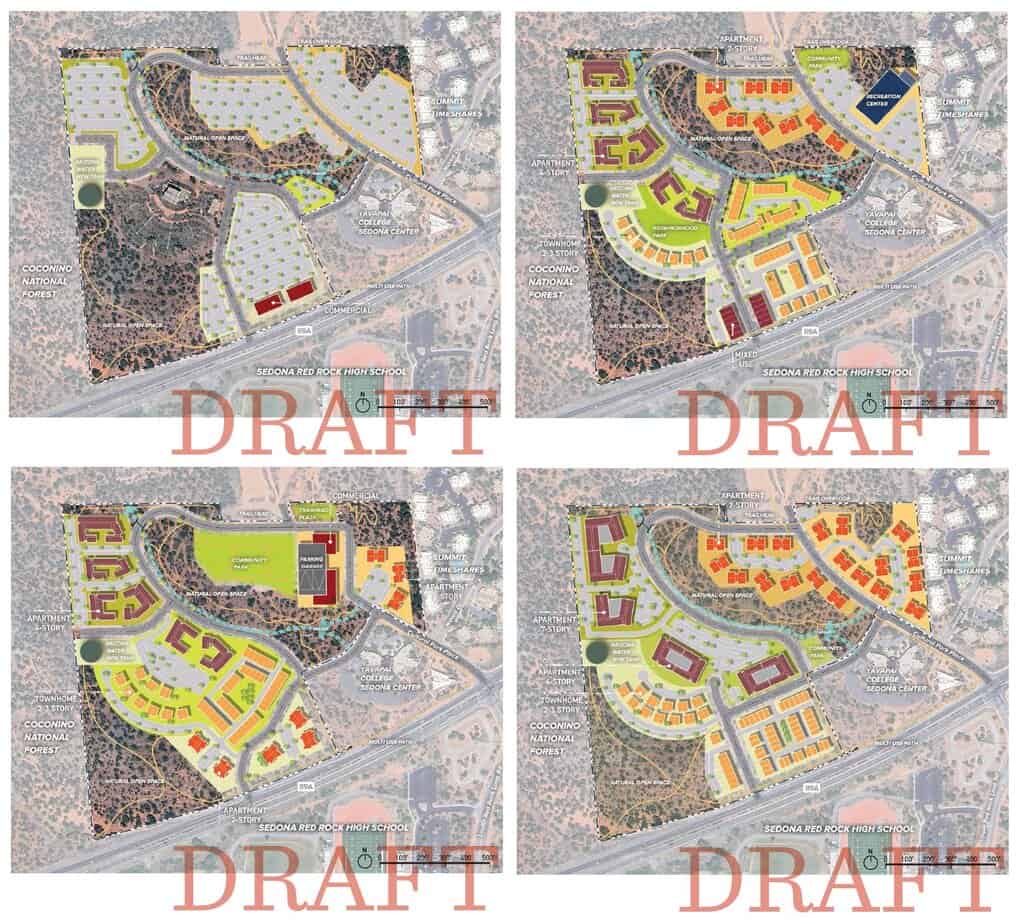
Draft Western Gateway Master Plan
This draft of the Western Gateway Master Plan is based on feedback from the public, the Sedona Planning and Zoning Commission and city staff through May 2025.