

The Yavapai County Board of Supervisors voted along party lines 4-1 on March 4, with Vice Chair Nikki Check [D-District 3] opposed, to approve the use of a U.S. Department of Homeland Security’s Systematic Alien Verification for Entitlements to verify citizenship and immigration status for voter registration and voter list maintenance.
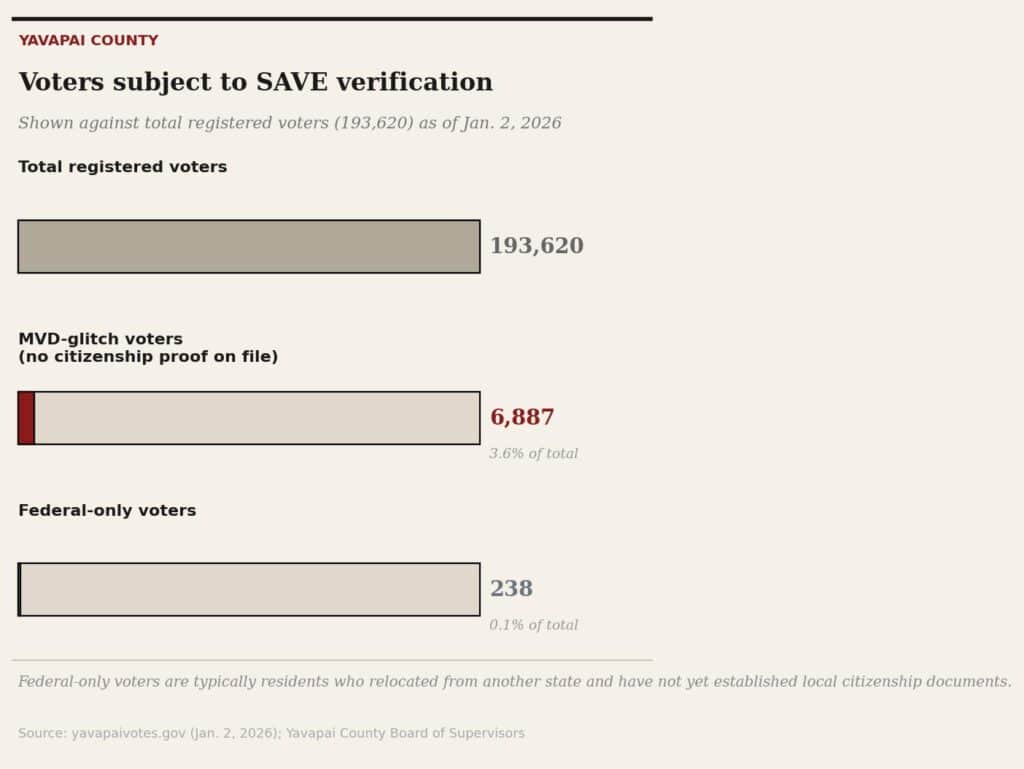
Yavapai County Recorder Michelle Burchill [R] will use SAVE to assist 6,887 voters still affected by a past Motor Vehicle Division data glitch who have not provided proof of citizenship, as well as 238 federal-only voters, typically those who have relocated from another state and have not yet established citizenship. She framed the program as a means to expand ballot access.
SAVE originally was created in 1987 to help federal, state and local agencies confirm the current immigration status of applicants for public benefits, and is not directly related to the SAVE Act working its way through Congress.
“The difference now is that the SAVE program has extended to where we have more information, more ways to actually obtain citizenship information, than we ever had before,” Burchill said. “Our current memorandum of understanding, or agreement, with the SAVE program, which has been in place for many years, only allows us to look for citizenship information using an alien identification number. Now we can use the last four of a Social Security number.”

Through Executive Orders 14159 and 14248, President Donald Trump expanded the information available to SAVE by pooling data across the federal government to allow states to mass-verify the voters’ citizenship status. However, according to the Texas Tribune and ProPublica, the quick rollout of the program has often not included the most up-to-date citizenship information.
As a result, SAVE has made persistent mistakes, in assessing the status of people born outside the U.S., data gathered from local election administrators, interviews and emails obtained via public records requests show, the Texas Tribune reported on Feb. 13.
“Some of those people subsequently become U.S. citizens, a step that the system doesn’t always pick up.”
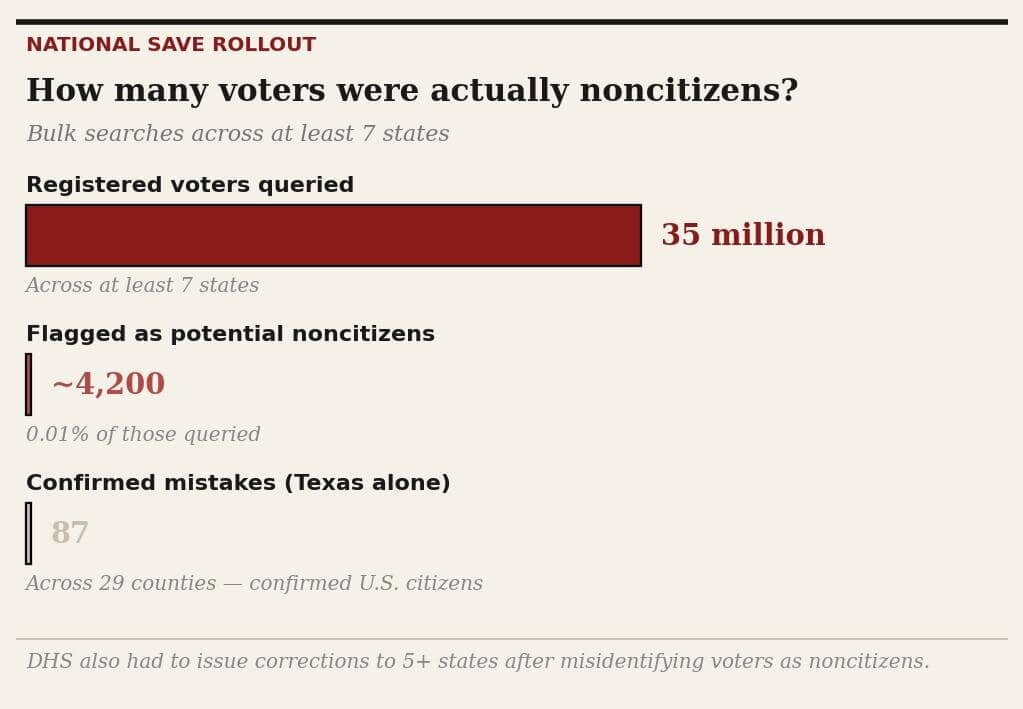
SAVE for voter rolls has been a system rife with errors since its rollout. Across at least seven states and some 35 million registered voters, SAVE’s bulk searches turned up around 4,200 potential noncitizens with at least 87 Texas voters across 29 counties mistakenly flagged and DHS having to correct information provided to at least five states after misidentifying voters as noncitizens, according to the Texas Tribune and ProPublica.
“I’m only interested in Yavapai County,” Supervisor and Chairman Brooks Compton [R-District 1] said about other Arizona counties using SAVE for their voter rolls. “I’m not interested in allegations in other counties, other states. Has there been a problem in Yavapai County? No. Has it helped us in Yavapai County? Yes.”
“I’ve received 127 unduplicated phone calls or emails regarding this, and when it comes to people’s data that’s actively involved here, I would prefer to slow this down,” Check said, stating that six people wanted to speak about the consent item and asked for it to be tabled.
“The vast majority of the people calling were in support of it,” Compton told the NEWS. “But since there were people that did have some issues or concerns about it,” Compton said. “That’s why I pulled it and had Burchill explain the entire apparatus to us … so there could be discussion from the board and Burchill.”
Check said her primary concern was false negatives — citizens wrongly flagged as non-citizens — not false positives.

Voters flagged as non-citizens will 35 days to verify their citizenship before cancellation, before appeals go to Burchill.
Supervisor Mary Mallory [R-District 5] responded to social media criticism by questioning the accuracy of the information being shared, rather than addressing the concerns.
“We are matching data. We’re not giving [DHS] new data, because they already have the data,” Burchill said. “They’re telling us, ‘Yes, your data matches ours.’ We are sending the first and last names, the birth date and the last four of the Social Security number.”
She added that the county is not sending other personal information.
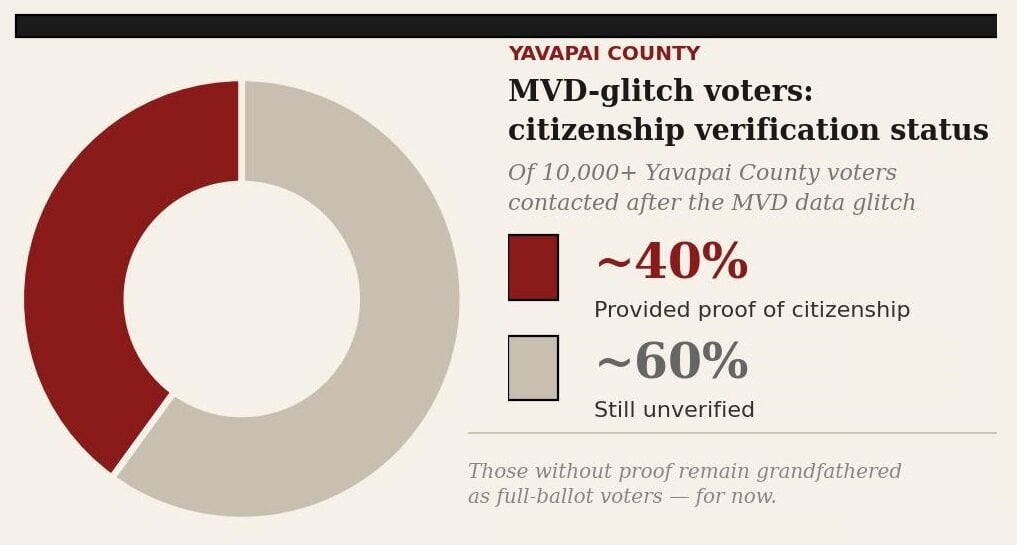
“If anyone is aware of the major MVD glitch that happened about a year and a half back, we were told that almost 198,000 Arizona residents had their citizenship information never obtained by the MVD. It went through court,” Burchill said. “We reached out to the 10,000-plus Yavapai County affected voters, and so far about 40% of them have shown me their documented proof of citizenship. At the moment, we are leaving them grandfathered in as full-ballot voters.”
Burchill said she bypassed the Arizona Secretary of State’s Office and prefers “to have a contract directly through DHS” instead of through the Secretary of State to avoid dependency on who holds that office.
“The Secretary of State’s office has been telling me for months that they’re going to do the same contract,” Burchill said. “We just haven’t seen that come to fruition yet. So I decided I prefer local control.”
“I’m all about local control. I want local control of elections. That’s what’s most important,” Compton said.
“I’m all about local control. I want local control of elections. That’s what’s most important. Clerk of the board, call for the vote,” Compton said, with the six members of the public not speaking prior to the vote.
Brooks classified the matter as routine, citing that as justification for its placement on the consent agenda and the absence of any county communications beyond the agenda being as is routine posted in advance.
Compton told the NEWS the six residents who wanted to speak were not denied a voice, saying their written emails and communications submitted beforehand constituted public comment.
“We all read them,” he said, adding that consent items do not allow for floor comment in the same manner as action items.
“It wouldn’t be a failure of the county, because it’s standard routine,” Compton said to the NEWS if the lack of a press release or other communications from the county contributed to the supervisors complaints of misinformation on social media.
Arizona Secretary of State Adrian Fontes’ [D] office did not respond to a request for comment by deadline.


