

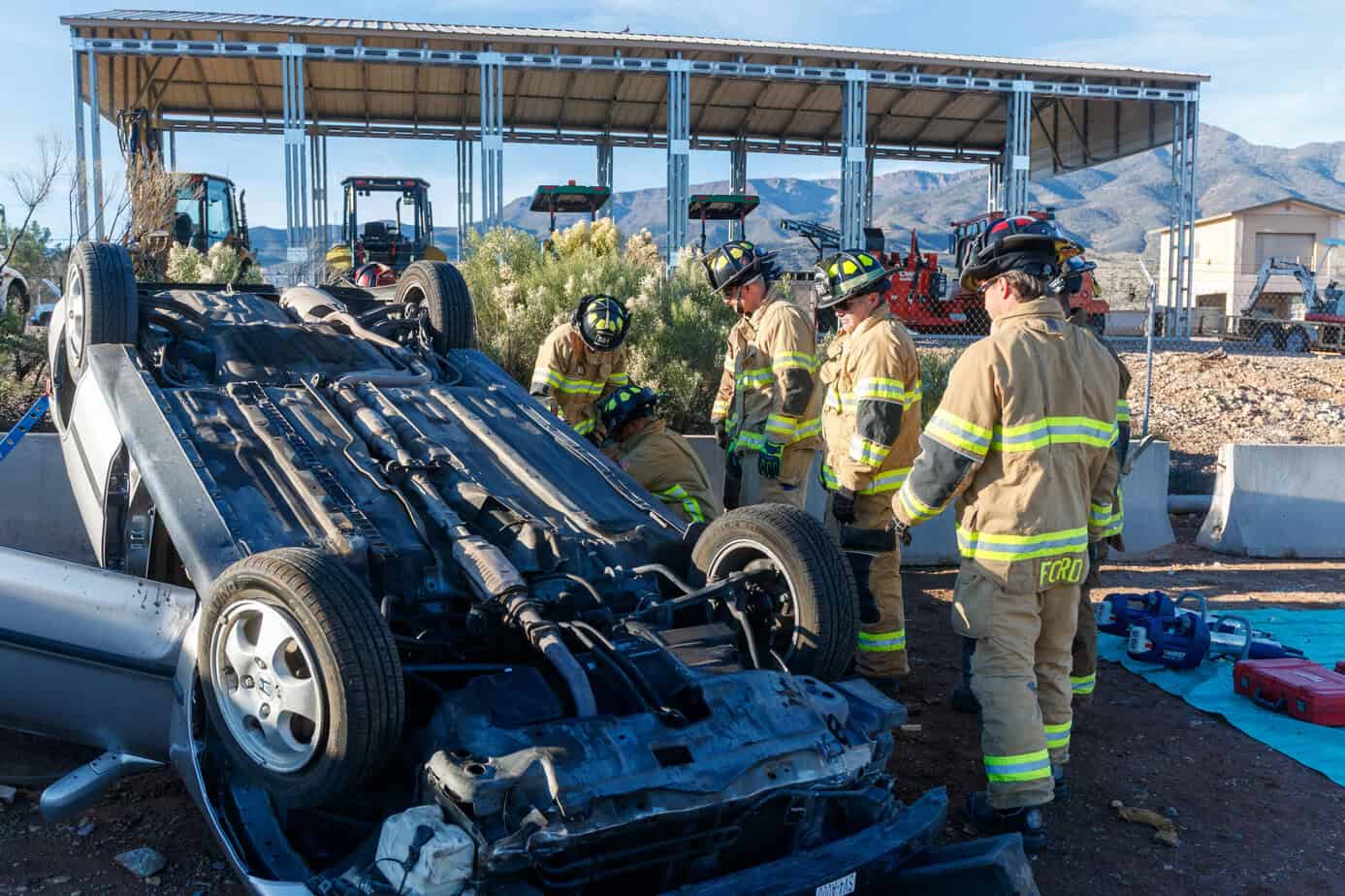
About 25 Sedona Fire District personnel from C-shift participated in SFD’s annual battalion-level vehicle extrication stabilization training Jan. 14 at the Verde Valley Fire Training Center in Cottonwood.
Each battalion goes through this training every three years to keep staff current on evolving rescue tactics, safety procedures and modern vehicle design.
“It’s the stabilization of the vehicle, because we don’t always approach a vehicle that’s stable,” SFD Paramedic Capt. Rodrigo Sanchez, said. Because when you’re out there in the field you never know how you’re going to come across a vehicle with a patient inside of it. “In other words, it could be on its lid, on its side. It could be off a roadway. We have to ensure that we can approach the vehicle and stabilize it before we start compromising its integrity by taking doors and roofs off, and extracting a patient.”
When a vehicle is on all four tires and on flat ground, the stabilization process is fairly straightforward. First responders approach the vehicle and check for any immediate hazards, such as fuel leaks or dangerous cargo.
When “we approach a vehicle, we just make sure that it’s not going to go anywhere by putting it into park, shutting the motor off, and then we chalk it,” Sanchez said. “We have tools that we carry on our engines, their step chocks, and we can place them on the sides of the vehicle, if we and they’ll keep the vehicle from moving side to side. … You want to stabilize the vehicle side to side, front to back, up and down; to take all that movement out.

“If we’re concerned about the vehicle moving down a hill like Oak Creek Canyon, for you have a vehicle going off the side of the canyon, off the road there on 89 we may have to back tie it
like set to an anchor system. We carry ratchet straps that are rated 3,000 pounds. …. We also carry a 70K chain, which is a rated chain that is approximately about 25 feet long. So we would back tie the vehicle to keep it from moving any farther.”
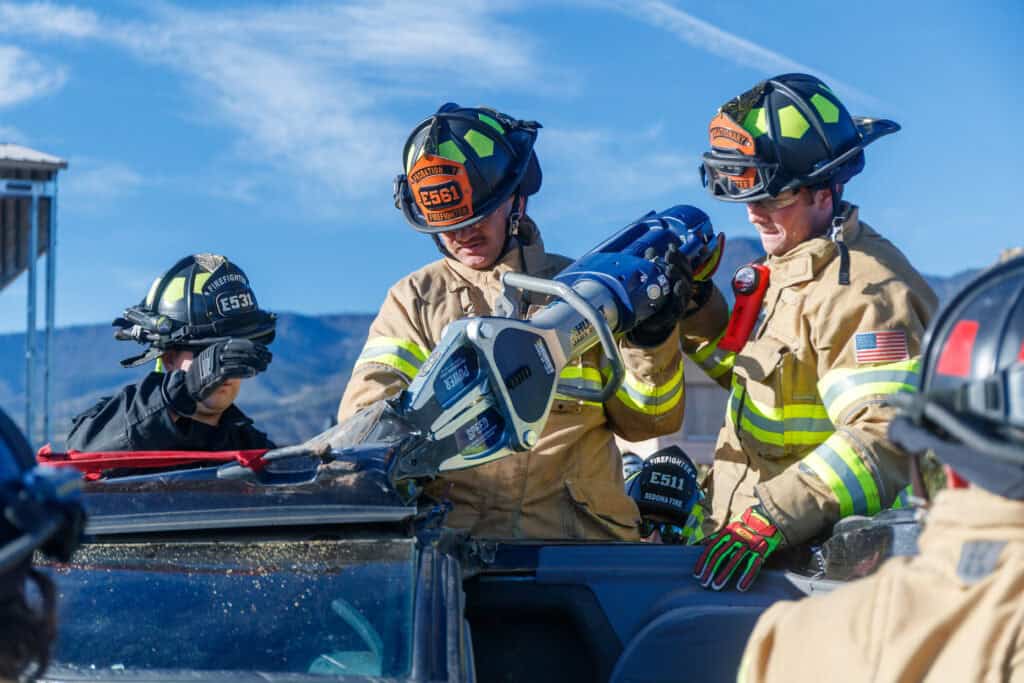
The primary goal is to be able to get patients to the patient so the paramedic can start life saving care. That’s when the “jaws of life,” the hydraulic rescue tool, comes out to cut away the vehicle in order to get a patient out safely.
“These trainings, they’re very effective,” SFD Firefighter Paramedic Brian Burke, 26, said. “They show us the anatomy of the car, and so you can kind of break down and you can start learning the weak points.
“It makes it a lot easier to get through a scene, just learning what’s strong, what’s weak, what’s the quickest way I can get this off” in order to get to a patient.
Burke, a Sedona Red Rock High School Class of 2018 graduate, said he has probably used the jaws of life about 20 times in the field since he started his professional firefighting career in 2022. He began with SFD in November after working for the Copper Canyon Fire & Medical District in Camp Verde for three years.
Sanchez estimated that the SFD as a whole is also “probably cutting a car once or twice a month.”
The training is critical as a refresher and because cars are ever changing, “there’s no mandate in the car industry that says that they have to build them a certain way for us,” Sanchez said, “so first-responders are constantly having to evolve their approach. In five years, who knows? A new car may come out with a new ultra high strength alloy or something that our cutters may not be able to get into.
“Vehicles are always changing, that’s why we do these scenarios.”


