









West Sedona School Student Council member Isaac Joyeno said he learned all about composting as a part of the council.
The school was beginning a composting project on Tuesday, Jan. 20, and it was the job of the student council to help teach the rest of the fourth- and fifth-grade classes about it. Two weeks after he learned about the project, the composting bins showed up in the cafeteria.
“Explaining what goes in the composting bins,” Joyeno said is what he did to help train the other students. “Lettuce, milk, cheese and ham — like anything to do with [composting].”
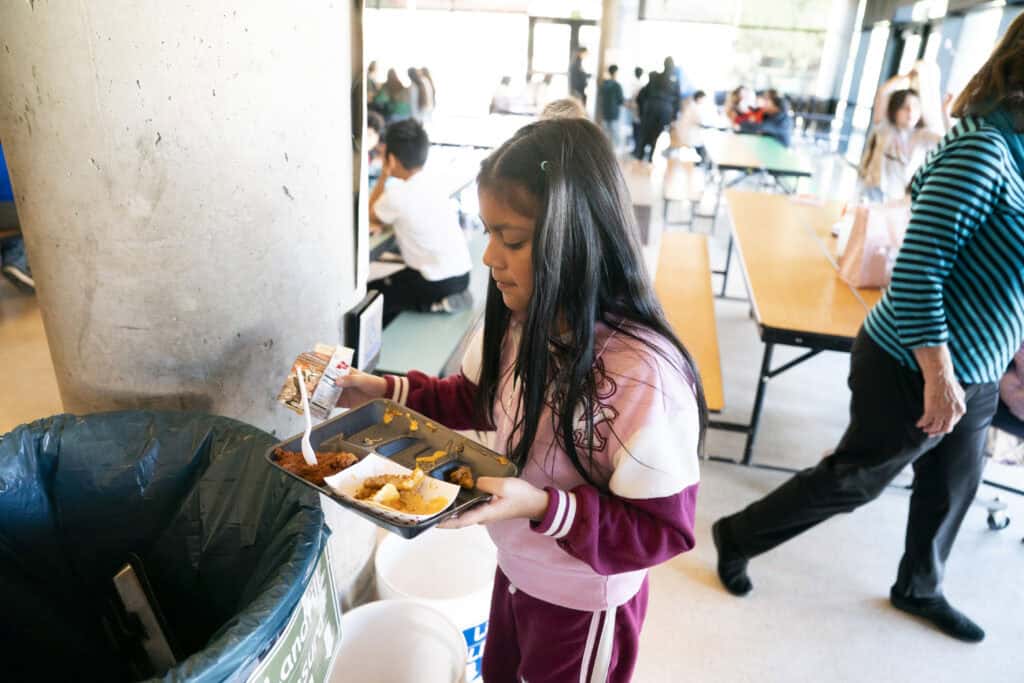
To do this, the 11-year-old said he and the other student council members gave short presentations to all the classes with the same lunch time. The project includes educating the students and having them separate the types of food waste into different categories when finished with their lunches.
Ellie Rodola, who’s also on the student council and helped train the rest of the fourth- and fifth-graders, said she learned how composting can help the community.
It helps “with the soil and plants and nutrients in the soil,” the 10-year-old said.
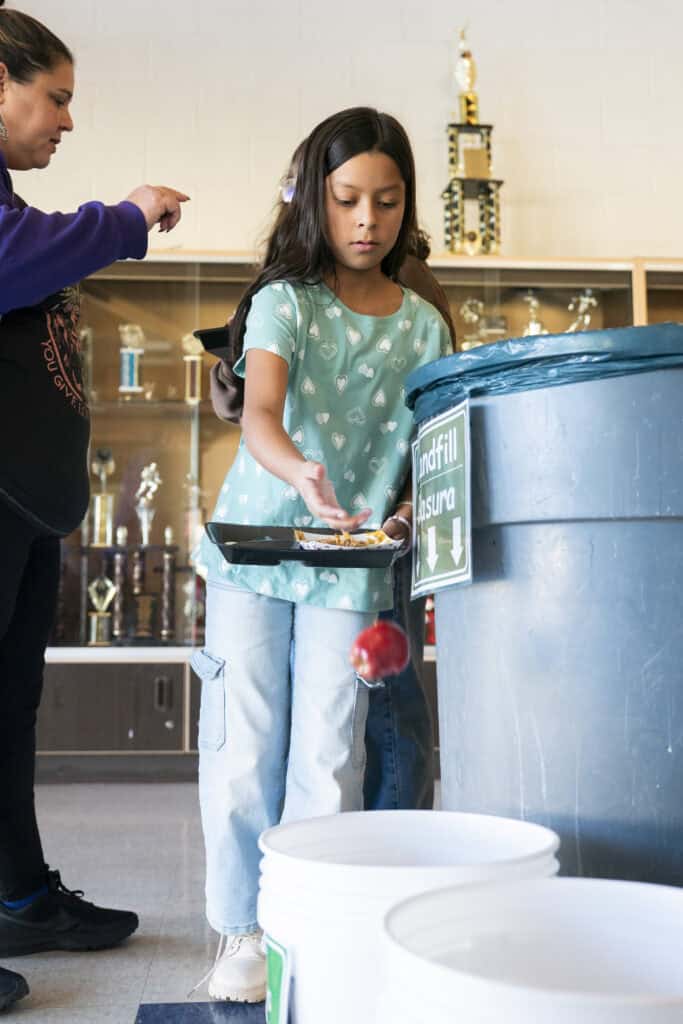
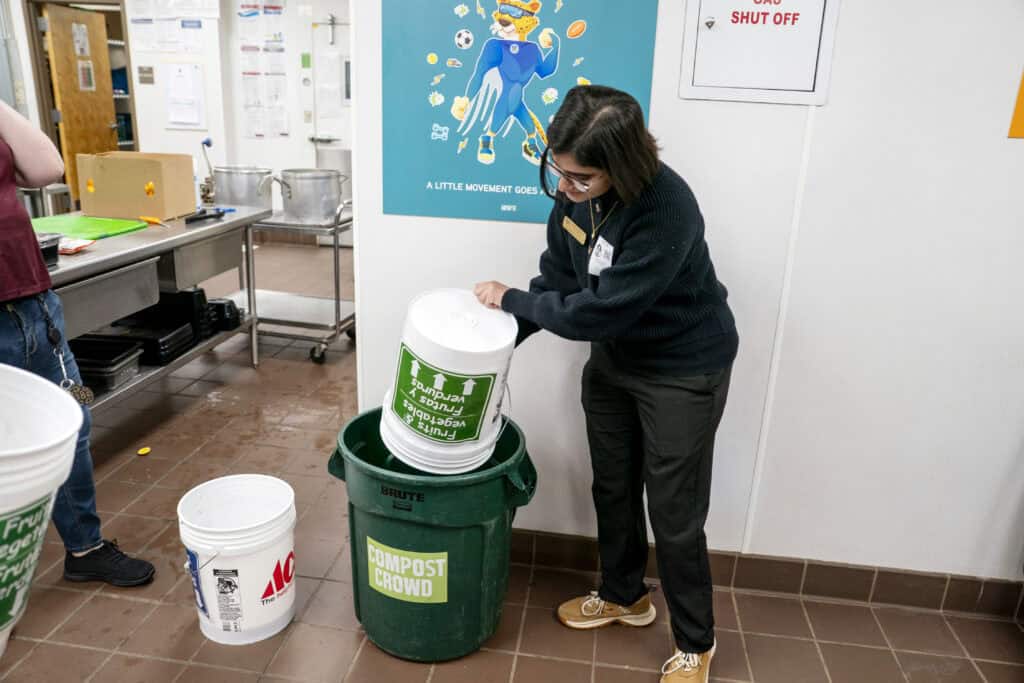
In the cafeteria are two stations of bins, each station has one for liquids, one for food scraps and one for landfill. Art students made a poster for each station with “acceptable compostable” fruits and vegetables.
“Someone said, ‘where’s the Spanish?’” organizer and resource teacher Deb Sanders said. “And I went ‘Oh, Maria,’ — we have a translator, Maria Ortega, and she helped make sure that we had Spanish put on all the fruits and vegetables that our kitchen serves.”
The stations will stay up for at least the rest of the semester, which is the duration of the pilot. After that, depending on its success, it may expand to the rest of the grade levels.
Alicia Pallares, a fifth-grade teacher who does the most work with the school garden, said she hopes to use some of the composting for it.
“We kind of needed somebody to man this [student farm] program because it hasn’t been active for a long time,” Pallares said. “So I volunteered for that and got connected with city of Sedona, who’s been a great help. We’ve done a few clean up days, and now the garden is actually functioning. We were able to harvest our first vegetable, actually radishes, a couple weeks ago.”
The classes participating in the semester-long pilot of the composting project will likely create more compost than they can use in the student farm, so the rest will be picked up by a compost hauler.
WSS Principal Alisa Steig said the garden was a major reason for the composting project. She’d always worked at schools with gardens and when she arrived at West Sedona in 2024, she was sad there was no garden.
“Fast forward a very short time and I happen to watch a ‘CBS Sunday Morning’ segment where students worked with family and community members to help battle food insecurity and learn about healthy eating through their school gardens,” she said. “I mentioned to Mrs. Sanders how much I hoped we could take that on at some point.”
After that, Sanders spoke with the rest of the West Sedona School STEM Leadership Team, which included volunteers from the Rotary Club, the U.S. Forest Service, Gardens For Humanity and the city who immediately started working on the project.
“It felt like I blinked and she had assembled everyone together so we could begin teaching students about the benefits of composting food waste and the concept of ‘farm-to-table,’” Steig said. “Families and community partners stepped up to help us with irrigating the space, donating their time and money to make this happen for us.”
Sanders is the one who taught the student council what they needed to know to coach its peers, and she said she was taught by city of Sedona Sustainability Coordinator Sarah Estrada.
“The school has Compost Crowd coming in once a week to pick up the food scraps, and they are a local compost hauler, they have been integral to all of the composting projects with the city,” Estrada said.” They bring them to a farm near Page Springs, and they have an area where they move the food scraps around and rotate the piles, and get the compost broken down and it’s used for a local farm.”
Tyler Maffitt, the city’s new communications manager, said the city’s Sustainability Department made the decision for the hauler and pays it directly. He wrote in a recent email the cost for the entire semester is “not expected to exceed $1,000.”
“This pilot is part of the city’s ongoing waste diversion efforts,” he wrote. “The schools have previously partnered with us by hosting our spring collection event, so this is a natural continuation of that collaboration.”
During the second- and third-grade lunch period, when the composting stations were being set up for the fourth and fifth graders, the students began asking the volunteers questions and separating their own food waste.
“The long term goal is to eliminate 80% to 85% of what used to go in the landfill bucket to be diverted to either composting or proper recycling,” Rotary volunteer Brad Parker said.
He said in addition to the environment and economic benefits are the educational benefits and the students learning about the different types of waste products and their uses.
“We’re going to be weighing what they collect, and they have the opportunity to track the development of how much gets diverted away from landfill over time,” Parker said. “They can make charts and graphs and learn the basics of working in the science lab. Turn the cafeteria into a science lab.”
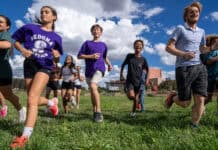
While on the student council, the fifth-graders do much more than solely work on the composting project. They conduct educational activities throughout the school year.
Joyeno said his favorite thing so far was “probably one of our skits that we did. There was a bus skit.”
“How to be safe on the bus,” Rodola said. She got to play the “mean girl,” while Joyeno was the narrator.