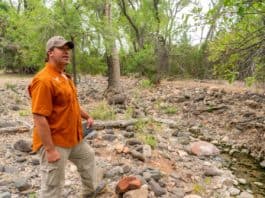

Restoration work across the Verde River Watershed is helping heal its landscapes, according to the newly released 2025 Verde River Watershed Report Card. The report shows that the condition of upland areas like grasslands and forests has improved from a D+ to a C+ grade since 2020.
“What we are seeing is real progress in the Verde River watershed,” said Kimberly Schonek, water program director for The Nature Conservancy in Arizona. “By restoring upland areas, we’re strengthening the entire system’s ability to absorb rainfall, reduce erosion and withstand drought and wildfire. This helps improve wildlife corridors and support the animals that rely on these lands.”
The report credits this progress to targeted restoration projects led by land managers, volunteers and community partners. In the Munds Draw area of Prescott National Forest, crews installed 288 erosion control structures and thinned 575 acres of juniper to restore grasslands and stabilize soils, which helps improve water quality in the river. In Flowing Springs on the Tonto National Forest, fencing was installed to keep vehicles out of sensitive areas, allowing the land to recover naturally. These restoration efforts are part of a larger strategy to strengthen watershed health to protect people and nature.
“One of the main goals of our stream, spring or gully restoration work is to slow water, dissipate the energy so degradation is slowed or halted. We’re using natural materials, rocks, logs and branches to mimic how the lands should naturally handle water,” said Chad Yocum, forest hydrologist for Prescott National Forest. “By slowing water as it moves across the land, we give soil and sediment a chance to settle and vegetation a chance to thrive.”
The Verde River Watershed Report Card, updated every five years, is a science-based tool developed by Friends of the Verde River and The Nature Conservancy in Arizona, in collaboration with regional partners. It evaluates the health of the watershed using indicators related to land, water, wildlife and community well-being.
“The Verde River flows from Prescott to Fountain Hills, and supports agriculture and wildlife, and provides drinking water for more than 3 million people in Arizona,” said David Gressly, the executive director of Friends of the Verde River. “The report card helps communities understand how the watershed is changing over time and where we should focus restoration and conservation efforts.”
One of the most significant improvements in the 2025 report is in water quality certainty, a measure of how well water quality conditions are understood across the watershed. In 2020, this score was just 27% [F], reflecting gaps in monitoring and data sharing.
Since then, Friends of the Verde River, The Nature Conservancy in Arizona and its partners developed a watershed-wide monitoring plan and joined the Arizona Department of Environmental Quality’s Community Science Alliance. With support from groups like the Sierra Club, Verde River Institute, Friends of the Forest and Oak Creek Watershed Council, the score has risen to 79% [B+], showing a much clearer picture of water conditions across the region.
For the grading scale, an A is 80 to 100%, a B is 60 to 79%, a C is 40 to 59%, a D is 20 to 39% and an F is 0 to 19%.
The overall score for the Verde River Watershed was 58%.
The full 2025 report card is available at verderiver.org/report-card.