
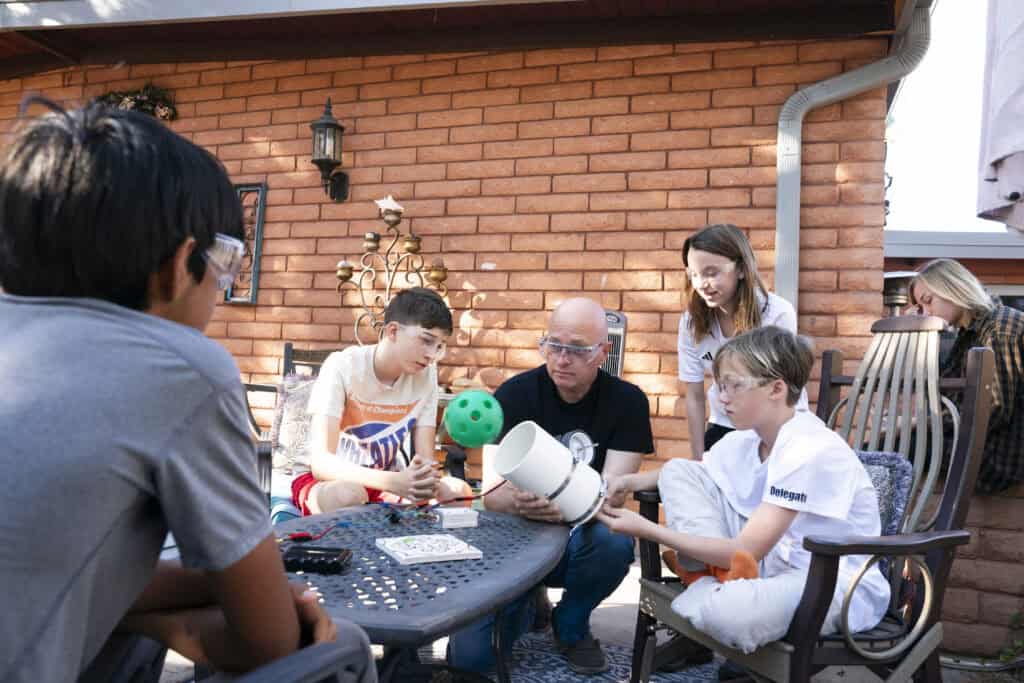
Five Sedona middle-schoolers gathered around a table after school on Monday, Oct. 20, to figure out the best way to use their cannon. Or at least, how they could mount it to their robot.
The students’ goal is to learn how to use different tools, metal bars, 3-D printed sockets and servos to best make their robot work best for this year’s game, coach Gunnar Mein said.
The robot’s fodder was large wiffle balls, either purple or green. The cannon was a wide PVC barrel with a motor attached that spun a wheel pointed toward the end. The rubber wheel would grab the wiffle balls and accelerate them through the tube.
Matthew Martinez, an eighth-grader on the team, said they’re trying to figure out how to shoot them by colors so they go in the collector in the right order, which they won’t know until the match starts.
FIRST Tech Challenge is a section of the worldwide robotics organization For Inspiration and Recognition of Science and Technology. The theme for each year’s competition for FTC is announced in late summer or early fall.
This year’s game, DECODE, includes alliances of two teams each facing off against each other. Each match is set up into two sections: Autonomous mode and Tele-op, which means it’s controlled by students on each team.
During the autonomous section of the game, the robot moves on its own and a pillar on the side of the field will show a QR code for whichever order of balls gets extra points. The order for the balls includes two purples and one green.
“There’s always one green,” Martinez said, pointing at three groups of code on his computer. “So that’s green in the first spot, green in the second spot, in the third spot.”

When the robot recognizes which order it wants to shoot the balls, it will hopefully be able to sort them into the right cannon barrel.
Martinez wants to be an electrical or software engineer when he grows up and has already made strides to hone his skills at the computer.
Martinez said while he prefers the C++ programming language, his past year of coding experience has gotten him more comfortable with Java, too.
The team, which recently lost the ability to store its robots and parts in the high school, has been carpooling to the Village of Oak Creek for the past four weeks to practice and build for this year’s game in the of home assistant coach Priscilla McKerracher.
“This is my first year doing this,” McKerracher said. “I was just thrilled to find out that we had such an experienced person in the area because I’m a retired engineer and I really wanted to do something.”
“Priscilla and I basically think through — if we have some time before — like, ‘What do we want the kids to do today?’” Mein said. “Then there’s always things that we need to do right now. But sometimes it’s pretty clear what the next thing is.”
He used to coach several FTC in Seattle before moving to Sedona shortly after the COVID-19 pandemic emerged. His first team had just two students and by the time the COVID-19 reached Arizona, he coached three teams of 10.
“Some of my better teams have made me crazy by putting together stuff with hot glue, wood and duct tape,” Mein said, “when I always just wanted them to work on an engineering solution, see whether we can get something to work.”
Last year, the Scorpions were mostly seniors and all graduated. Mein has been coaching robotics in Sedona since 2022.
The first year Mein said they tried working with the school to get space for them, but the administration changed during that year so it was hard to make any sort of arrangement permanent.
“So in the second year, we just met at our house, two seniors in our entryway,” he said. “The third year, we actually worked with the school — this was last year.”
The team, Mein said, was slow to get assigned a room, which meant less practicing time for them and finding storage in the school was very, very difficult.
“We were meeting at Lyncoln’s [Malinski, one of the seventh-graders] house first,” Mein said. “That was a very small space and they couldn’t really try anything, but we did assemble that second chassis [the frame and wheels] and then we moved over here, and they were gracious enough to clean out their garage for us.”
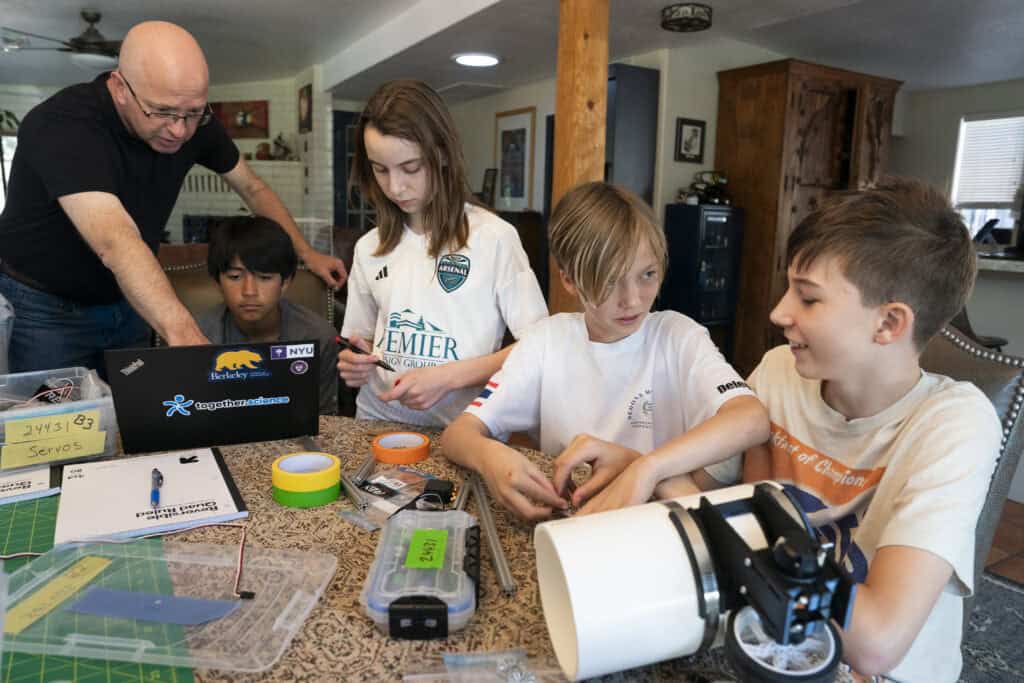
to figure out their ball cannon.
In the garage, a game field was set up with floor mats and tape denoting different places that would be on the competition field.
“Everyone calls the jobs they want to do,” Martinez said. Jobs include driving, programming, building and designing, and most people help out with multiple roles, although Martinez is the only student coder.
Amarra Barringer and Sacha Waddell, both seventh-graders, are the team’s drivers for the robot.
During the Oct. 20 meeting, Barringer was practicing putting the robot completely in the square it needs to end the game in.
“Park perfectly, you have 30 seconds,” her fraternal twin sister Sierra Barringer cheered.
After a couple tries, Mein reminded Barringer she had a “slow down button” she had requested Martinez code into the controller.
On her next try, she parked perfectly.
It’s difficult, Barringer said, because the controller was inverted; a left turn on the remote control meant she turned the robot right and vice versa. Once Martinez got back to his computer, he fixed it in just a few seconds.
Sierra Barringer and Malinski both help a lot with designing things, they said.
“My friend and sister is doing it, and since my grandma’s driving them to robotics, and I was always in the car with them and nothing to do, I decided to join the team,” Sierra Barringer said.
She said she’s been “just helping out,” mainly doing a lot of designing for the team’s banner and the T-shirts, but also with putting the robot together.
“Yeah, when it comes to screwing stuff together, somehow those jobs always end up with Sierra, in the end,” Mein said. “They don’t always start with her, but they typically end up there. Lyncoln also is pretty good at screwing stuff together.”
Mein said he’s pleased with how the team is doing, especially because of their lack of experience. All five students are new to the team this year and there’s a learning curve many people don’t realize.
“No one tells you, that ‘you know what, a nut driver is a really good thing,’” he said.
During the meeting, Malinski was trying to design the banner and which sponsors would go where.
“Everybody who gave us 100 bucks or more gets to be on the table banner, three by five or something like that,” Mein explained. “Everybody who gave us $500 or more gets to be on the T-shirt, if they want to be.”
This year, the team has upped its efforts to fundraise and raise awareness of the team and its needs.
“In the past two years, the team flourished mostly based on sponsorship from the Rotary Club, my own company together.science, and the generosity of a few individual donors,” naming Melissa Dunn, George Goley and Julian Mein, Gunnar Mein wrote in a fundraising letter to the community.
They’ve been able to reach their fundraising goal of $5,000 for this year, and have passed the deadline to go on this year’s banner or T-shirts, but never turn away gifts.
In his fundraising letter, he said Zelle is the preferred method of sponsoring, but PayPal also worked. Both use sedonascorpions@gmail.com. Its Venmo is @sedonascorpions.
The team has two competitions scheduled, one on Saturday, Nov. 15, and the other on Saturday, Nov. 22. Both are in Phoenix. Information about the competitions is on the FTC website.
“I always tell visitors to show up in the early afternoon (1 pm or 2 pm) for the best experience,” Mein said in an email.
Mein also recently made a Facebook page for the team.
Sedona Robotics Team
- Matthew Martinez, eighth grade
- Amarra Barringer, seventh grade
- Lyncoln Malinski, seventh grade
- Sacha Waddell, seventh grade
- Sierra Barringer, seventh grade
Volunteers
- Gunnar Mein, coach
- Priscilla McKerracher, assistant coach