













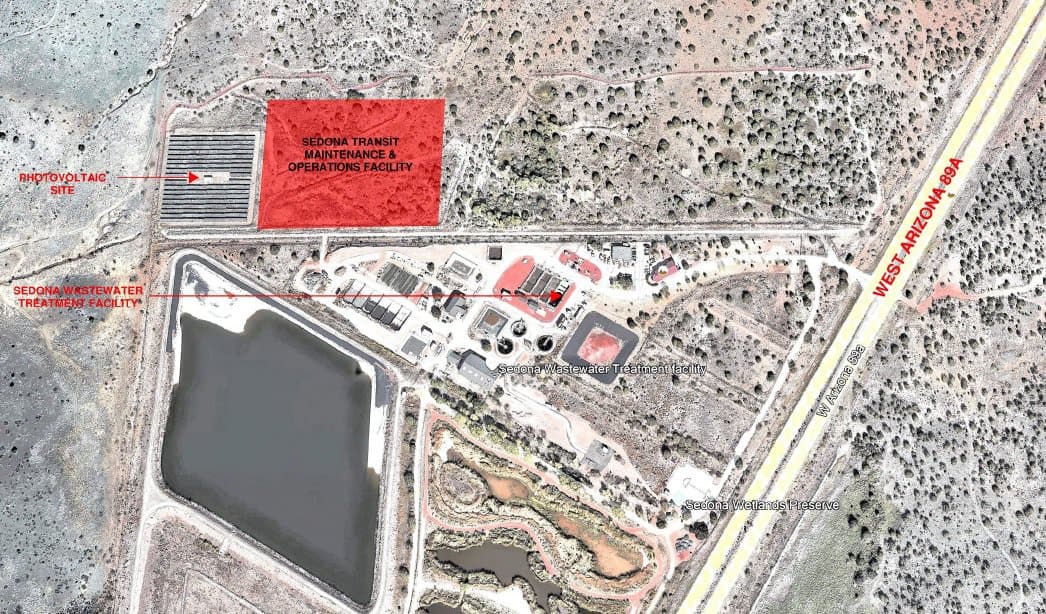
The second half of the update on the Sedona in Motion transportation projects during the Sedona City Council meeting on Sept. 23 focused on long-term infrastructure projects and the city’s Transit Maintenance and Operations Center, which is slated to be constructed across the street from the Sedona Wastewater Treatment Facility in an area known as the Dells. The center is currently 30% designed and the final design anticipated this May.
“The latest estimate, at the 30% design level, is approximately $31.9 million,” Deputy City Manager Andy Dickey later wrote. “Because this is an early-stage estimate, it’s intentionally conservative, and we expect the number to decrease as the design is refined. As for the timeline, the design is anticipated to be complete next spring.
“Beyond that, the schedule will be shaped by upcoming City Council discussions on governance for the transit program and facility, as well as the business plan for the facility. The outcomes of these discussions could extend the timeline to allow for additional business planning or the formation of new governance structures. Progress toward construction will also depend on securing funding. To date, the expectation has been that construction will rely heavily on grant funding, and the grant cycle process can be lengthy.”
A $1.8 million design contract for the facility was awarded to Prescott-based engineering consulting company Kimley-Horn in January. The facility, wastewater plant and the potential development of the Dells is so critical to the city’s plans that council voted to annex 3,422 acres around them, increasing the city limits by 30%, to bring the land under its jurisdiction.
The operations center still needs to go through the city’s own planning and permitting process. Staff anticipates to have 30 to 50 employees working out of the site from transit administration, operations and maintenance.
“How many would be new positions that are paid for directly [by] the city, not contracted out?” Councilwoman Kathy Kinsella asked.
“We’ve been talking with [the] council and direction of getting a fleet manager, so it wouldn’t be much less than five, 10 for staff out there at this time,” Public Works Director Kurt Harris said. “Remember, we’re designing
this for a 50-year life, so they’re using the space analysis to project what it’s going to be in 50 years. So there’s a lot of rough estimates right now.”
Councilman Brian Fultz asked whether staff will consider using more reflective colors on the facility since the facility would be away from the road and residential areas in order to not contribute to a heat island. Harris responded saying color variances are “open options.”
The facility could be “extended and built out to serve other Verde Valley communities,” Amber Wagner confirmed. The current design contract includes the city of Sedona’s buses and maintenance.
“Phase 1 is transit [maintenance] specifically, including potential regional partners,” such as the Yavapai-Apache Nation and the Verde Valley Caregivers Coalition, Dickey said. “Phase 2 is going beyond transit to … the rest of our fleet like the big part will be the [Sedona Police Department’s fleet].”
Harris said once the center has certified mechanics that it will be a “big draw” for other potential partners such as fire districts and school districts for maintenance of their buses.
Sedona Fire District Chief Ed Mezulis and Sedona-Oak Creek School District Superintendent Tom Swaninger, Ph.D., expressed interest in such a partnership, however, their respective organizations do not have an official position on the facility at this time.
“With an organization as small as [SOCSD] to have a full time diesel mechanic is a challenge,” Swaninger said to the NEWS. “First of all, they’re difficult to find and the hourly wage for a diesel mechanic is substantial relative to what hourly employees make in the field of education in general. Very early on, we would be interested in potentially exploring that as an option.”
While SFD has two in-house mechanics for vehicles and has all the equipment it needs, modern fire trucks are larger than the “two-bay single fire truck-deep garage attached to Fire Station 1 in West Sedona,” Mezulis said.
“A lot of times they can’t even work on [vehicles] inside the apparatus bay, [but] they have all the tools,” he said. “We’re always entertaining partnerships with everybody in the region. … One of our top goals is to get our [staff] in an appropriate fleet maintenance facility.”
City staff will need to incorporate those broader area’s needs in their next presentation, according to Fultz.
“I’m very concerned about the maintenance and operations facility that the business case is not going to look good,” he said.
“[It doesn’t sound like that’s what we’re going to see, and in a world of capital constraints, we need to prioritize what we spend capital improvement dollars on and I don’t know that this is going to make the top of that list,” Fultz later said, adding that he doesn’t have a comment on SFD and SOCSD’s operations since staff hasn’t brought that information before council.
“One of the things we said about the operation and maintenance facility was, like the garage, it has to pay for itself,” Councilwoman Melissa Dunn said, echoing Fultz’s concerns