

The public documents in our Aug. 29 story “City Manager memo to council accuses Sedona Mayor Jablow of manipulation over Flock” revealed that the discussion over the city of Sedona’s process of installing 11 Flock Safety automatic license plate readers around the city was not as above-board, legitimate and public as most residents assumed.
Sedona residents expect everything their city government discusses is public and out in the open even when Sedona City Council votes in ways individual residents believe is wrong or those votes defy marginal or overwhelming public opinion.
Many residents simply don’t pay attention to what Sedona City Council does on a biweekly basis or what Sedona city government does daily, which is why they turn to us, the local newspaper, to see what they might have missed while living their lives and not worrying about governance.
That’s the basis of republican democracy: We elect leaders to worry about the nuts and bolts of governance so we, the electorate, don’t have to.
It’s the civil contract — we, the public, place in trust decisions to elected officials and our taxpayer dollars to those elected officials who then must be 100% transparent about what goes into making their decisions on our behalf.
If officials hide what they’re doing or why, then the civil contract is nullified and republican democracy falls apart. That betrayal of required and mandatory transparency leads to ousting the offending public officials at election time or earlier than that in a recall or forced resignation. In national governments throughout history, that betrayal of the public trust leads to revolts, rebellions, coup d’états and revolutions.
That’s why it’s so disturbing that the discussion of ALPRs was intentionally hidden from the public for over a year. This was not simply council discussing the cameras in a haphazard way that left the public in the dark by accident, but an intentional choice, and one made by single council member pushing the cameras onto the city, onto the public and onto his fellow council members, as revealed in the documents we obtained and reported on.
Six members of council appeared largely indifferent to the ALPRs, which were tangentially discussed throughout 2024, but were not subject to a major council discussion in full view of the public that the installation of spy cameras to monitor, record and retain information about every resident and visitor vehicle passing through the city could have and should have warranted. Jablow appears to be the only council member pushing for the ALPRs — the reasoning behind that decision is immaterial to the fact that the discussion should have been public from the very start. Council seemed bewildered on Aug. 13 when discussing the ALPRs and how they came to be installed without their express vote to do so.
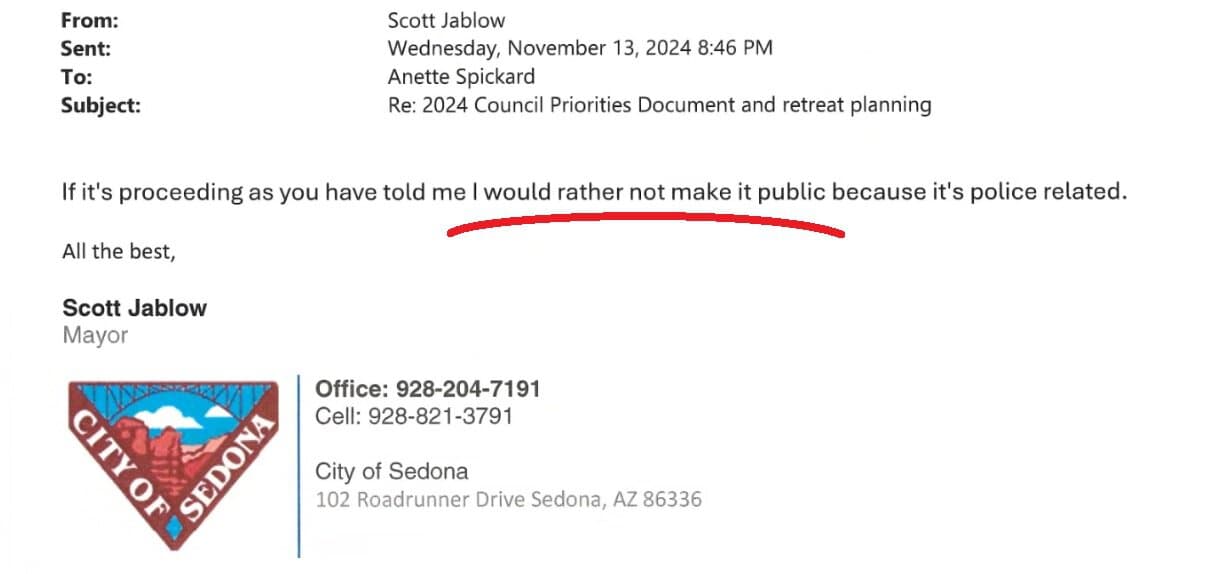
City Manager Anette Spickard suggested to Mayor Scott Jablow they “touch on the project” during the council’s December council priorities session.
Jablow responded to Spickard in an email on Nov. 13: “I would rather not make it public because it’s police related.”
Such a statement fundamentally undermines the civil contract of republican democracy and contradicts a statement the mayor recently made in a local magazine, wherein he is quoted saying: “I’m very transparent, sometimes overly transparent. Because that’s the best way to be.”
We agree, transparency is the best way to be. Every government program, service, operation, project, contract, discussion, plan, document, email, text message, police report, voicemail, court filling and memo should be and must be public — that’s transparency. Every tax dollar spent on these government operations and in the maintenance of the computer servers to write, store and archive them, as well as every facility, piece of property, vehicle and device belongs to the public.
No official, elected, hired or appointed, has the right to unilaterally hide from the public any records fundamentally owned by the public and must be public.
This debacle should remind council members and the public at large that major and minor decisions should never be hidden from the public. We — both us as a newspaper and the public at large — always discover secrets eventually. Individuals and the electorate are unforgiving when lied to — governments and officials fall or survive by whether they are honest or transparent with the public.


