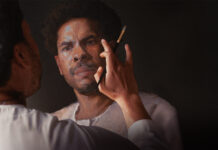











At age 19, Morton was sentenced to 135 months in federal prison after pleading guilty to possessing two ounces of crack cocaine, ultimately serving nine-and-a-half years.
The film documents Morton’s transformation from prisoner to professional artist, highlighting the awards he received from Italy’s Florence Academy of Art, where he became the first African-American to graduate from any of its campuses, and his efforts to confront systemic inequality by painting his family in the style of 17th century Dutch masters like Rembrandt van Rijn and Johannes Vermeer.
“The release of ‘Master of Light’ cracked something wide open … not just for me personally, but in the way people began to engage with art, restoration and justice all in the same breath,” Morton said. “Since the film, my days have been filled with building programs that do what that documentary only began to reveal: Using drawing, sculpture and sacred design as tools of deep personal and cultural healing.”
More Light is Morton’s new nonprofit, a national arts and restorative justice initiative, he founded 2022 and serves as its executive director. It recently received its 501(c)(3) state, with the purpose of providing art education and community to those either currently incarcerated, recently released and people affected by the incarceration. The SIFF screening is the Arizona launch of More Light’s Young Masters Program.
“We are not only providing questions with a film like ‘Master of Light,’ but with More Light, we seek to provide answers,” Morton said. “We chose to launch our flagship model for our youth program as part of those solutions to bigger problems in the community that no one person can topple alone. But this is me doing my part and choosing to find a home in partnership in your beautiful community.”
Morton has previously referred to the film as a “love letter to future generations,” and it’s an affection that extends beyond his own family.
“Fatherhood has been the most profound act of re-parenting my own spirit,” Morton said. “Loving my daughter Nuri, being gentle with her, slowing down to see the world through her eyes — it’s helped me learn to extend that same compassion to the wounded child in myself. That shapes everything about how I design programs for youth.
“In our Young Masters initiative, we create sacred spaces where [prison] system-impacted teens can not only learn classical drawing, but tell their stories, see themselves in works of art and begin to rewrite narratives that were handed to them long before they could consent. So much of our model is about giving them the careful, loving mentorship I once needed, while showing them that mastery and healing can exist in the same breath.”
Morton and NARJ will co-lead a three-day workshop, Duality of Seen vs Unseen, in Flagstaff later this month. It combines classical art techniques with restorative justice as a pilot for More Light’s national restorative arts curriculum, supported by a $14,000 grant from the Arizona Community Foundation of Flagstaff and other donations.
The workshops serve as “a creative process for individuals to gain deeper insights to their own feelings, thoughts and behaviors,” NARJ Executive Director Jeremy Hawkes said. “It’s crucial for personal growth and accountability and having an outlet to express those emotions, when I think our culture and society doesn’t have a lot of space for some of those emotions to be expressed. People need to be heard and they need to be seen and one of the best ways to do that is through art.”
Hawkes added that NARJ is creating fundraising events and is looking at partnering with local schools to reduce student suspensions and expulsions.
Morton is focused on expanding his creative work, including film, visual art and finishing his memoir “Florence to Florence,” that he anticipates to be released within a year. The book delves deeper than the film and explores spiritual themes, prison experiences, ancestral visions and his personal transformation.
“Readers will see the raw moments — the recurring dream where I’m shackled like Houdini at the bottom of a river with the key already on me,” he said.
“The parallels between my mother’s addiction and the European paintings I was copying, the way art saved me long before I ever touched a brush in Florence,” Morton said. “It’s also a roadmap. It lays down the philosophical and personal foundation for everything we’re now building through More Light — so that the next generation doesn’t just have to heal from what I did, but inherits a system already designed for their thriving.”
Morton added that part of redemption is his personal realization that “a candle loses no light by lighting other candles.”
Tickets are available online at sedonafilmfestival.com for $12, or $9 for Film Festival members or by calling (928) 282-1177. To learn more or visit morelightimpact.org.