

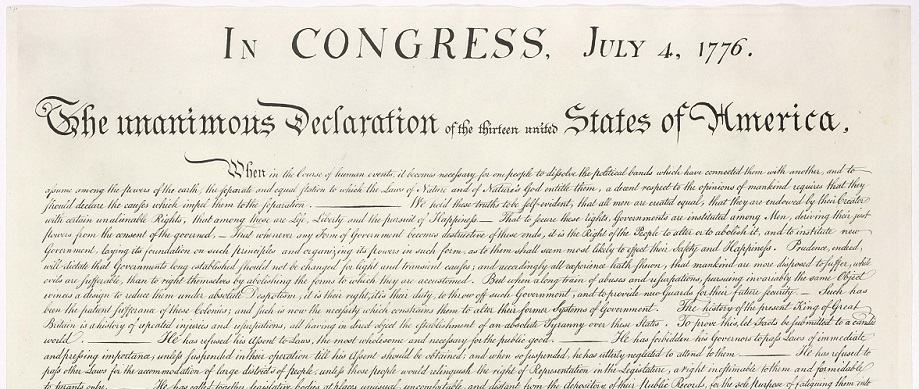
Friday, July 4, marks the 249th anniversary of signing of the Declaration of Independence in 1776. The Second Continental Congress voted two days earlier, on July 2, 1776, to pursue independence with the Lee Resolution, which read: “Resolved, That these United Colonies are, and of right ought to be, free and independent States, that they are absolved from all allegiance to the British Crown, and that all political connection between them and the State of Great Britain is, and ought to be, totally dissolved.”
Twelve of the 13 colonies voted for the resolution, with only the New York delegation abstaining because they had not received direct instructions from their legislature to pursue independence. The Second Continental Congress directed Massachusetts representative John Adams, Virginia’s Thomas Jefferson, Pennsylvania’s Benjamin Franklin, Connecticut’s Roger Sherman and New York’s Robert Livingston to draft what became the Declaration of Independence, that was approved on July 4, 1776.
Invariably around the Fourth of July a 25-year-old, grossly inaccurate essay circulates claiming that numerous signers of the Declaration of Independence suffered disastrous consequences for their actions. One example states “Five signers were captured by the British as traitors, and tortured before they died,” the truth is they were imprisoned during the normal course of the war, none were tortured and none died. The American Revolution, like most conflicts in the 18th century, was “gentlemanly,” not the “total war” of the later Napoleonic era or the world wars of the 20th century. Rank-and-file soldiers always suffer in wars, but men of means, wealth or status were treated better, especially in this era. For instance, Revolutionary Major Gen.
Charles Lee was captured in New York in 1776. He was neither tortured nor killed but instead paroled in 1778 in a prisoner exchange, after which he promptly rejoined the Continental Army.
Also, the signers weren’t all civilians. Many actively served in the Continental Army, so their capture was not for their political status but because they were apprehended during military operations as active combatants.
Another claimed that Delaware delegate Thomas McKean, which the essay misspells as “McKeam” was hounded by the British and died penniless. McKean was actually absent on the day the declaration was signed, so the British would have had no reason to target him. He did move his family several times due to their proximity to British advances and American Indian incursions, but that was his choice, not due to British pressure. He died with a “substantial” estate consisting of “stocks, bonds and huge tracts of land in Pennsylvania.”
Most glaringly, the essay claims that at the Battle of Yorktown in 1781, signer Thomas Nelson Jr., “noted that the British General Cornwallis had taken over the Nelson home for his headquarters. He quietly urged General George Washington to open fire. The home was destroyed and Nelson died bankrupt.”
Yet you can visit the un-destroyed Thomas Nelson House in Yorktown, Va., which was built in 1730, designated as a National Historic Landmark in 1966 and was added to Yorktown’s Colonial National Historical Park. Nelson did die bankrupt due to bad investments after the war.
Please check memes like this before sharing them blindly. We should be accurate when discussing our own history.
The declaration is an essay in four parts: The preamble, the Declaration of Natural Rights, the List of Grievances and the Resolution of Independence. The declaration of natural rights begins “We hold these truths to be self-evident, that all men are created equal, that they are endowed by their Creator with certain unalienable Rights, that among these are Life, Liberty and the pursuit of Happiness.”
It was not a proclamation to the American people — it was a letter from elected leaders of the American colonists to their British cousins, telling them about the offenses to the 13 Colonies by King George III, and rhetorically argued so that no Briton would accept such mistreatment.
After all, only 127 years earlier, the English Parliament had fought with and executed the English monarch, Charles I, for similar abuse.
While we cite the phrase “… all men are created equal …” in our modern political discourse, “all men” as written in 1776 did not include all Americans as we interpret now, nor did it just include all English-born white colonists and their American descendants, but rather all white men over age 21 who owned land.
The majority of soldiers in the Continental Army did not enjoy the voting rights for which they had fought, though they and non-property-owning “inhabitants” — also only white freemen — could vote on hometown officials in public assemblies. However, they did believe that having local control and being able to speak was preferable to being ruled by nobles from oversees.
The Framers wrote in the Constitution’s preamble that the document’s purpose was conceived “in order to form a more perfect union.” It’s up to us to bend history toward justice and ensure “all people are created equal and treated equally” under the law, not for the founders long dead, but for future Americans, including those we will never meet.

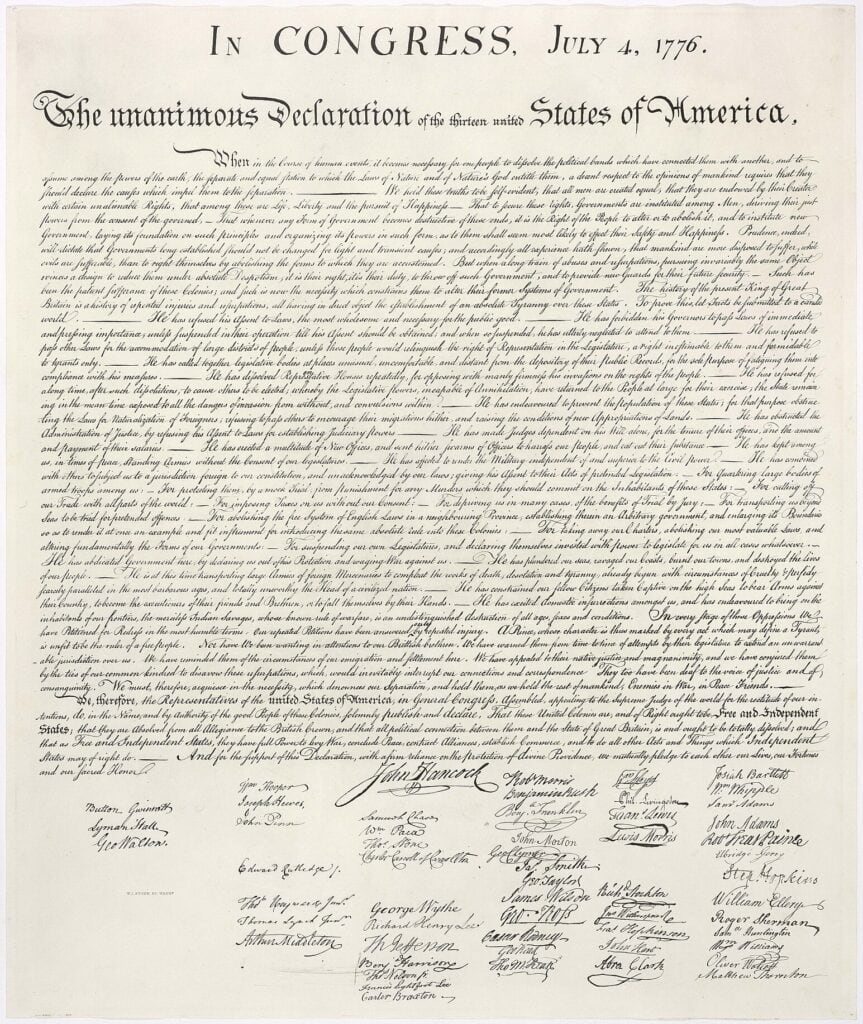
The Declaration of Independence
In Congress, July 4, 1776
The unanimous Declaration of the thirteen united States of America, When in the Course of human events, it becomes necessary for one people to dissolve the political bands which have connected them with another, and to assume among the powers of the earth, the separate and equal station to which the Laws of Nature and of Nature’s God entitle them, a decent respect to the opinions of mankind requires that they should declare the causes which impel them to the separation.
We hold these truths to be self-evident, that all men are created equal, that they are endowed by their Creator with certain unalienable Rights, that among these are Life, Liberty and the pursuit of Happiness.
That to secure these rights, Governments are instituted among Men, deriving their just powers from the consent of the governed,
That whenever any Form of Government becomes destructive of these ends, it is the Right of the People to alter or to abolish it, and to institute new Government, laying its foundation on such principles and organizing its powers in such form, as to them shall seem most likely to effect their Safety and Happiness. Prudence, indeed, will dictate that Governments long established should not be changed for light and transient causes; and accordingly all experience hath shewn, that mankind are more disposed to suffer, while evils are sufferable, than to right themselves by abolishing the forms to which they are accustomed. But when a long train of abuses and usurpations, pursuing invariably the same Object evinces a design to reduce them under absolute Despotism, it is their right, it is their duty, to throw off such Government, and to provide new Guards for their future security.
Such has been the patient sufferance of these Colonies; and such is now the necessity which constrains them to alter their former Systems of Government. The history of the present King of Great Britain is a history of repeated injuries and usurpations, all having in direct object the establishment of an absolute Tyranny over these States. To prove this, let Facts be submitted to a candid world.
- He has refused his Assent to Laws, the most wholesome and necessary for the public good.
- He has forbidden his Governors to pass Laws of immediate and pressing importance, unless suspended in their operation till his Assent should be obtained; and when so suspended, he has utterly neglected to attend to them.
- He has refused to pass other Laws for the accommodation of large districts of people, unless those people would relinquish the right of Representation in the Legislature, a right inestimable to them and formidable to tyrants only.
- He has called together legislative bodies at places unusual, uncomfortable, and distant from the depository of their public Records, for the sole purpose of fatiguing them into compliance with his measures.
- He has dissolved Representative Houses repeatedly, for opposing with manly firmness his invasions on the rights of the people.
- He has refused for a long time, after such dissolutions, to cause others to be elected; whereby the Legislative powers, incapable of Annihilation, have returned to the People at large for their exercise; the State remaining in the mean time exposed to all the dangers of invasion from without, and convulsions within.
- He has endeavoured to prevent the population of these States; for that purpose obstructing the Laws for Naturalization of Foreigners; refusing to pass others to encourage their migrations hither, and raising the conditions of new Appropriations of Lands.
- He has obstructed the Administration of Justice, by refusing his Assent to Laws for establishing Judiciary powers.
- He has made Judges dependent on his Will alone, for the tenure of their offices, and the amount and payment of their salaries.
- He has erected a multitude of New Offices, and sent hither swarms of Officers to harrass our people, and eat out their substance.
- He has kept among us, in times of peace, Standing Armies without the Consent of our legislatures.
- He has affected to render the Military independent of and superior to the Civil power.
- He has combined with others to subject us to a jurisdiction foreign to our constitution, and unacknowledged by our laws; giving his Assent to their Acts of pretended Legislation:
- For Quartering large bodies of armed troops among us:
- For protecting them, by a mock Trial, from punishment for any Murders which they should commit on the Inhabitants of these States:
- For cutting off our Trade with all parts of the world:
- For imposing Taxes on us without our Consent:
- For depriving us in many cases, of the benefits of Trial by Jury:
- For transporting us beyond Seas to be tried for pretended offences:
- For abolishing the free System of English Laws in a neighbouring Province, establishing therein an Arbitrary government, and enlarging its Boundaries so as to render it at once an example and fit instrument for introducing the same absolute rule into these Colonies:
- For taking away our Charters, abolishing our most valuable Laws, and altering fundamentally the Forms of our Governments:
- For suspending our own Legislatures, and declaring themselves invested with power to legislate for us in all cases whatsoever.
- He has abdicated Government here, by declaring us out of his Protection and waging War against us.
- He has plundered our seas, ravaged our Coasts, burnt our towns, and destroyed the lives of our people.
- He is at this time transporting large Armies of foreign Mercenaries to compleat the works of death, desolation and tyranny, already begun with circumstances of Cruelty & perfidy scarcely paralleled in the most barbarous ages, and totally unworthy the Head of a civilized nation.
- He has constrained our fellow Citizens taken Captive on the high Seas to bear Arms against their Country, to become the executioners of their friends and Brethren, or to fall themselves by their Hands.
- He has excited domestic insurrections amongst us, and has endeavoured to bring on the inhabitants of our frontiers, the merciless Indian Savages, whose known rule of warfare, is an undistinguished destruction of all ages, sexes and conditions.
In every stage of these Oppressions We have Petitioned for Redress in the most humble terms: Our repeated Petitions have been answered only by repeated injury. A Prince, whose character is thus marked by every act which may define a Tyrant, is unfit to be the ruler of a free people.
Nor have We been wanting in attentions to our Brittish brethren. We have warned them from time to time of attempts by their legislature to extend an unwarrantable jurisdiction over us. We have reminded them of the circumstances of our emigration and settlement here. We have appealed to their native justice and magnanimity, and we have conjured them by the ties of our common kindred to disavow these usurpations, which, would inevitably interrupt our connections and correspondence. They too have been deaf to the voice of justice and of consanguinity. We must, therefore, acquiesce in the necessity, which denounces our Separation, and hold them, as we hold the rest of mankind, Enemies in War, in Peace Friends.
We, therefore, the Representatives of the united States of America, in General Congress, Assembled, appealing to the Supreme Judge of the world for the rectitude of our intentions, do, in the Name, and by Authority of the good People of these Colonies, solemnly publish and declare, That these United Colonies are, and of Right ought to be Free and Independent States; that they are Absolved from all Allegiance to the British Crown, and that all political connection between them and the State of Great Britain, is and ought to be totally dissolved; and that as Free and Independent States, they have full Power to levy War, conclude Peace, contract Alliances, establish Commerce, and to do all other Acts and Things which Independent States may of right do. And for the support of this Declaration, with a firm reliance on the protection of divine Providence, we mutually pledge to each other our Lives, our Fortunes and our sacred Honor.
Georgia
Button Gwinnett
George Walton
Lyman Hall
North Carolina
William Hooper
Joseph Hewes
John Penn
South Carolina
Edward Rutledge
Thomas Heyward, Jr.
Thomas Lynch, Jr.
Arthur Middleton
Maryland
Samuel Chase
William Paca
Thomas Stone
Charles Carroll of Carrollton
Virginia
George Wythe
Richard Henry Lee
Thomas Jefferson
Benjamin Harrison
Thomas Nelson, Jr.
Francis Lightfoot Lee
Carter Braxton
Massachusetts
John Hancock
Pennsylvania
Robert Morris
Benjamin Rush
Benjamin Franklin
John Morton
George Clymer
James Smith
George Taylor
James Wilson
George Ross
Delaware
Caesar Rodney
George Read
Thomas McKean
New York
William Floyd
Philip Livingston
Francis Lewis
Lewis Morris
New Jersey
Richard Stockton
John Witherspoon
Francis Hopkinson
John Hart
Abraham Clark
New Hampshire
Josiah Bartlett
William Whipple
Massachusetts
Samuel Adams
John Adams
Robert Treat Paine
Elbridge Gerry
Rhode Island
Stephen Hopkins
William Ellery
Connecticut
Roger Sherman
Samuel Huntington
William Williams
Oliver Wolcott
New Hampshire
Matthew Thornton


