











A potential sale of up to 3 million acres of public land managed by the Bureau of Land Management and the U.S. Forest Service that was included in draft legislation in the Senate’s Energy and Natural Resources Committee was put in limbo by Senate Parliamentarian Elizabeth MacDonough on the evening of Monday, June 23.
The legislation could remain in the bill but require 60 votes to pass, which is unlikely given that Republicans only have a 53-47 majority and Democrats are in opposition, or be removed so that bill would only require a 51-vote simple majority.
Senate Republicans, led by U.S. Mike Lee [R-Utah], were seeking to require between 0.5 and 0.75% of BLM and USFS land holdings in 11 western states — Alaska, Arizona, California, Colorado, Idaho, Nevada, New Mexico, Oregon, Utah, Washington and Wyoming — be sold to promote housing development. Both of Montana’s Republican senators, Steve Daines and Tim Sheehy, have stated their opposition and the state was excluded from the bill.
MacDonough determined that the land divestment proposal violated the Senate’s Byrd Rule.
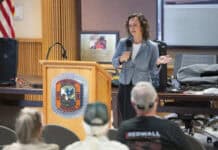
Named for late U.S. Sen. Robert Byrd [D-W.Va.], “the Byrd Rule basically states that an unrelated policy can’t be included in a budget reconciliation bill, because a budget reconciliation bill only requires a simple majority, and something like this would require 60 [senators], so it was pulled,” Assistant Sedona City Attorney Monique Coady said to Sedona City Council during the meeting Tuesday, June 24.
The One Big Beautiful Bill Act budget reconciliation was passed by the House of Representatives in May and is currently being reviewed in the Senate.
Sedona City Council approved a resolution to be sent to federal representatives to formally oppose the mandatory disposal of federal public lands, with the language also amended to voice opposition to any similar potential future sales, which several council members and city staffers said they believe will be attempted by Congress.
Environmental groups in opposition also argue that the amount of land divested could have been significantly larger than what’s been proposed.
The council agenda cited the Wilderness Society’s map as part of the justification for its position, with the map including a vast swath of U.S. Forest Service land up Schnebly Hill to Interstate 17 to the east and land west of the city, as well as Cathedral Rock.
Lee took to X, formerly known as Twitter, shortly after the parliamentarian’s decision to post that his plan would significantly change with the following: The sale of USFS land would not occur, the amount of BLM land for sale would be “significantly reduced … and only land within 5 miles of a population center would be eligible. Lee additionally called for the establishment of “freedom zones” to make sure these lands would be used for future housing projects.
“Yes, the Byrd Rule limits what can go in the reconciliation bill, but I’m doing everything I can to support President [Donald] Trump and move this forward,” Lee posted.
Coady told council she believes Lee’s “intent is still there.”
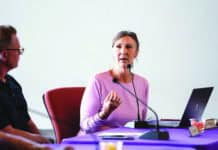
National Association of Counties Public Lands Committee Representative and Yavapai County Supervisor Nikki Check [D-District 3] and Northern Arizona Outreach Coordinator for U.S. Sen. Mark Kelly [D-Ariz.] Judy Sulltrop weighed in during the public comment at council.
“One of the main things that I don’t like about what’s happened in this thought process is that you’re mandating the sale of something for something that the federal government doesn’t have control over — how that land gets developed — and so we’ve already been dealing a lot with local control being taken away at the state level, and now the federal government gets in the game it’s very chaotic,” Check said. “Can [the federal government] also mandate that the city of Sedona would provide water and sewer to these parcels?”
Check noted that the town of Clarkdale had a similar discussion about the One Big Beautiful Bill Act during its meeting earlier in the day of Tuesday, June 24.
“The Board of Supervisors, I hope to have addressed it in our July 2 meeting, which is relevant, because after our regular meeting, we have a special meeting scheduled to discuss a potential Intergovernmental Committee to look at water resources and open space,” Check said. “So that committee could potentially become incredibly relevant, should [the Senate] continue to pursue that.”
Sulltrop stated that “[Kelly] is opposed to any effort to force the sale of public lands.”
She added that U.S. Sen. Ruben Gallego [D-Ariz.] also opposes the divestment, and encouraged council to direct advocacy towards Arizona’s seven U.S. representatives.
“[We] expect that the bill in the final form will hit our office on Thursday, [June 26] so we are expecting at that time to make sure that they haven’t slipped something else in,” Sulltrop said.
Two other speakers during the meeting spoke against the possible federal land divestment legislation, and one spoke in favor.