

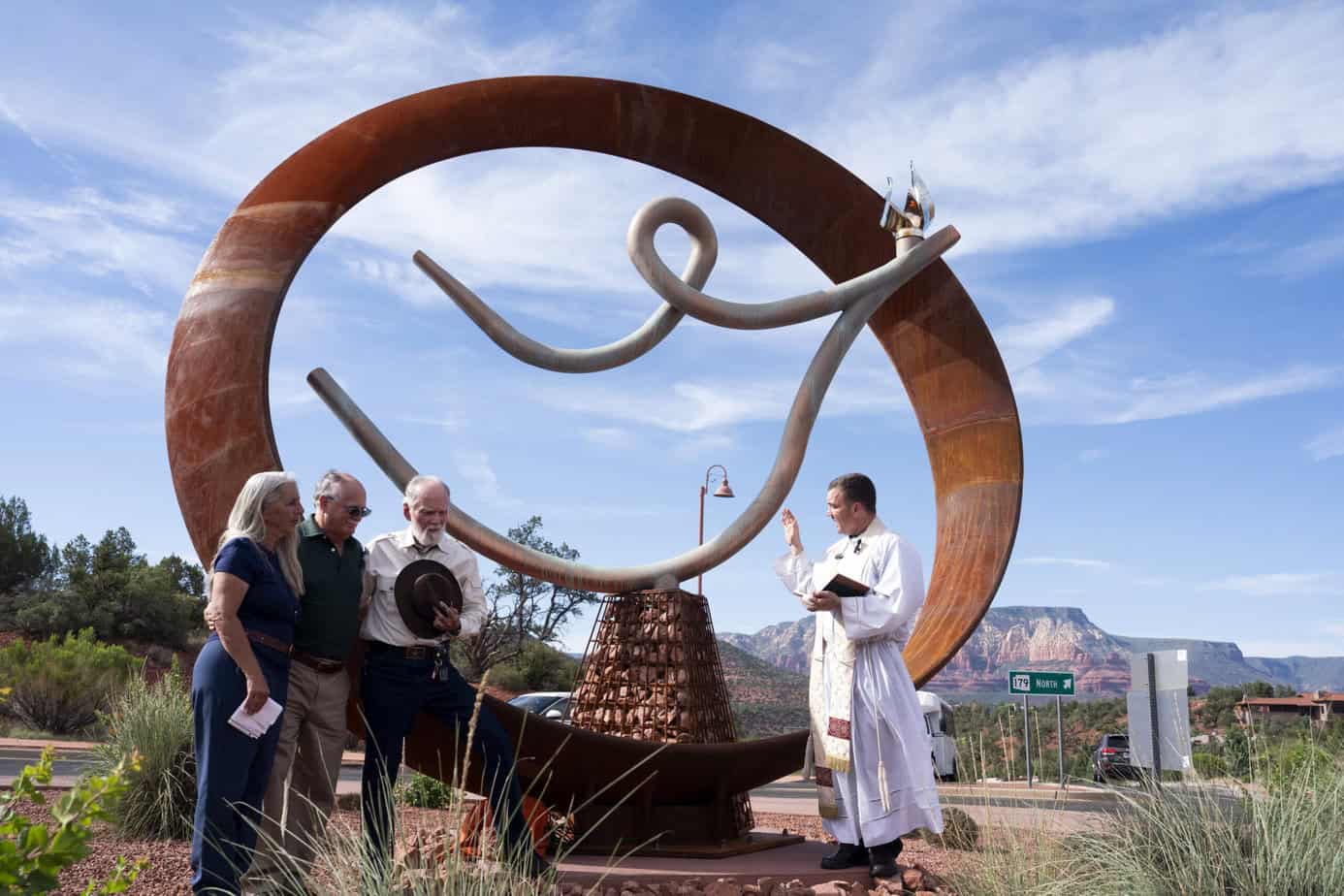

James Muir’s sculpture “Eternal” became the latest addition to the city of Sedona’s Art in the Roundabouts project at the Chapel Road roundabout, following a short interfaith blessing by Rabbi Alicia Magal and Father Ignatius Mazanowski, along with remarks from Mayor Scott Jablow and Arts & Culture Coordinator Nancy Lattanzi. The unveiling, held on the afternoon of Friday, June 13, drew about 50 attendees.
“I feel very humbled to have this beautiful piece of artwork here forever as a legacy to James, so whenever we enter the community from this side of of the city, we will always be thinking of James Muir,” Jablow said.
The sculpture represents the outline of an oil lamp with an eternal flame at its tip, which points in the direction of the Chapel of the Holy Cross, surrounded by a 15-foot Mobius ring. The idea of a journey is reflected in the lamp’s base, a welded rebar gabion basket filled with red rocks, evoking the cairn system commonly used to mark trails.
“You can start at any point on the surface, never leave the surface, and go around twice, and you’ll come back to exactly where you started soon. It has only one side,” Muir said. “I relate that to a perception, an allegory, a symbol of God … Because God has only one side, and that’s love.”
Muir described the piece as a “sculptural billboard” that would promote Sedona and guide visitors to the chapel, which also houses Muir’s 33-foot bronze sculpture “Christ of the Holy Cross,” a work installed in 2018 that portrays a living Christ crucified upon the Tree of Life.
“The whole piece symbolically is representing a divine pathway,” Muir said of “Eternal.” “We have hiking paths all over Sedona. So this is paying tribute to a recognition that not only can you look at the red rocks, but you can actually hike into the red rocks to enjoy an up-close-and-personal relationship with nature in the sanctity of the red rocks.”
The piece is Muir’s first non-figurative public work, and he said it departed dramatically from the highly detailed bronze sculptures for which he has been known over the last four decades due to budget constraints and the difficulty of designing a piece that would not distract drivers.
“It was liberating for me, personally and artistically,” Muir said. “Ever since 1980, I’ve been known for emotionally explicit sculptures — human figures, horses, animals. This made me distill my allegorical work to its essence.”
Muir describes his work as allegorical art, meaning it’s rich with symbolic meaning and deeper messages beyond its visual form and the power of this style is its universality.
“That’s why I speak the language of symbolism, which transcends spoken language … it doesn’t have to go through the head,” Muir said. “The head and the mind can get in the way. … With [‘Eternal’] I can describe what it means symbolically, but to someone else, when they see it, they will see what they need to in it without having to go through a language. It’s like Isadora Duncan, the famous dancer, once said when she was asked to explain what her dance meant, and she said, ‘If I have to explain it, why dance?’”
Creating the Mobius Ring at such a large scale required collaboration. Muir turned to James Tyler, a metal fabricator with Metal Pro of Phoenix.
“It’s probably the first one that’s been made like this and it was a challenge … some of the panels are bent in two different directions,” Tyler said. “The best part was the wow in [Muir’s] eyes when he saw the flame being installed.”
Muir previously expressed an appreciation for the combination of flame and sculpture that he said originated with his arrival in Sedona on April 1, 1978, at night.
“I saw that cross lit up on Airport Hill — it’s been removed since,” Muir said. “I’m a great believer in signs and symbols. It’s a different language than we’re used to, and it just spoke to me and said, ‘This is where you need to move to.’ I ended up staying the night because it was too late to make it to Flagstaff … And it wasn’t until dawn the next morning, when I stepped out the front door, that I saw what an incredible place this was. But I had already decided this is where I was going to move to.”
The fourth and final roundabout art piece will be Mark Feldtkeller’s “Look In Up,” which Lattanzi said is scheduled to be installed at the Back O’ Beyond roundabout by the end of July or early August, pending a 30-day curing process for the concrete foundation.