

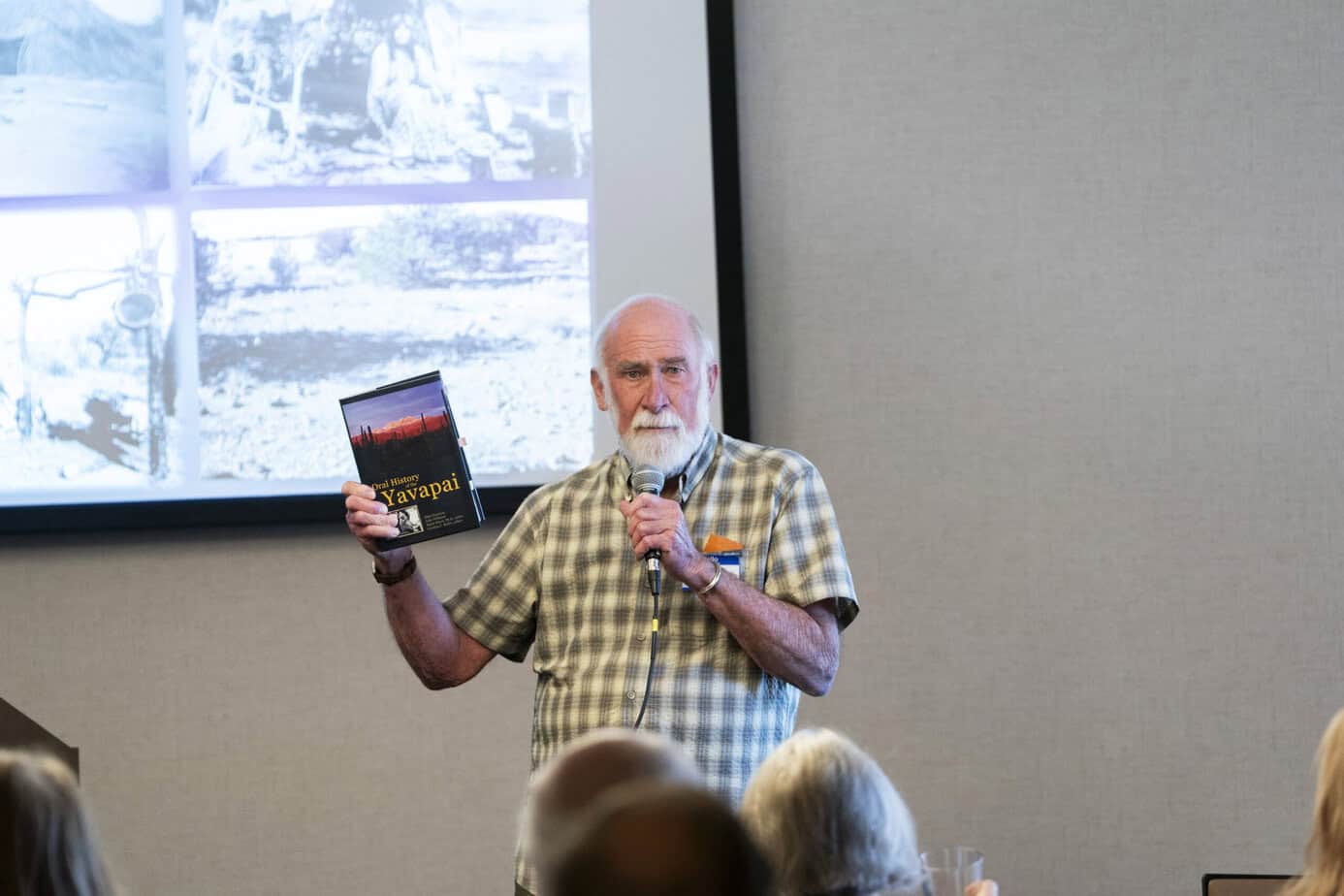

Peter J. Pilles Jr., who was the longest-serving forest archaeologist for the Coconino National Forest for over 45 years, presented “Kinyuriki of the Wipukpaia” during a luncheon hosted by the Verde Valley Archaeology Center and Museum in April.
Pilles also discussed the history of the Yavapai and ethnobotany in the Verde Valley.
The Yavapai were a semi-nomadic people who ranged over 20,000 square miles of what is now southern and central Arizona prior to contact with Europeans, which presents a challenge for archaeologists to understand their history because much of their material culture was constructed from perishable items, such as basketry made from reeds.
“What we tend to rely upon in the Verde Valley, [to] identifying possible Yavapai sites, is the presence of Hopi pottery called Jeddito black-on-yellow,” Pilles said. “This was a popular trade item in the American Southwest from around 1300 to about 1425 [CE] or so. The only thing that still causes some confusion is that the last people in the Verde Valley area, the Southern Sinagua, also traded for Hopi yellowware pottery. So when we find it, and we really don’t know for sure, if looking at a late Sinagua site … or an early Yavapai site.”
Pilles added that other distinctive Yavapai items found in the Verde Valley included desert side-notched or “Pai” specialized projectile points.
“There are a few stone tools that are also fairly common in the Yavapai sites,” Pilles said. “One of them is a lap stone, which is a large flap of rock that has been smoothed naturally and further smoothed through use for grinding seeds, nuts, and also for pigment processing. Another one, also used for a specialized food production, is called nutting stone, and it’s simply a smaller version where the central area has been used and pecked to roughen it for treating cracking nuts and seeds.”
Pilles also said that Pai-hafted agave knives and scrapers were distinctive tools used by the Yavapai for harvesting agave, a plant of great importance in their diet. Each spring, several Yavapai bands would gather in one location for several weeks to collect, process and prepare agave.
“To process agave, the outer leaves must be cut away, a task that often left hands, arms and legs bloodied,” Pilles said. “After trimming, the agave heads are taken to a large pit, about two meters wide and one meter deep. A fire is built in the pit and allowed to burn for several days. Rocks are then gathered and tossed to retain the heat. Once the pit reaches the right temperature, the Yavapai would place 20 to 40 agave heads inside, cover them with plant material to retain moisture and then add a thick layer of dirt. The agave is left to roast for about four days until it’s ready to eat.”
Pilles reminisced about his own efforts roasting agaves, noting that he was undercooking them.
“It’s recently been discovered that the Yavapai also cultivated agaves, maybe the prehistoric folks did, too,” Pilles said. “We’re not sure when this began, but through selective breeding, they were able to develop at least five different varieties of cultivated agaves here in Arizona.”
Pilles identified agave roasting pits as the most useful diagnostic feature for determining whether an archaeological site was created by the Yavapai.
“[The Yavapai] tend to return to the same places year after year and over time,” Pilles said. “The residue from the burned earth and rocks and fill are tossed out to the side, and you eventually end up with a mound that they would dig and then clean out every time they wanted to use it. And these are ubiquitous throughout much of the Verde Valley, especially in the rocky areas up along the Mogollon Rim … You can tell that they’re roasting a number of different things in the agave roasting pits, but again, very distinctive for the presence of the Yavapai in the Verde Valley.”
VVAC will be unveiling new digital kiosks offering presentations on American Indian astronomy, pottery of the Verde Valley and the Dyck Cliff Dwelling on Thursday, Sept. 18.