













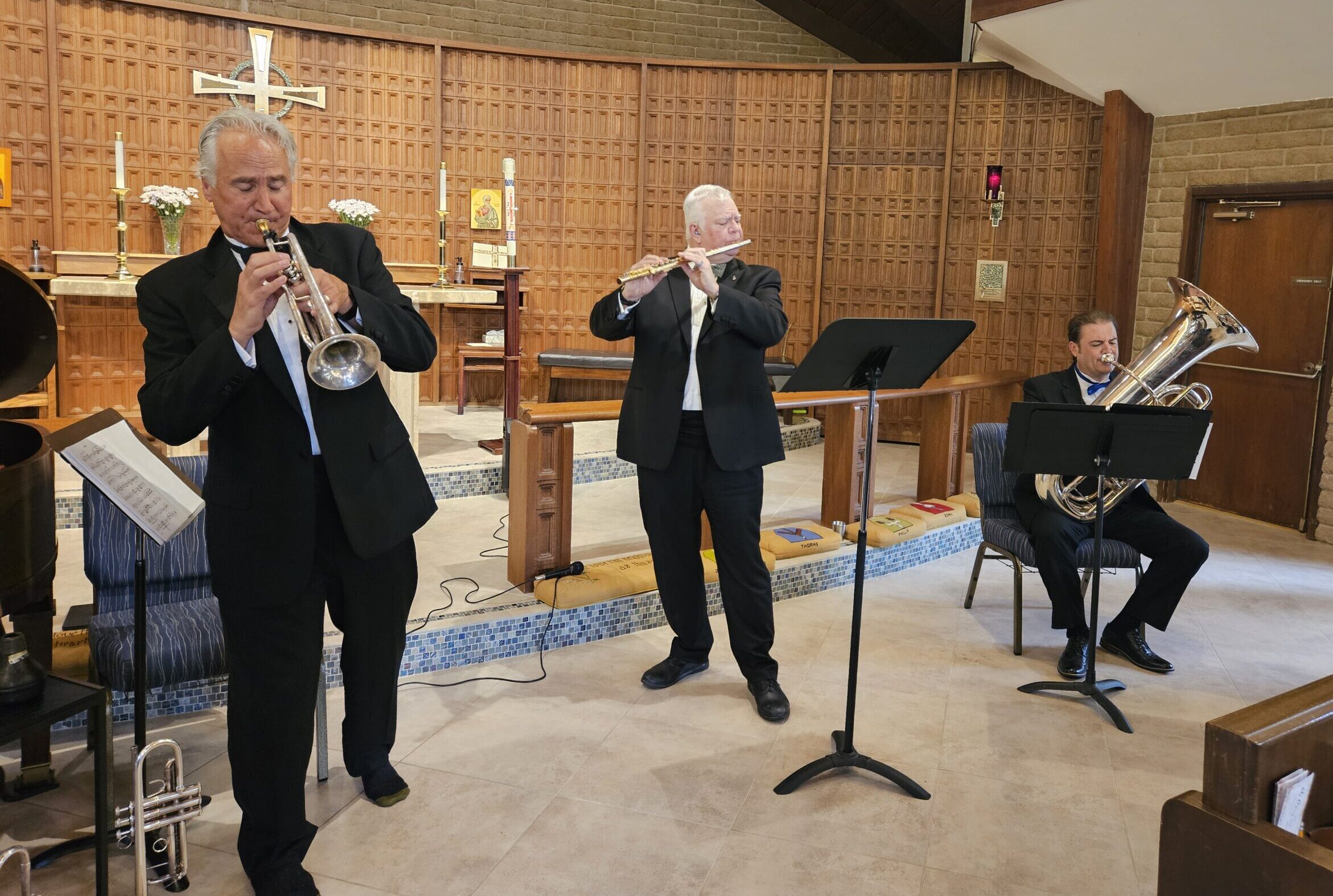
The virtuoso tuba — yes, you read that right — was in full voice during St. Andrew’s Episcopal Church’s “Shout for Joy” concert on Sunday, May 11. Tubaist Curtis Peacock, principal tuba of the Prescott Pops Orchestra, joined his colleague Jaime Ondrusek on flute, St. Andrew’s music director Dave Len Scott on trumpet and pianist Rita Borden for an eclectic selection of wind works from the baroque to the contemporary.
The frisky foursome started the afternoon off with Claude Bolling’s “Irlandaise,” which they translated variously as “Irish-like” or “Irishy,” a piece that traded off two different sets of ideas, one relaxed, the other exhibiting some trepidation. A laid-back saunter from the tuba segued into a flute-and-trumpet chat that couldn’t settle on just one mood — and were those elements of “Greensleeves” making themselves heard?
The listeners were also treated to Scott’s reduction of the allegro from Johann Georg Neruda’s Trumpet Concerto in B Flat for flute and tuba, which featured the additional entertainment factor of watching Scott play two roles in alternation as he rendered part of the accompaniment on a muted trumpet and the solo passages on an unmuted trumpet. This was a light, elegant work in which the flute was prominent at first and carried much of the accompaniment alongside the brassy muted trumpet. The strong formality of the music never moved into abandonment and featured passages of explicit restraint, with the unmuted trumpet taking the boldest, proudest, most uncontained lines.
The recital was anchored by Peacock’s performance of Ralph Vaughn Williams’ Tuba Concerto — yes, there is such a thing — from memory on the F tuba, joined by Borden. Peacock noted that he has also performed the work on the B flat, C and E flat tubas as well. The first movement lived up to its marking of moderato, with the mellow voice of the tuba in contrast to the somewhat strained note relationships of the piano part. Distinctly modern without much internal structure, the piano offered up a ragtime feel while Peacock slid easily through the high-low jumps the work demanded and adeptly and amusingly stretched his tuba up into the saxophone’s aural space. The succeeding romanza was even more mellow, offering a ponderously relaxed tuba part, albeit with some passionate throbbing arcs, and more integrated roles for both instruments. For the third movement, Vaughn Williams threw in speed and uncertainty, the solo part and the accompaniment both riding the edge and falling all over each other. A toying cadenza ended with two perfectly-timed blats from the tuba designed to get an audience response — and they did.
Ondrusek, a specialist in the baroque flute, showed off his original 1830 Romantic keyed flute for the audience in a demonstration of Wolfgang Amadeus Mozart’s K.315, the Andante in C for Flute and Orchestra, with Scott taking the role of the orchestra on the church’s organ. The combination was perfectly suited to the space, with inviting opening and closing elements around a somewhat chilly B section and the organ providing a very smoothed background for the flute, more ambience than accompaniment. Ondrusek also exposed some incredibly interesting details of Mozart’s writing just before the cadenza.
For Paul Schoenfield’s “Achat Sha’alti,” one of the composer’s Hasidic tunes, Ondrusek picked up the modern flute again, which sounded almost Celtic over the dark and solid piano base. It wasn’t exactly haunting, but certainly gave the feel of water flowing softly in a dim and mossy glade. Scott and Peacock next took a merrier tack with William Schmidt’s “Tony and the Elephant, or Jim and the Roadrunner,” at first a set of talkbacks between trumpet and tuba that involved both of them flourishing at each other in little bursts and runs of notes before it grew slow and smoky in the blues-inspired second part and cried out for the addition of a drum kit in the swinging third section, each instrument distinct yet complementary.
“Seeing the theme for this was ‘high and low,’ you can’t get much higher than the piccolo unless you play the orchestral dog whistle or something,” Ondrusek commented in the leadup to Amanda Harberg’s Sonata for Piccolo and Piano — and then pointed out that he had selected the Harberg work specifically to emphasize the piccolo’s low range, which he did to enormous effect with the sonata’s wispy, questing melodies that required considerable breath control from the player. Sounding tremendously antique in its lower range, more like a recorder or other end blown flute, Ondrusek was able to use the piccolo to convey a sense of fragility and tremendous depth that were somehow reconciled.
Scott and his fellow wind players then closed the proceedings with an arrangement of the allegro from Oskar Bohme’s Trumpet Concerto in F Minor, which launched itself at the audience with a quick and intriguing start that dropped the listener right into the thick of the music. There was almost a foreshadowing of the Sabre Dance from Aram Khatchaturian’s ballet “Gayane” in the flute and tuba parts. Scott would play clear, crisp, long lines on the trumpet, and Ondrusek would then play catchup on the flute. Not a fast piece, the solo part grew in demonstrativeness as it progressed and Scott did a beautiful job with the sustained detail at the finish.
The next “Shout for Joy” concert will take place on Sunday, Aug. 10, when Scott and some of his brass colleagues will perform as a quintet.