

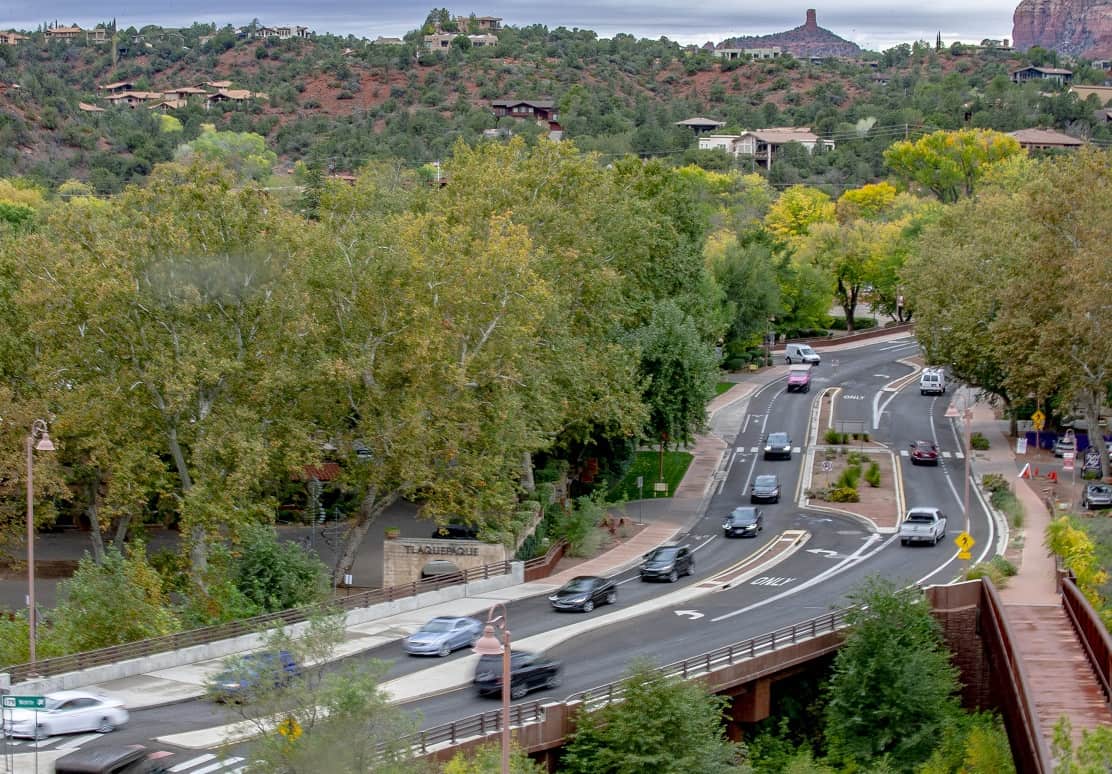
As the city of Sedona embarks on its $35 million Sedona in Motion plan, the key word for many projects is “motion.” One of the many areas where the opposite of motion is often experienced is on State Route 179 near Tlaquepaque.
Right now, a city consultant is doing a feasibility analysis for four different options to help reduce congestion in that area. Those include an overpass, underpass, an improved pedestrian control at the current crosswalk and a pathway that goes below Oak Creek Bridge.
“These options are a bit of a combination between the city and consultant,” City Engineering Supervisor Stephen Craver said.
“As we were developing the scope of work we talked about what we’d like to explore and what should be considered.” Once the city staff has a formal design, it will then go before the Sedona City Council. But for now, it’s a matter of deciding which option is best and affordable. And while the city has given input, City Engineer Andy Dickey said they have not expressed any preferences to the consultants. This way they can get an unbiased look at all four options. In terms of the city’s traffic woes, Dickey said there’s a misconception among many who feel most of those issues begin and end with one area.
“We’ve heard from many people that all of our problems are related to the Tlaquepaque crosswalk,” he said.
“Some have said issues in Uptown are related to that as well, which is not true. But that is the conception many people have. The reality is, it is a contributing factor, but when you look at what causes congestion on 179 it’s really not just the crosswalk.”
Dickey said that before Tlaquepaque North opened a few years ago, there was congestion on State Route 179 and back-ups on Cooks Hill. One of the biggest contributing factors in the area, he said, are all those vehicles making U-turns at the Schnebly Hill roundabout, which halts northbound vehicles on State Route 179.
This is where the proposed Portal Lane connection out of the Tlaquepaque complex during congested periods comes into play. The plan is to direct Uptown and West Sedona-bound motorists onto Brewer Road, eliminating the need for them to use the roundabout.
“We’ll be looking at doing both of these improvements,” Dickey said in regards to Tlaquepaque and the Portal Lane exit.
“Most of our improvements are not either/or, they’re this and this and this. We keep hearing people say we need to do this instead of that, but a lot of times all these improvements are in our program.” One of the problems the city faces in Uptown and Tlaquepaque is jaywalking, which adds to the problem of vehicles stopping and starting. This is where the issue of compliance comes in. In the Uptown work that is being considered, the preliminary design includes man-made barriers or tall shrubs that would prevent people from crossing in areas they shouldn’t be while directing them to proper areas to cross.
“We’re looking at what the options would be to help control pedestrian traffic,” Dickey said. “There’s a lot of new technology these days that makes pedestrian crossing safer but my question is, how do we get compliance at Tlaquepaque as well as in Uptown?”
Craver said that while pedestrian safety is a high priority, there has to be a balance between it and vehicular efficiency and the flow of traffic.
“A lot of times, you will have pedestrians who are waiting but when you’re in a congested condition where vehicles are already moving slowly, a lot of times motorists will be courteous,” Craver said.
“A driver who sees pedestrians trying to cross, and even though it’s a green light for them, will stop and let them pass. At that point you lose efficiency.”
As for the four proposed options at Tlaquepaque, the study will look at both a ramp with a gradual grade increase over State Route 179, as well as an elevator with a walkway over the highway in order to be Americans With Disabilities Act-compliable. Dickey said going underground may be the biggest challenge because the area is in a floodplain — not to mention the amount of underground utilities that are already in place. This is why the pathway under the bridge and improved crosswalk would be the most feasible options but not necessarily the best, he said.
“We’re still in the early stages, so right now we don’t have any cost estimates,” Dickey said, adding that the owners of Tlaquepaque put $18,000 in escrow to help with any design costs for pedestrian improvements. In the end, regardless of what option the city may choose, the Arizona Department of Transportation will have to give its blessing. Considering that, this fiscal year the design and feasibility study should be completed. But any construction — after council approval — would start no sooner than a year from now.
“Our hope is that whatever we decide would be done through a right-of-way encroachment permit with ADOT,” Craver said. “It’s not the type of project where ADOT would be the managing agency. This way, it wouldn’t be as long of a process where they’d be contributing money and them having to find that funding.”


