

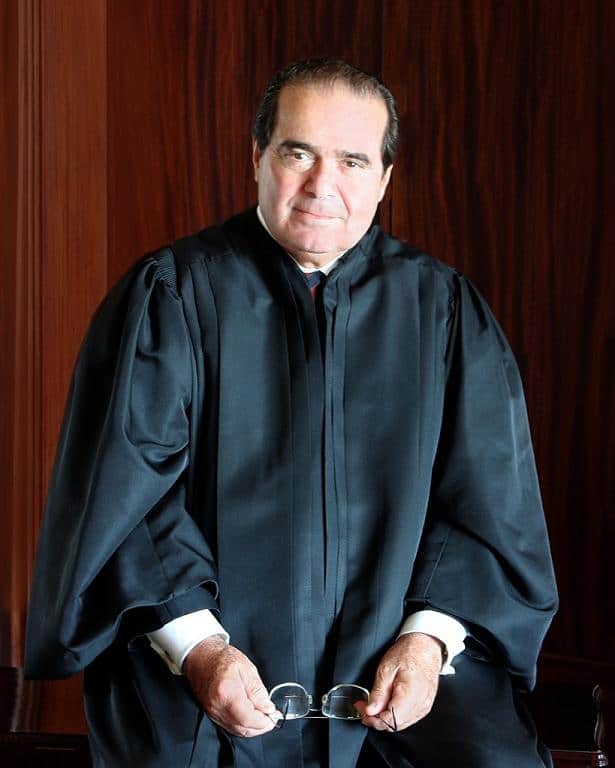
On Saturday, Feb. 13, the U.S. Supreme Court lost one of its most influential members, Justice Antonin Gregory Scalia.
Appointed by President Ronald Reagan, Scalia served on the court for 29 years and led the conservative wing of the court in some of its most profound rulings. Scalia infuriated liberals with his opinions, both those written in the majority and in his dissents. He seemed to revel in their hatred, often hurling insults in his opinions targeted against litigants as well as his fellow justices: “The stuff contained in today’s opinion has to diminish this court’s reputation for clear thinking and sober analysis” and “the opinion is couched in a style that is as pretentious as its content is egotistic.”
Scalia may have been a conservative, but he wrote opinions that defended flag burning (Texas v. Johnson, 1989, which involved a 28-year-old member of the Revolutionary Communist Youth Brigade buring a flag at the 1984 Republican National Convention in Dallas, Texas) and depictions of violence in entertainment (Brown v. EMA, 2011) as protections of the First Amendment because he was first and foremost a strict textual constitutionalist, one of his enduring influences on his fellow justices.
While many thought he was often on the wrong side of history on social issues, he was the best ally of the accused. Citing the Fourth Amendment, he successfully argued for minors’ rights (Brown v. EMA, 2011) and wrote a stirring dissent railing against the state collecting DNA from criminal defendants against their will:
“Today’s judgment will, to be sure, have the beneficial effect of solving more crimes; then again, so would the taking of DNA samples from anyone who flies on an airplane (surely the Transportation Security Administration needs to know the “identity” of the flying public), applies for a driver’s license, or attends a public school. Perhaps the construction of such a genetic panopticon is wise. But I doubt that the proud men who wrote the charter of our liberties would have been so eager to open their mouths for royal inspection”
from Scalia’s dissent in Maryland v. King, 2013
He will be known best for defending the Confrontation Clause of the Sixth Amendment, prohibiting police from using thermal imaging of homes (Kyllo v. United States, 2001), conducting intrusive car searches (Arizona v. Gant, 2009), using drug-sniffing dogs without a warrant (Florida v. Jardines, 2013) or detaining drivers any longer than it takes to write a ticket and release them (Rodriguez v. United States, 2014).
“In all criminal prosecutions, the accused shall enjoy the right … to be confronted with the witnesses against him…”
– “Confrontation Clause” of the Sixth Amendment to the U.S. Constitution


Ginsburg wrote Scalia “was eminently quotable, his pungent opinions so clearly stated that his words never slipped from the reader’s grasp.”
As a rhetorician, his opinions were almost required reading, rich in Shakespearean-esque wordplay, as he enshrined the phrases “argle-bargle,” (United States v. Windsor, 2013) “jiggery-pokery” (King v. Burwell, 2014) “judicial Putsch” (Obergefell v. Hodges, 2015) “tutti-frutti” (Sykes v. United States, 2011) “Kulturkampf” (Romer v. Evans, 1996) “platonic golf” (PGA Tour v. Martin, 2001) “philippics of Demosthenes” (Hamdan v. Rumsfeld, 2006) “pure applesauce” (King v. Burwell, 2014) and “spirits from the vasty deep” (Johnson v. Transportation Agency, 1986) into American case law, leaving them to be quoted by lesser judges in lower court cases.
“We disagreed now and then, but when I wrote for the court and received a Scalia dissent, the opinion ultimately released was notably better than my initial circulation,” Ginsburg wrote.
On paper, the Supreme Court is laughably impotent yet, because the other two branches of government have sworn to yield to its rulings, the mere words of nine robed jurists are as mighty as Congress’ legislation or the president’s standing army.
It is a shame that Scalia’s death immediately began a partisan battle by the other branches to name his replacement. Scalia abhorred the politicization of the court and to best respect the weight of his tenure, allies and foes should have waited until he was laid to rest before fighting over how to fill his seat.
Christopher Fox Graham
Managing Editor


