

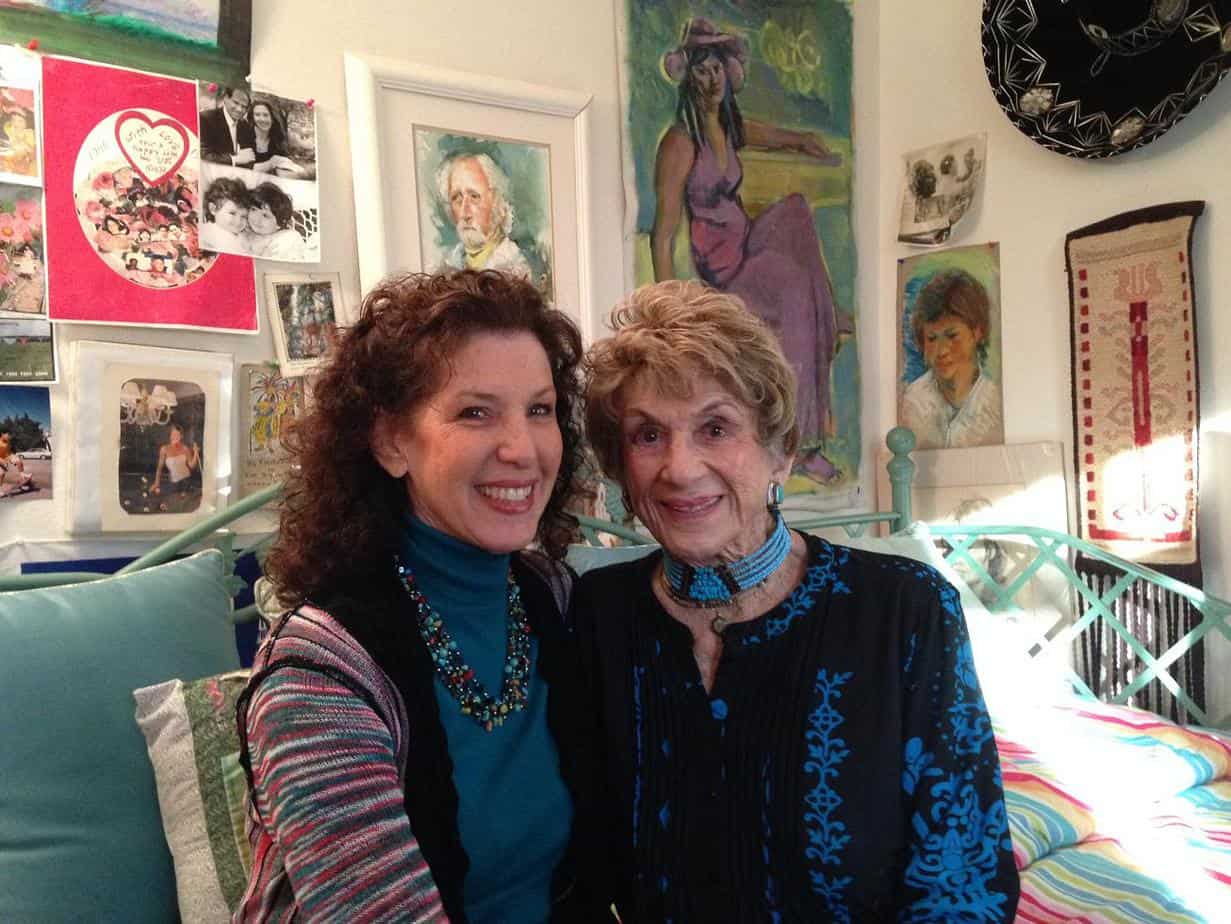
Walking into 95-year-old Holocaust survivor Nika Fleissig’s home in the Village of Oak Creek, one is immediately struck by the artwork on the walls: More often than not filled with color, exuberant, but now and then somber, cast in muted tones, they are in the majority Fleissig’s own work, a testament to decades of self-expression.
“I never saw a blank wall till I went to college,” said Jewish Community of Sedona and the Verde Valley Rabbi Alicia Magal, Fleissig’s daughter. “Nika has an incredible zest for life and is a magnet for adventure. She leaves the house and returns with a new friend. Her positive attitude, sense of humor and innate wisdom make her really inspiring to both young and old people. She always, always dresses in beautiful, colorful clothes and has a distinctive style all her own.”
Fleissig, a resident of the VOC since 2008, is the polar opposite of timid when it comes to communication, especially when she speaks about aging and living in Sedona — a thing she not only does with verve on her blog, Life Begins at 90!, but with equal energy in person.
“I thought I’d be bored to death here, but it’s the most exciting time of my life,” Fleissig said as she gave a tour of her art studio, its walls plastered with artwork and photographs. “Age has nothing to do with a number. I do everything with passion. Nothing stops me if I want to do something.”
“She can do everything. She’s a hard act to follow,” Magal said.” She has influenced her children, grandchildren and all who meet her to rethink their priorities and get in touch with their passion.”
After coming to the United States in 1946, having hidden her identity to escape detection during the Holocaust, art became an outlet for Fleissig. Her mother — who told Fleissig at a young age that “everything can be taken away from you” and emphasized that all a person really needs resides in her mind — seemed to have predicted both the Holocaust and her daughter’s own way to recovery from its immense trauma.
“Art saved my sanity, such as it is,” Fleissig explained, describing the years she spent acclimating to the culture of the United States as difficult on more than one level. The people she encountered, while friendly, knew nothing of what she and her fellow European Jews had gone through. Fortunately, she eventually found a mentor, a man who offered to teach her to paint. In this way, through the revelation of art, she “started to breathe again” and trust others.
After five years, she “woke up” and started to live again. Artwork became a way of life.
“It was heaven,” Fleissig said of the first years learning to express herself through painting.
The Holocaust will always be a part of her life, Fleissig added — both as an enduring memory and as a topic she addresses publicly.
“Nika gave testimony of many hours to the Shoah Foundation project in 1997,” Magal said, adding that the experience prompted new relationships, new connections with other survivors and sympathizers. “She treasures friendships and is saddened by the loss of nearly every single one of her childhood friends. A few were saved by being on ‘Schindler’s List’ and most ended up living in Israel.”
German industrialist Oskar Schindler saved the lives of 1,200 of his Jewish workers in Poland during the war.
“She was asked to speak to school children on Nantucket, and did so in 1998, remaining a friend of that teacher all the years since,” Magal said. “It was difficult to speak, and caused her to have nightmares and relive horrific scenes from the war for several nights afterward, but her grandchildren encouraged her to speak to other young people. Since then, Nika and I have spoken as a team in Mingus [Union] High School and St. Joseph’s school in Cottonwood, on Holocaust Remembrance Day at the Jewish Community in Sedona, at presentations in Wellfleet, Mass., and in 2013 in Krakow at museums, a newly formed cultural dialogue center, at the new Jewish Community Center and a growing Reform Jewish congregation in Warsaw.”
Fleissig and Magal admitted that doing each talk is difficult but important, especially as the number of survivors diminishes.
“A live person makes a much greater impact than pages in a printed history book,” Magal added.
“I never know what I’ll say until I see them,” Fleissig said when asked what she will say during an upcoming talk at Verde Valley School. “Whatever I say, I don’t mince words.”
Despite uncertainty about the exact wording, one thing is clear to Fleissig and anyone who hears her speak: She knows the values and wages of growing older — of living in the most exciting time of one’s life, doing good in the world through art and education, but also knowing the limitations of the body.
“I’m studying growing old — what it is,” Fleissig said.


