
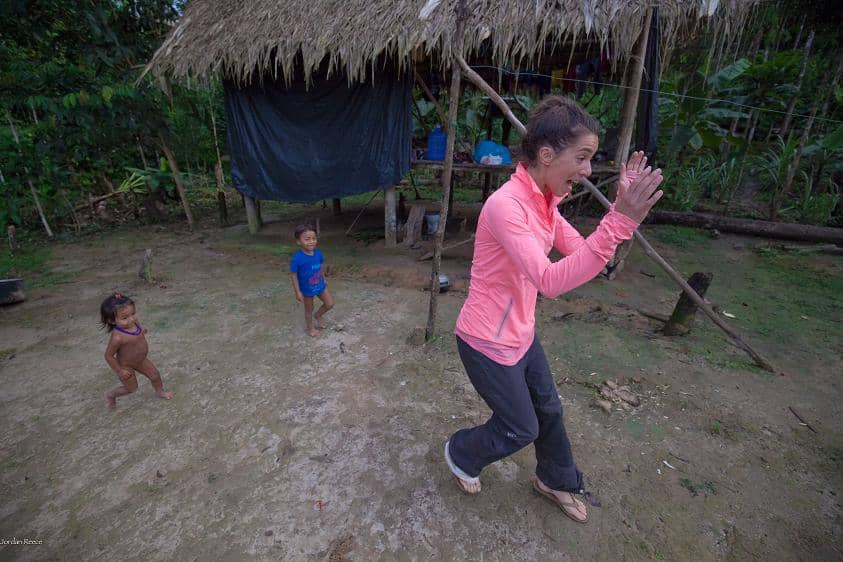
Sedona photographer Jordan Reece has long been passionate about the tenuous future facing the Amazon rainforest, its indigenous people and wildlife. His interest began as a child with an aquarium his father gave him and the exotic species of fish that originated in the rain forest area, many of which are now extinct.
Last month, however, he witnessed firsthand the tragic decline of the vital ecological area when he and his wife Beth traveled to the Ecuadorian jungle. While there, he also was struck by the absurdity of the situation during a visit with a tribal chief.
He had been told that the corrupt government has been ignoring pleas for conservation and granting increasingly more access to oil companies, who in turn attempt to bribe members of local tribes — who by law are entitled to their ancestral lands — to leave.
While at the chief’s home, Reece saw a television, DVDs and large speakers — not unusual for most homes, except that the jungle hut had no electricity.
“An asinine bribe attempt,” Reece said, shaking his head.
The challenges to the rainforest, however, extend beyond the oil companies, which obtain large tracts of land and clear them of vegetation, according to Reece, who traveled to Ecuador to “document the Huaorani people and their home in the Yasuni National Park,” one of the most biologically diverse places on Earth.
“I want to show how the people, wildlife and beauty are being devastated by the oil companies as well as the corrupt government, illegal poachers, deforestation and gold mining,” he said.
“I wanted to go to be able to walk there. To see, feel, taste the full experience instead of just reading about it in a book.”
The tour company that took the Reeces into the jungle works to make people aware of what the oil companies are doing and promotes conservation. It shares its revenue with the local tribes. Only 50 people per year are permitted into the area, Reece said.
The couple’s trip, however, wasn’t just an examination of the ongoing environmental degradation of the rainforest. They took the time to appreciate what makes it worth preserving.
The trip was Beth’s gift to Jordan based on a wedding promise they exchanged: That they would support one another in pursuit of their respective bucket lists.
They spent about two weeks in Ecuador, flying into the capital city of Quito on June 17. After a few days, it was on to Coca, a provincial capital located at the Amazon rain forest.
From there, they were driven to the edge of Yasuni, got clearance from local police and joined several other visitors, a guide/translator — Spanish was the primary language but there also were tribal languages — and the son of a chief, who acted as a sort of escort/protector in regard to other tribes that may not have been so open to outsiders.
The group spent three days paddling inflatable kayaks down the Shiripuno River, trailed by a motorized boat that carried a cook, food and other supplies. The boat purposely lagged far behind as not to disturb the wildlife that the Reeces and others were there to see.
They slept in little huts along the river each night.
To read the full story, see the Wednesday, July 22, edition of the Sedona Red Rock News.