

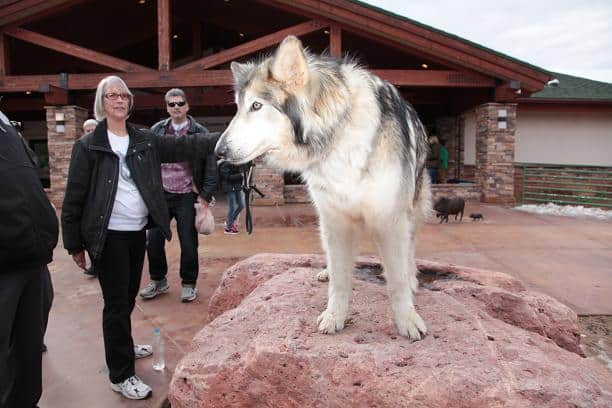
A good way to begin to understand a wolf’s intelligence is to take a dog’s brain and increase it by 30 percent.
“Wolves have very complex social behavior,” Jeff Dolphin said to a packed crowd at the Red Rock Ranger District complex, Friday, Jan. 9. Compared to coyotes, which begin living and breeding independently after only six months, wolves are bound together in unique social structures that last throughout their lives. Though each individual weighs less than 100 pounds, a pack of six is able to bring down half-ton elk using sophisticated hunting techniques.
Due to their complex intelligence — not to mention an impressive set of teeth and a bite producing 1,200 pounds of pressure — the wolf is an apex predator that often finds itself at odds with mankind. It has long been cast in fairy tales as a malicious force. According to Dolphin, there is still a strong anti-wolf contingent in the United States.
“We have to be very careful with the information that is distributed out there,” Dolphin said. “A lot of anti-wolf propaganda says 200-plus pound wolves kill elk.”
As field team supervisor for the Arizona Game and Fish Department, Dolphin directly oversees the project to reintroduce the Mexican Gray Wolf into Arizona and New Mexico.
To read the full story, see the Wednesday, Jan. 14, edition of the Sedona Red Rock News.


