















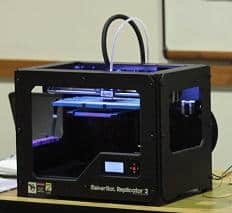
At the Sedona Public Library on Wednesday, residents witnessed Chris Guerra show off the novelty of 3-D printing.
Most 3-D printers, especially those for private or educational use, print items with plastic. While some may see the use of this non-renewable resource as a technological dead-end, such printers use this material because of its pliability and relative ease.
As the technology grows and develops, 3-D printers will start to use metals, clays, glass, organic matter and perhaps one day human tissue.
Although 3-D printing currently is limited, the implications for our future are boundless and the first leaps forward are already being made. In 2015, SpaceX will launch a rocket, its Dragon module. Its liquid rocket engine — made from a nickel-chromium-based superalloy designed to resist the intense heat of liftoff — was 3-D printed to specifications, as well as was the nacelle that houses the engine.
A mote of dust from human interaction can ruin the specialized lenses for giant telescopes, but a lens can be printed and sealed up in a vacuum, preventing blemishes from ruining images from across the cosmos.
With biological matter, 3-D printers already create food from pasta and chocolate. In the future, rather than slaughter animals for meat, 3-D printers could take protein and nutrients and create a healthy meal for our increasing human population. Vast swathes of land used for grazing or animal farms could be reopened to the wild and those inside cities could be built on to make room for human habitation. While the vision of vats of reconstituted protein creating Soylent Green-brand “chicken” nuggets may seem repugnant, our species is quickly running low on resources to survive and 3-D printing offers us a reprieve.
Using human tissue, 3-D printers could build replacement organs for those affected by trauma or disease or print skin grafts for victims of burns, gunshot wounds or car accidents.
Breaking down our waste products into reconstituted protein and biological material has long been proposed by scientists and science-fiction writers as the only way to survive on the Moon or Mars where there is no organic matter yet. Food replicators on “Star Trek” use this same theory. As our species makes long voyages to nearby stars, colonists could “reprint” what they already have rather than bring along 30 years worth of one-time-use food.
Like any technology, 3-D printing has the potential for abuse.
The U.S. Department of Homeland Security has already warned about the risk of people using 3-D printers to print gun components and firearms, which if made from plastic could evade metal detectors. Nations with strict gun possession laws have also noted large numbers of downloads for 3-D firearms.
A virus or biological agent could be added to an organic 3-D printer and used to kill. People could use 3-D printers to manufacture clones, build weapons or armies. Science-fiction is full of explorations about the abuse of our creations. Technology does not have a moral compass — that exists solely with us. How we choose to use the technology we create reveals who we are as a species.