














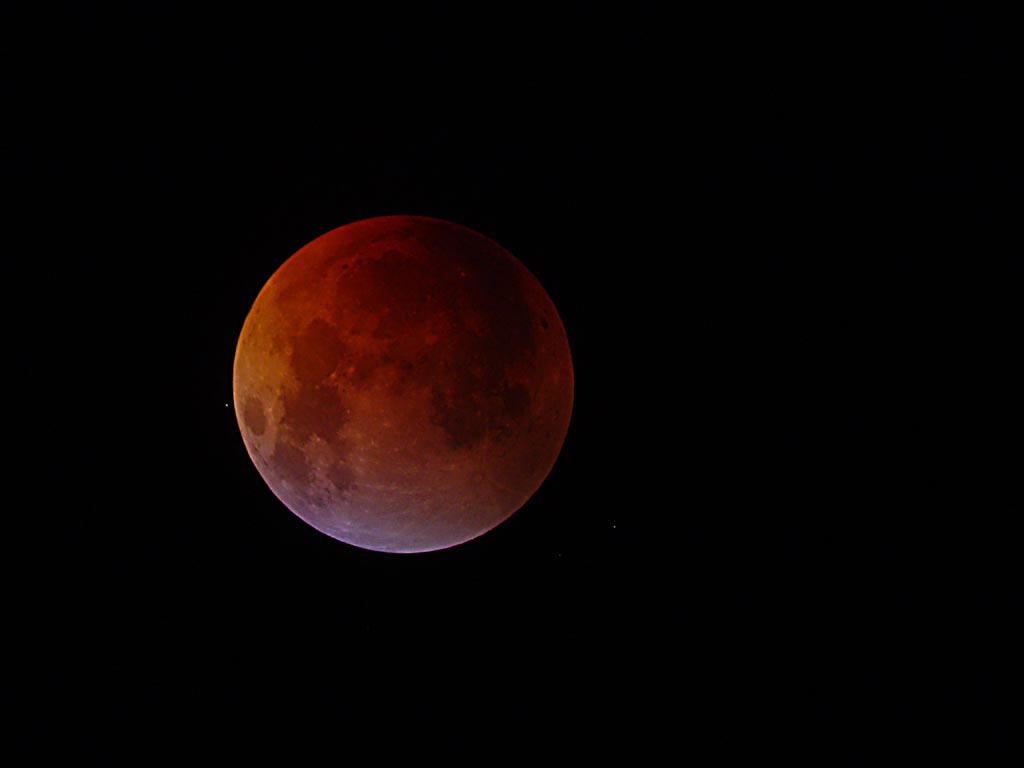
On Monday, April 14, the Western Hemisphere was treated to a rare blood moon, a total eclipse of the moon as it passed through the Earth’s umbra, or shadow.
If the Earth had no atmosphere, the moon would be pitch black in the night sky as it passed through our umbra. However, because of our planet’s atmosphere, longer wavelengths of the sun’s light — i.e., reds in the color spectrum — refracts through it while shorter wavelengths — yellows, greens and blues — are deflected, meaning the moon is cast in a beautiful blood red.
 For those of us in Arizona, the eclipse began just before midnight, as the moon moved between the planet Mars and star Spica in the constellation Virgo. I got nearly a dozen text messages from friends in Sedona, the Village of Oak Creek and Flagstaff reminding me to go out and see it.
I stepped into my backyard in West Sedona several times Monday night and early the next morning to see the moon rising high over Airport Mesa. The experience was surreal — the typically dull white and grey moon was a bright red, almost appearing like an entirely new object in our night sky.
Celestial events like eclipses remind us of our tiny place in the grand scale of the universe.
I have been in love with the stars and science ever since Halley’s Comet passed Earth in 1986, when I was a boy. My parents made sure my brother and I were able to see it through a telescope, knowing it would not come again until 2061, when I would be in my early 80s. When the comet last passed in 1910, my great-grandfather was also just a boy about my age.
In June 2012, I went to Sunset Park to watch the transit of Venus and shared the viewing shades with fellow Sedona residents.
The next transit of our sister planet won’t take place again until 2117, long after most of us are dead, transformed into cyborgs or living in lunar colonies in cloned bodies, so seeing such a rare phenomenon is more than a once-in-lifetime experience.
Placed in the timescale of centuries makes us contemplate our species’ survival and planet’s future in the extreme long term.
What changes will occur the next time Halley’s Comet arrives or Venus passes between Earth and the sun?
Will the human species be facing the final death throes of our self-extinction or exploring the inner solar system in colonization vessels?
For those who missed Monday’s blood moon total eclipse, fear not. This eclipse is actually part of a series, known as a tetrad, of four lunar eclipses with no partial eclipses between them. The next blood moons will pass over our skies on Wednesday, Oct. 8, Saturday, April 4, 2015, and Monday, Sept. 28, 2015. Witness what beauty the universe has to offer.
Christopher Fox Graham
Managing Editor