










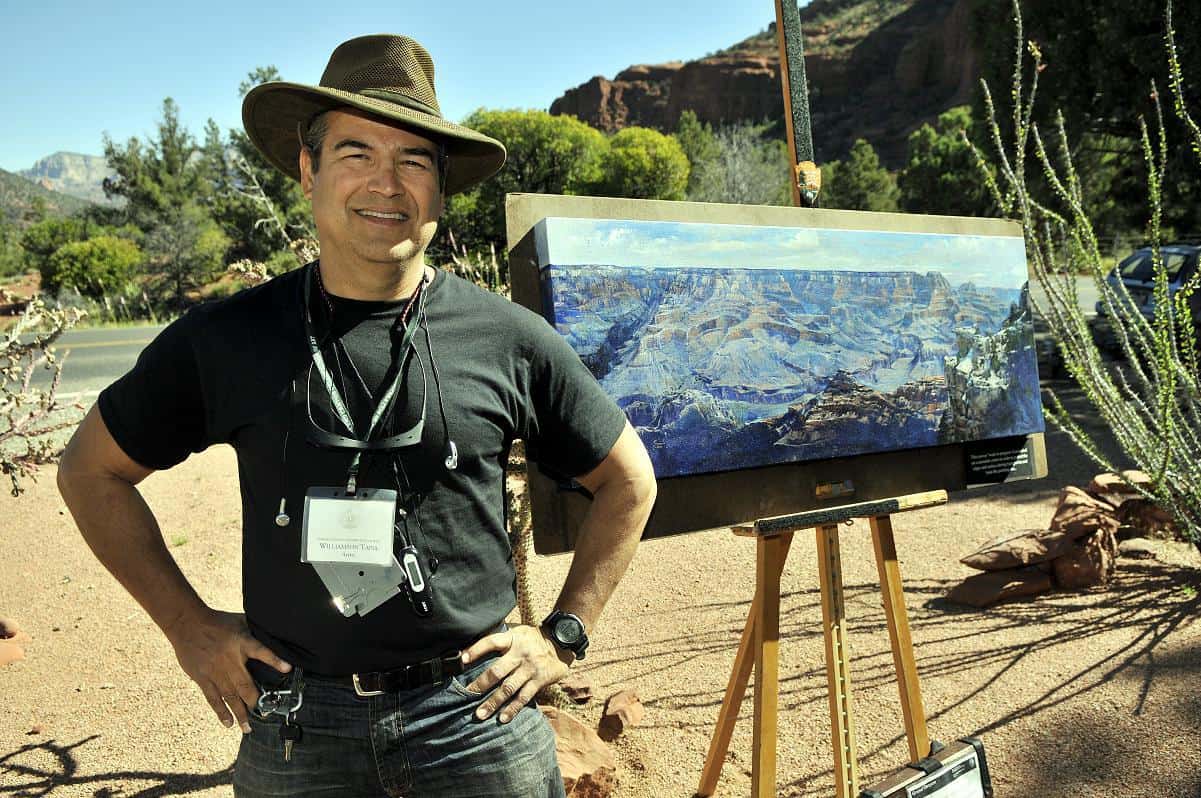
Sedona painter Will Tapia recently experienced a first although he has painted at the Grand Canyon for years.
The National Parks Service chose Tapia to be the South Rim Artist-in-Residence in March, which made him the first American Indian artist to do so. He said even more important was the opportunity to work in relative comfort while demonstrating for and sharing with the visiting public as he painted.
“To me there is no better source of inspiration than our natural world, in its natural state,” Tapia said. “I have found no better teacher of nature exists for an artist, like myself, than to commune and interpret directly with the landscape.”
Tapia is a plein air artist and is passionate about painting beautiful, natural subjects just as he sees them with his naked eye.
“The challenge of bringing home compelling studies directly from what I see with my own eyes and nothing else is the most satisfying experience I have ever known,” he said.
Tapia came from an artistic Yaqui family. He was born in Phoenix and grew up in Glendale. His grandfather sculpted and painted masks for the clans in Tucson, and his mother painted in oils. Tapia’s inspirational mentors continued through high school and college. Other influences include John Constable; Michelangelo Merisi da Carvaggio, a 16th century Italian artist; Thomas Moran; Frederic Catherwood; Camille Pissaro and Gunnar Wiforss.
After graduating from Arizona State University’s Fine Arts College in 1983, Tapia went into corporate work for seven years creating slide presentations for business meetings.
He moved to Sedona in 1995 where he expanded his color palette and taught at the Sedona Arts Center. He also sat on the board of directors.
“Color. That’s the primary reason I moved to Sedona. There is a wide spread of color in the landscape and it’s still pristine,” Tapia said.
Another inspiration for Tapia was the Grand Canyon. He first saw the natural wonder as a young man and became a Grand Canyon National Park Junior Ranger at the age of 11.
During his residency, Tapia met with some youth also preparing to take their oath as junior rangers.
“I could often hear them through the floorboards at Verkamp’s,” he said. Tapia stayed in an apartment above the Verkamp’s Visitor Center during his three-week residency.
“My favorite experience was always nearing the end of a work when what I produced literally drew passersby to stop and comment,” Tapia said. “To stand at the precipice of the Grand Canyon where all the world converges to celebrate what is natural and good on our planet is an incomparable experience.”
Tapia began and/or completed about two dozen studies while working around the less predictable aspects of the March weather and the changes in light.
“As you’re looking, you’re interpreting even as the light changes. It is a challenge, but you lose something when it’s static like in a photograph. It has some sort of pulse as you’re looking at it,” Tapia said.
What he enjoys most is painting toward the end of the day when the sun comes in at a low angle, especially in Sedona.
“Our red rocks almost go up in flames, they get so red. It’s really great to see it and capture it in paint,” he said. “You paint memories. I love looking at them. It brings the experience right back to me.”
The sunset’s light gave Tapia his “definitive” study in his Grand Canyon residency creation “Sunset at Yaki Point.” The painting will be part of the third annual Grand Canyon Celebration of Art show coming up in September. Tapia is one of five Sedona artists invited to the show presented by the Grand Canyon Association. The show features 30 artists from around the country who will paint plein air during the competition from Saturday, Sept. 10, through Saturday, Sept. 17.
The other Sedona artists are Gregory Hull, Michael Chesley Johnson, Joella Jean Mahoney and Curt Walters.