

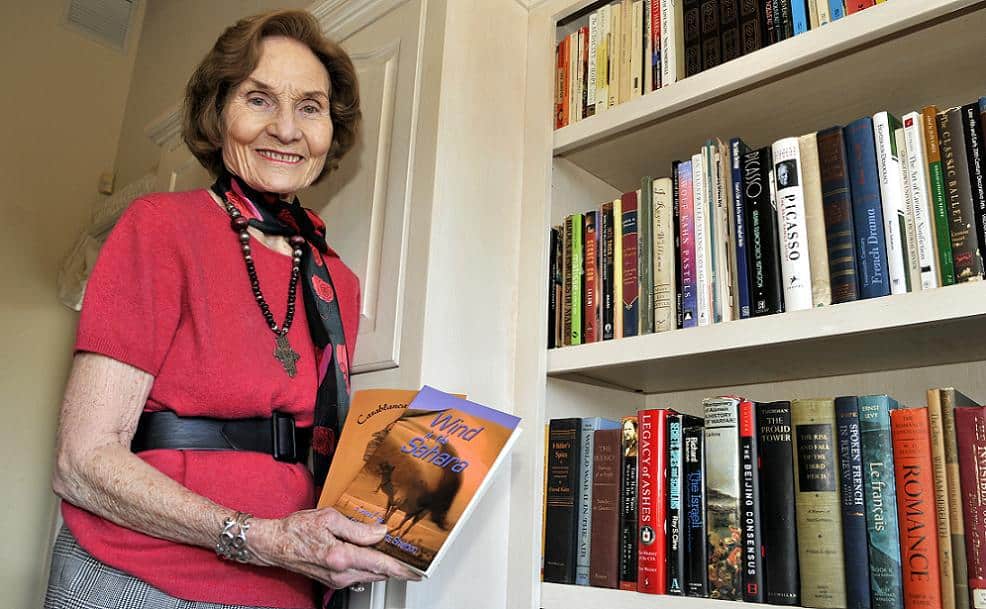
When Louise McDonald looked to see if the two books she wrote were being sold online, she was shocked.
“I think it’s crazy. They’re both out of print, and the one is selling online for more than $200 and the other one is $84,” McDonald said.
Both books are based on McDonald’s experiences in Morocco when she was a freelance correspondent there from 1975 to 1981. She covered the war for independence in the West Sahara, an area along the Atlantic Ocean between Nouadhibou in the south to the southern border of Morocco. The war lasted from 1975 to 1991. McDonald was the only American journalist, and the only female journalist.
“I worked there for [United Press International]. Morocco was great. I had to learn Arabic and besides the war, I wrote about the Atlas Lion. They didn’t exist anymore [in the wild], but the king kept a pride of lions. The Smithsonian got interested and took a pair and bred them,” McDonald said.
Morocco has always been a United States ally, she said, but in the beginning McDonald had to be OK’d as a correspondent and issued a pass.
“They laughed at me and said they had no time to talk to me, a woman. Then I mentioned something about Morocco wanting U.S. arms. All of a sudden I was treated like royalty,” McDonald said.
From then on they took her wherever she wanted to go. She wanted to go to the Western Sahara. They put her on an airplane with about 50 other journalists — all men. There were no seats so everyone sat on the floor for the long flight.
“The other Moroccans wondered why a woman was there,” McDonald said.
One thing that stood out in McDonald’s mind was the scenery.
“I’ll never forget the beauty of the changing hues of the sunsets as we flew low to avoid enemy fire,” she said.
In her books, which she wrote under her maiden name, Louise Roberts Sheldon, McDonald includes her Moroccan experiences. She also talks about the people, who she said are very beautiful and generous, especially the Bedouin people.
“I’ve been several times in Bedouin tents. They are very hospitable,” she said. “Even Muammar Gaddafi [leader of Libya] always lived in a tent. The Bedouin life was considered a higher order.”
Her first book was a collection of short stories called “Casablanca Notebook” published in 1998. McDonald also did the illustrations. The other book, titled, “Wind in the Sahara,” was published in 2002.
“It’s the oddest thing I ever heard, books selling online for so much. They’re still available at a bookstore here in Sedona,” she said.
McDonald has a long history of being a correspondent abroad. She studied abroad in Mexico and Switzerland where she learned Spanish and German, respectively. After graduating from Bryn Mawr College, cum laude in German literature, she went on to California State University for a master’s degree in French literature, adding French to the languages she can speak. McDonald also picked up Russian along the way.
“My mother was fascinated with languages, and I guess I am too,” McDonald said and chuckled. Throughout her career starting in 1952 at Life Magazine’s International Editions, McDonald has written articles that appeared not only in Life, but Smithsonian, Time, The Christian Science Monitor, Middle East Magazine, the International Herald Tribune and the Baltimore Chronicle in Baltimore where she and her husband, Bob McDonald, lived until they moved to Sedona a few months ago.
“I suffered terrible migraines, and we needed a drier place to live. We came out here and rented the house we’re in. My headaches are much better. I think we’re going to stay,” McDonald said and grinned.
Both McDonalds teach at the Osher Lifelong Learning Institute at Yavapai College Sedona Campus, something they also did in Baltimore.
Although McDonald and her husband retired, she said a writer never really retires.


