

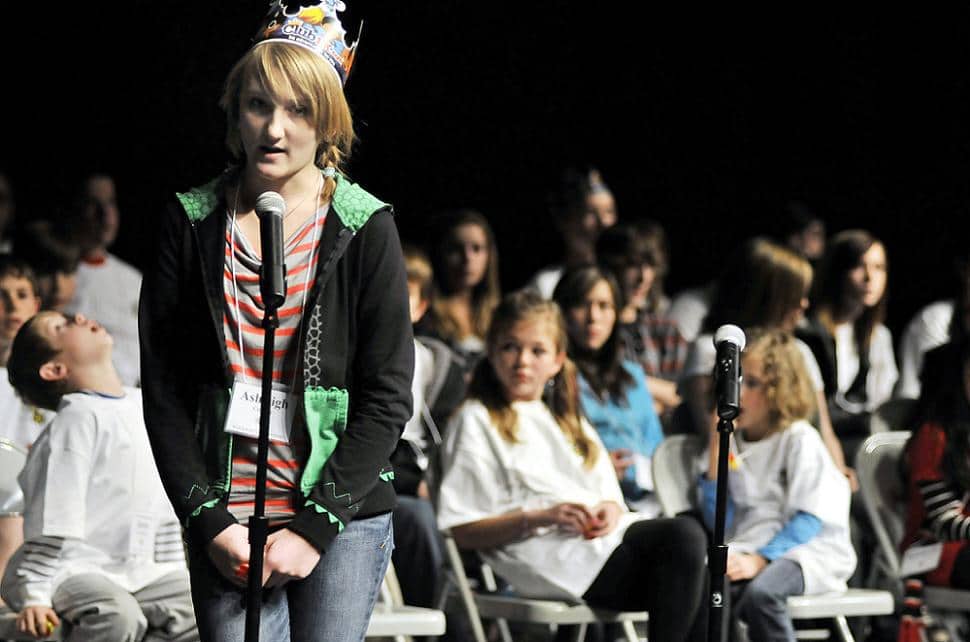
Sedona Charter School’s Connor Derby takes runner-up
After Rachel Feingold spelled the final word in the 65th annual Yavapai County Spelling Bee at the Sedona Performing Arts Center, she halted slightly on the “im” in “impetuous.”
When she heard the words, “That is correct,” from the judges, Feingold jumped into the air. The fifth-grade student at Abia Judd School in Prescott beat out 50 other elementary and junior high students from public, charter and private schools throughout Yavapai County in 19 rounds Feb. 16. This year was the first time the county bee was held in Sedona and Verde Valley.
Sedona Charter School’s Connor Derby, who is in the sixth grade, was the runner-up. The third-place winner was Ezekiel Pogue, an eighth-grade student from Mile High Middle School, and Shayle Mediano, a sixth-grade student from Mountain View Elementary School in Prescott Valley, took fourth place. Philip Eason from Camp Verde Middle School narrowly missed the top four when he spelled “blithe” with an “y.”
Each of the four winners received congratulations and a certificate from Yavapai County School Superintendent Tim Carter. They also received kid-sized hockey sticks from the Arizona Sundogs.
Spelling bees have a long history in the United States. In 1925, the Louisville Courier-Journal conducted a spelling match for boys and girls in all of Kentucky’s grade schools. In the next four years spelling bees spread across the country.
While some rules have changed and the vocabulary expanded over the years, the main purpose of the spelling bee is the same — to improve student spelling, increase vocabularies, learn concepts and etymology, and develop correct word usage that will last throughout students’ lives.
Of the 51 schools that participated in the county competition, 15 were located in Sedona and the Verde Valley, including Big Park Community School, West Sedona School and Sedona Charter School.
Robin Bascom, bee coordinator from the Yavapai County Education Service Agency, said spelling is still important despite online spell check programs.
“For one, it’s been a tradition for many years, and not everything is done on the computer. Plus we don’t want to lose the ability,” Bascom said.
Carter agreed.
“Spelling is the basis of our language and how to read. Words are fun,” Carter said. “At a young age I was not a good speller, but once I learned I became much better at all of my subjects.”
Part of the benefit of learning to spell is knowing what the word means, where it came from and how to use it, he said.
Sitting in the audience watching the students spell the words given by JoLynne Richter, the bee’s pronouncer for 27 years, was a humbling experience. Many audience members learned some of the words people use every day are spelled differently than believed.
Some of the students missed words containing silent letters. If unsure, they could ask Richter to repeat the word, give an alternate pronunciation, the definition or the origin — information that may help with the spelling.
One girl missed the word “jaguar.” An alternate pronunciation probably would have helped, Richter said. The girl broke down in tears.
Feingold will go on to the state spelling bee Saturday, March 26, on the Arizona State University campus in Tempe. She will compete along with representatives from Arizona’s 14 other counties.
The winner of the state spelling bee will participate in the Scripps National Spelling Bee in Washington, D.C., in May.
Winning words in the national contest over the years include: “appoggiatura” in 2005, “vivisepulture” in 1996, “staphylococci” in 1987, “esquamulose” in 1962 and “insouciant” in 1951.


