

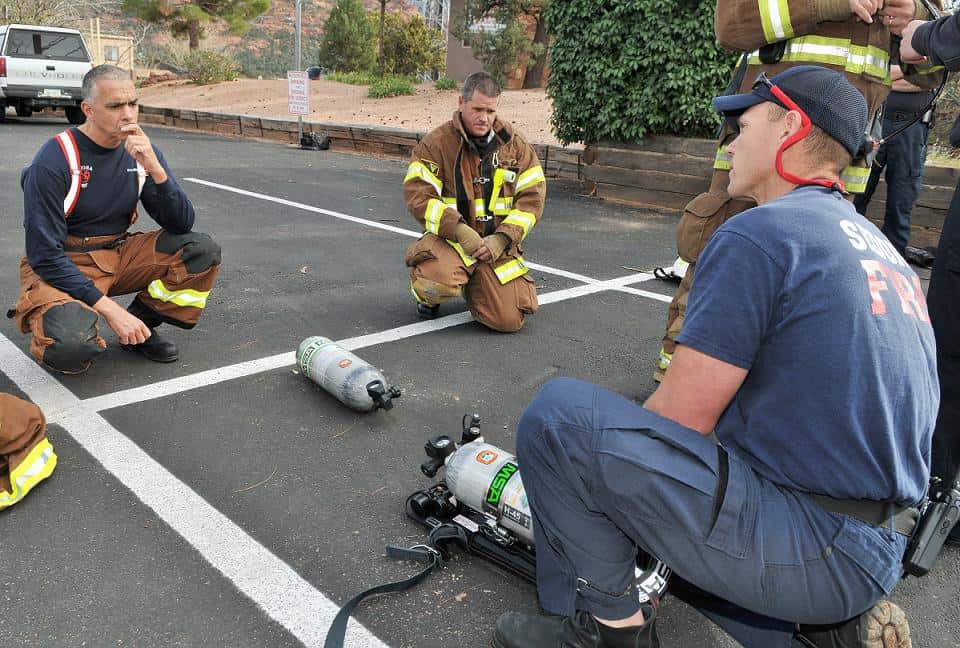
Crews with the Sedona Fire District are sporting new gear.
SFD recently purchased 60 new self-contained breathing apparatuses for the district, at a cost of approximately $332,000 for the units and associated accessories. The tanks have been in use for the last three weeks, according to Assistant Fire Chief Terry Keller. Firefighters have been training on the new equipment over the last several weeks. The packs were used to combat an oven fire Dec. 1 on Forest View Drive.
“The standard is to wear a self-contained breathing apparatus,” Keller said explaining the importance of the breathing apparatuses. “The reason why we do that, as a standard, is that any time you are operating in a contaminated atmosphere or an atmosphere that can become contaminated or oxygen deficient, or contain carcinogens or hazardous chemicals or anything else, you’re required to wear a breathing apparatus.
“Since the ’60s, fire services transitioned into breathing apparatus. The old days of a wet cloth over the mouth, or a big wet beard, like they used in the old days, are gone. The gear has gotten to a point where we can actually fight fires in a building now, and affect a firefight within the building, to protect a structure rather than have to fight it defensively from the outside.”
Every fire truck has one of the new tanks positioned at every riding position within easy reach of a firefighter. Apparatus training, Keller said, includes navigating a maze built into a semitrailer, in which firefighters crawl through wearing the packs.
“It’s been good training to actually get used to the packs, because you have to actually take them off, maneuver yourself through and still maintain your connection and your air supply as you go through,” Keller said. “You don’t want to be fumbling with these things when it counts; you want to be proficient with it through training before you really need to have it in a real fire.”
The district’s older tanks were purchased in 2001, Keller said.


“Our packs met that standard at the time, but because they were having challenges with adding electronics to something that went into such volatile environments, we had a lot of problems with those packs over the course of years between 2001 and now, issues with batteries failing, issues with electronic components failing, just a host of issues.
“There were two safety bulletins put out by the manufacturer on them, one recommending the pack be taken out of service, which kind of limits our operations if we don’t have a pack we can use, so we had a lot of challenges.”
Having a number of packs in need of repair, Keller said, meant fewer were available on the fire trucks for use. Having fewer self-contained breathing apparatuses also limited the safety options when it came to answering calls.
“We knew we needed to do something so we started looking at the market,” Keller said. “We actually bought the packs for about the same amount of money as what we paid back in 2001, a little more because we had a few more things in there, but considering the fact that the market is very competitive in Arizona right now to purchase packs we were able to get an extremely good price on those.”

“We used them in live fire evolutions, we tried them in different scenarios and crews got to use them and give their input and vote on them, with a variety of evaluation comments, and all of that was tabulated through a process,” Keller said.

Mine Safety Appliance, he said, came out as the favored provider following the process.
“They’re a large company that does a lot of breathing equipment for mining industries, but they have a subbranch that does the fire service. They’ve been a very popular brand in the fire service,” Keller said.
“They’re a state-of-the-art pack, actually the 2007 standard. The local vendor gave us extremely good pricing on that, because they wanted to maintain market share of that product in the state.”
Matt Fischer, a Sedona firefighter, is a trained self-contained breathing apparatus tech. He said the new packs, which include a personal accountability system, allow the battalion chief to monitor air flow for firefighters from a remote location.
“It has the ability to track,” Fischer said. “The BC [battalion chief] can tell the firefighters inside whether they need to get out or whether they can stay. If they have a low-air alarm, it will actually tell the BC in his rig that they have a low-air alarm, and he will tell them to get out. I love them. They are a lot more simple. There’s not 20 things we’ve got to disassemble to get to the one part that’s broken. These are a lot easier to work with.”


