

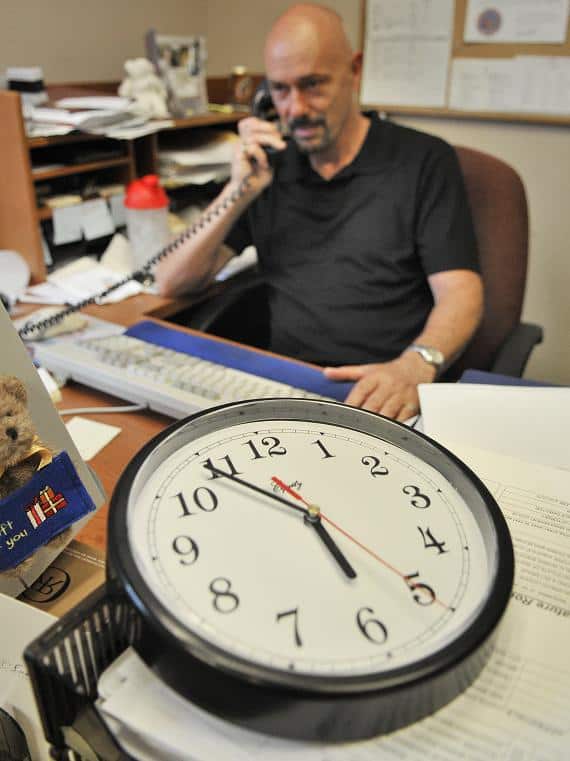
Mixed feelings is what Sedona’s city staff reports about its new summer workweek of four 10-hour days instead of five eight-hour shifts.
Several city staff members think the 10-hour work day is too long, and the extra day off might not be enough compensation.
City Clerk Randy Reed said he has mixed feelings about the new work schedule that ends Saturday, Oct. 9. His work schedule is 7 a.m. to 6 p.m. Monday through Thursday with an hour off for lunch.
“It’s been kind of exhausting,” he said.
Other cities in Arizona have already gone to a four-day workweek or are planning to in the near future.
After arriving home at 6:30 p.m., Reed walks his dog, and by the time he cooks dinner and cleans up, it is 8:30 p.m., not leaving much time to do anything else.
Fridays are not a free day either for Reed because he uses this day to catch up on personal errands he did not have time to do during the week. Saturday, however, is a wide-open day, since Reed is usually able to finish errands on Friday.
Even though Reed goes into work earlier now, he said he stays up later to finish chores around the house that need to be done.
Reed said he prefers the five-day a week work schedule, and he is not alone. He thinks most staff members agree with him.
While a 10-hour day may be too long for some employees, Reed said most would be OK with a nine-day 80-hour work schedule, where employees would work about nine hours a day for nine days before getting a three-day weekend.
Reed prefers working five days a week rather than working four long days, but also thought he was going to like the summer schedule until experiencing it.
“I thought we would get used to it, but I am not,” he said.
City Manager Tim Ernster said the overall response has been positive, but he realizes a 10-hour workday is a long one. The question is whether employees want the extra day off for working longer days.
“By the time it is 6 p.m., it is a long day,” Ernster said.
Getting feedback from the public and employees is what Ernster wants to compile on the test schedule after it ends in October.
He said the city will look into all options for future summers, including working close to nine hours a day for nine days and getting a long weekend every two weeks.
He said one member of the public came forward to thank the city for the summer hours because it enabled him the time to do business with the city since the clerk’s office stayed open later.
If Sedona institutes some type of summer hours next year, Ernster said it will be from Memorial Day to Labor Day.
Sedona contacted other cities in Arizona that changed to a four-day workweek to get their input, and 95 percent of the feedback was positive, Ernster said.
Some staff members do not like the new schedule because the increased hours make it tough to find childcare or go to the gym after work, he said.
In an attempt to help employees, the city was able to get discounts for them at the new Cottonwood Recreation Center.
“People are adjusting,” Ernester said.
Police officers, wastewater plant workers and the parks and recreation maintenance staff are not included in the 4-day workweek schedule, Ernster said.
The city will go back to the typical five-day eight-hour shifts in October, and Ernster said opinions of employes will be paramount in his decision for next year.
The Sedona-Oak Creek School District also went to a four-day workweek in June and July for summer employees.
Superintendent Mike Aylstock said some employees liked working longer hours to get three-day weekends.
The thought was to give summer employees three-day weekends, which everyone likes, he said.
A survey will be sent to the summer employees to get their input on whether to do this again next June and July.
The school district was also able to shut down its buildings for one weekday in June and July, and he is waiting to see those savings, but he does not think it will amount to much.
The city anticipates saving about $20,000 by going to a four-day workweek for three months.


