

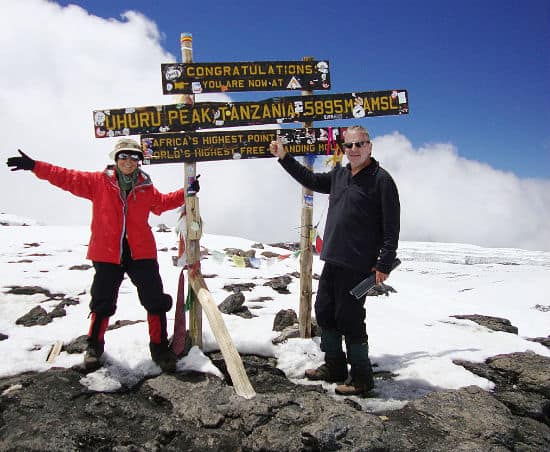
Woman wanted to do the climb while she is still in shape
Part-time Sedona resident, Helga Ausman, 78, didn’t think about George Mallory’s 1924 retort to the question, “Why do you want to climb Mount Everest?” as she began to ascend the slopes of Mount Kilimanjaro.
Mallory’s response is probably the most famous quote in mountain climbing — “Because it’s there.” He is said to have spoken the words just prior to planning his first attempt to conquer the world’s tallest mountain peak at 29,029 feet.
He and his climbing partner, Andrew Irvine, disappeared on the north slope some time during their expedition. Mallory’s body was discovered in 1999, only a few hundred meters from the summit.
Ausman was not among the first to attempt Mount Kilimanjaro, but she is reportedly the second-oldest woman to reach the 19,340-foot summit and return under her own power.
“Nothing happens by coincidence. Someone up there is pulling the strings,” Ausman said. “Even this Kilimanjaro thing — it’s a fabulous story, how it came about.”
Ausman is an avid hiker. She joins the Sedona Westerners hiking group whenever she is in Sedona and has hiked most of the surrounding trails.
When she is not in Sedona she spends her time between Austin, Texas, and San Francisco. She has grandchildren in both cities.
About four years ago, Ausman decided to go with a group to hike near Mount Shasta in Northern California but ended up climbing the mountain.
“I was surrounded by experienced mountaineers. I was a hiker and ended up with them by accident. I got with the wrong group,” Ausman said. “They helped me reach the top. The whole time they talked about Mount Kilimanjaro and thought I should go. I told them I didn’t think I could do it.”
Well, the thought crossed Ausman’s mind several times over the following four years — until January when the mountain kept creeping into her life in various ways. Ausman had been to Africa many times but never climbed a mountain there.
“I decided I’d better go while I was still fit. Two weeks after I signed up they e-mailed me for a medical certificate stating that I was fit to go,” Ausman said and laughed. “I think it was just because of my age.”
Before leaving, Ausman had to buy several medications, including one for altitude sickness. A person can train physically but not for the altitude, she said.
“They told me about 16 people die every year on the mountain, but thank goodness I didn’t know that until I came down,” Ausman said.
The first two nights in Africa, the eight men and three women in Ausman’s group stayed in tropical-style lodges. Tanzania is only a few degrees latitude south of the equator.
The climb began the morning of the third day.
“They took us by Jeep to the trailhead outside of Moshi. Again, I told the leader I didn’t think I could do it. He said, ‘Don’t worry. You’re German and I’ve never had a German not make it to the top,’” Ausman said.
Most of the group were in their 40s, 50s and 60s. Ausman was the only grandmother so the porters nicknamed her “Bibi,” which means “grandmother” in Swahili.
“I was called Bibi for three weeks and they pampered me,” she said.
Ausman’s group climbed six to eight hours every day, and took seven days to go from the jungle to the snowy peak. Moshi in January is approximately 85 degrees. The top of Mount Kilimanjaro in January is from zero to minus 8 degrees at night.
Fortunately, the porters carried the major weight and a lot of food. Ausman said the group was very well fed because of the energy needed to climb the mountain.
“The higher we got, the harder it was to breathe and to walk. We barely took steps at times, but when we reached the top it was very spiritual. There’s snow and icy glaciers. It was 20 degrees and windy, but you had a tremendous feeling of accomplishment. Only about 40 percent make it to the top, and we all did,” Ausman said.
“Going down was much more difficult. First, you’re very weak and exhausted. Second, you want to go down as fast as possible, but that’s when it’s dangerous,” she said.
There is loose rocky debris on the mountain, increasing the possibility of sliding and falling while descending. The urge to descend quickly is strong but it can exhaust a person.
Back at the bottom, during an evening ceremony, each person was called by name to receive a certificate for a successful climb. When Ausman’s name was called, the porters hoisted her on their shoulders and danced around the lodge shouting “Bibi, Bibi,” Ausman said as she danced around her living room demonstrating what the porters did. “It was so heartwarming.”
Although the trip was physically exhausting — Ausman lost eight pounds — and expensive, climbing Mount Kilimanjaro was worth every sore muscle, labored breath and dollar she spent.
“Oh heaven’s yes, it was well worth it,” Ausman said and closed her eyes as she relaxed back into her chair.


