

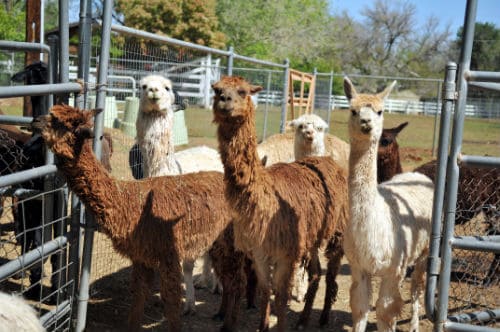
They are cute, luxurious to the touch and make good pets but most people who have alpacas have them primarily as a source of income.
It’s no wonder. The fleece, or fiber, can bring in between $240 to $800 per animal a year, depending on the quality and quantity of the fleece.
Combine that with the low cost of keeping alpacas — a bale of hay can feed one alpaca for 15 to 20 days — and a 20-year lifespan alpacas can be a good source of income. They are also not noisy, smelly or prone to try and escape.
According to the Alpaca Owners and Breeders Association, up to 10 alpacas can be raised on one acre. Jake and Helen Vannlipe have 19 alpacas and one llama on their ranch in Cornville.
“We started alpacas about 1½ years ago, although we’ve had llamas for about 10 years. We have them as an income, but we enjoy them too. About the only sound they make is a humming. We have one male who hums all the time.”
The big male llama, Alph, is kept as a guard to protect all the females.
“We don’t get critters in our yard,” Jake Vannlipe said, saying Alph ran off a deer recently. “Normally, they’re not aggressive, but llamas and alpacas are herd animals and will protect their own.”
Vannlipe’s brother, Gary Machesney, lives next door and said he has seen the herd in their protective mode.
“If a wild animal or even a horse comes too close, they all gather together,” Machesney said.
Vannlipe’s alpaca heard consists of eight dams [females], nine sires [males] and one runt male named Peanut, who is about half the size of the rest. Vannlipe called them all by name as he brought each animal to the shearing area Saturday, April 24.
“We’re shearing 19 animals today,” he said as he brought a reluctant Wyatt Earp from the pen. “He’s my wild child. I should have named him Doc Holiday.”
Every year the Vannlipes invite neighbors and friends to a shearing party.
Helen Vannlipe arranges for the food and usually makes homemade peach cobbler. They have several fruit trees on their ranch, including peach.
As Paul Sands, a shearing company owner, sheared off the fleece, Vannlipe clipped Wyatt Earp’s toenails. Alpacas and llamas are members of the camel family and do not have hooves. They have foot pads with nails growing on the top, similar to human fingers and toes.
“It takes about 15 minutes to shear one animal, and you shear them once a year,” said Sands, who travels throughout the state to shear alpacas, llamas and sheep.
Alpacas are probably one of the most domesticated of all animals. They are native to the Andes Mountains in South America, particularly Peru, Bolivia, Chile and Equador.
Unlike llamas, they were not bred as beasts of burden but strictly for their wool fiber for making knitted and woven items. It is highly prized for its silkiness and lack of lanolin, which make it hypo-allergenic.
Alpacas are one of the easiest and most inexpensive animals to maintain, according to the Alpaca Owners and Breeders Association. One alpaca will eat one half-flake of hay a day. A bale of hay, depending on its size, consists of 10 flakes. Alpacas are efficient eaters because they, like cows, are ruminants and have a four-chambered stomach, which requires less food than most animals their size.
“Normally they graze on grass in the pasture, but when we do feed them hay it’s Timothy or orchard hay. Alfalfa is too hot for them, and many plants are poisonous to them such as oleander, agave, ragweed, calla lily, carnations and broom snakeweed,” Vannlipe said.
Alpacas are essentially hardy and healthy animals, toughened by 5,000 years of life in the hostile environment of the high Andes. They can tolerate almost any winter that may come to the Verde Valley, but they require protection from the summer heat and sun as well as a continuous supply of clean, fresh water.
The Vannlipes have several large trees near where the alpacas are kept and a covered shed large enough for them to congregate.
Although alpacas have been around in South America for millennia, they were relatively unknown in the United States until 1983 when a small group of American importers brought a few to the United States. They come in two breeds: Huacaya and Suri.
Alpaca fleece is graded by the fineness of the fiber. The finer the fiber, the more valuable, Vannlipe said. Ancient Incas called the fleece “fiber of the gods.”
“I haven’t sold any of the fleece yet, but I’m going to send some in for testing,” he said.
What Vannlipe plans to do with the fleece this year is an experiment to insulate his office. The fleece is very dense, so he is going to see how it works.
“It could be very expensive insulation,” Vannlipe said.
While alpacas are a shy, Vannlipe said he is working with Peanut to make him a mascot.


