













Ahhh, the comfort of nestling into bed after a long day to sleep for the next several hours is a welcome treat.
Yet, nearly 100 million Americans wake up feeling as tired as when they went to bed, according to sleep research studies. Most people who do not get enough, or inadequate sleep, reach for coffee or an energy drink to get through the day.
“If your sleep isn’t good, your next day isn’t so good either,” Verde Valley Medical Center’s Northern Arizona Sleep Center physician Dr. Donald Curran said. “A person who does not get good sleep becomes lethargic, irritable and gets excessively sleepy during the day.”
Stella Crozier had all three symptoms. Crozier thought she just had to live with it, until her husband convinced her there was a problem.
“I was exhausted, plus Rory told me I was snoring terribly and would stop breathing,” Crozier said.
Crozier decided she should be tested. Her primary physician recommended the sleep center.
“[Curran] worked really hard with me and made me feel good about the study and took me through the center,” Crozier said. “It’s very homey with a TV and your own private bathroom, just like at home, and a comfortable double bed.”
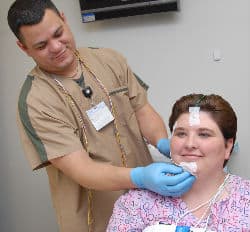
In the first two hours the sleep technicians who monitor the clients saw the problem. Crozier did, indeed, suffer from sleep apnea, meaning her breathing stops during sleep.
When Crozier’s problem was discovered, the technicians fitted her with a Continuous Positive Airway Pressure Machine, or CPAP. The machine, through a mask, delivers room temperature air through the nose and mouth. The client gets more oxygen into the lungs. The brain requires oxygen, and when it does not get it, the brain wakes the body to breathe, but the person does not know it, Curran said.
“After the machine, I had the best four hours of sleep I’ve had in years,” Crozier said with a smile and a sigh.
Sleep apnea is one of several sleep disorders. Others include insomnia, narcolepsy, limb movement disorders, such as restless leg syndrome, and parasomnias such as sleep walking, sleep talking and teeth grinding.
Several factors can cause abnormal sleep such as noise, light, a different location or bed, work schedule, medications, psychiatric disorders, medical problems and hormonal fluctuations.
Symptoms of sleep disorders include: excessive sleepiness or fatigue while awake, difficulty sleeping, loud snoring, pauses in breathing, difficulty concentrating, irritability or depression, morning headaches, nighttime leg discomfort, weakness, sleep walking or sleep talking.
Crozier has used the CPAP for about 3½ weeks now and can tell a huge difference.
“I don’t get as upset over little things anymore and I have a lot more energy — and I feel awake all day,” Crozier said.
The VVMC Sleep Center opened in summer 2008, but the hospital has been doing sleep studies for more than 10 years, Northern Arizona Healthcare Media Relations Coordinator Starla Collins said.
The center has four rooms with a separate observation area operated by board certified sleep technicians. The center’s manager is nurse Janelle Anthony and two physicians certified in sleep medicine: Curran and Dr. Jeffrey Arnold. The center can perform 24 sleep studies per week, six nights each week.
While some people regard sleep as unproductive down time, Curran said research has shown adequate, quality sleep is necessary for renewing good physical and mental health.
Most sleep disorders can be treated. If a person suspects they have a sleep disorder, they should contact their primary physician.