







City-sponsored camp comes to Posse Grounds Hub July 20 to 23
The Science Vortex in Cottonwood, which recently celebrated a six-week summer program for students with the Cottonwood-Oak Creek School District, hosts three- to five-day public summer camps in Cottonwood and Sedona throughout the summer.
It had one public camp each in Sedona and Cottonwood, with two more planned for Cottonwood and one more for Sedona.
The July 13 through 16 camp for ages 6 to 9 at the Science Vortex in Cottonwood is sold out. The next one is scheduled for ages 8 to 12 from July 20 to 23. The Sedona camp, sponsored by the city of Sedona, is from July 20 to 24 for ages 6 to 9 at the Sedona Posse Grounds Hub.
Visit sciencevortex.org for more information.
During her first summer in the program — Camp Innovation, the sixweek summer camp for COCSD families — Cottonwood Community School second-grader Nora Millikan said finding water insects was her favorite part. She went on a field trip from the Science Vortex in Cottonwood to Tuzigoot National Monument.
“We found the ones that only like clean water use the water that’s clean,” she said during a celebration potluck on June 24.
These were macroinvertebrates, Science Vortex Executive Director Laurie Altringer said.
“They’re water quality indicators,” she said. “So they’re learning about water quality.
“The way we set it up is that they start learning about the Artemis missions. So, ‘what do you need to inhabit the moon, and then eventually Mars?’ ‘What would you need for a moon base?’ And, so, they come up with food, shelter, water, clean air or oxygen. And then they do experiments, and we shoot off rockets here and collect data, and then we bring it back down to earth and talk about ‘what do we need here on Earth?’”
The camp, which is primarily grades one through eight, took an additional field trip with its about 200 students to places along the Verde River for more hands-on learning about water.
Science Vortex
In addition to the summer camps, the Science Vortex at Cottonwood Community School is open weekly on Saturdays and Sundays from 10 a.m. to 1 p.m. for open play and exploration, Thursdays from 4:30 to 6 p.m. for family makerspace and Fridays from 10 to 11 a.m. for little learners STEAM time.
Anyone in Sedona or the Verde Valley is invited.
For 13-year-old Tanner Williford and his friend, 14-year-old Josiah Pirtle, the Thursday makerspace times are best. Williford likes to find ways to make cool shapes and sculptures.
“I cut up the cardboard and glue it together,” Williford said.
“I’ve got to come here more often,” Pirtle said during the celebration potluck on June 24. “I’ve been trying to get into cosplay.”
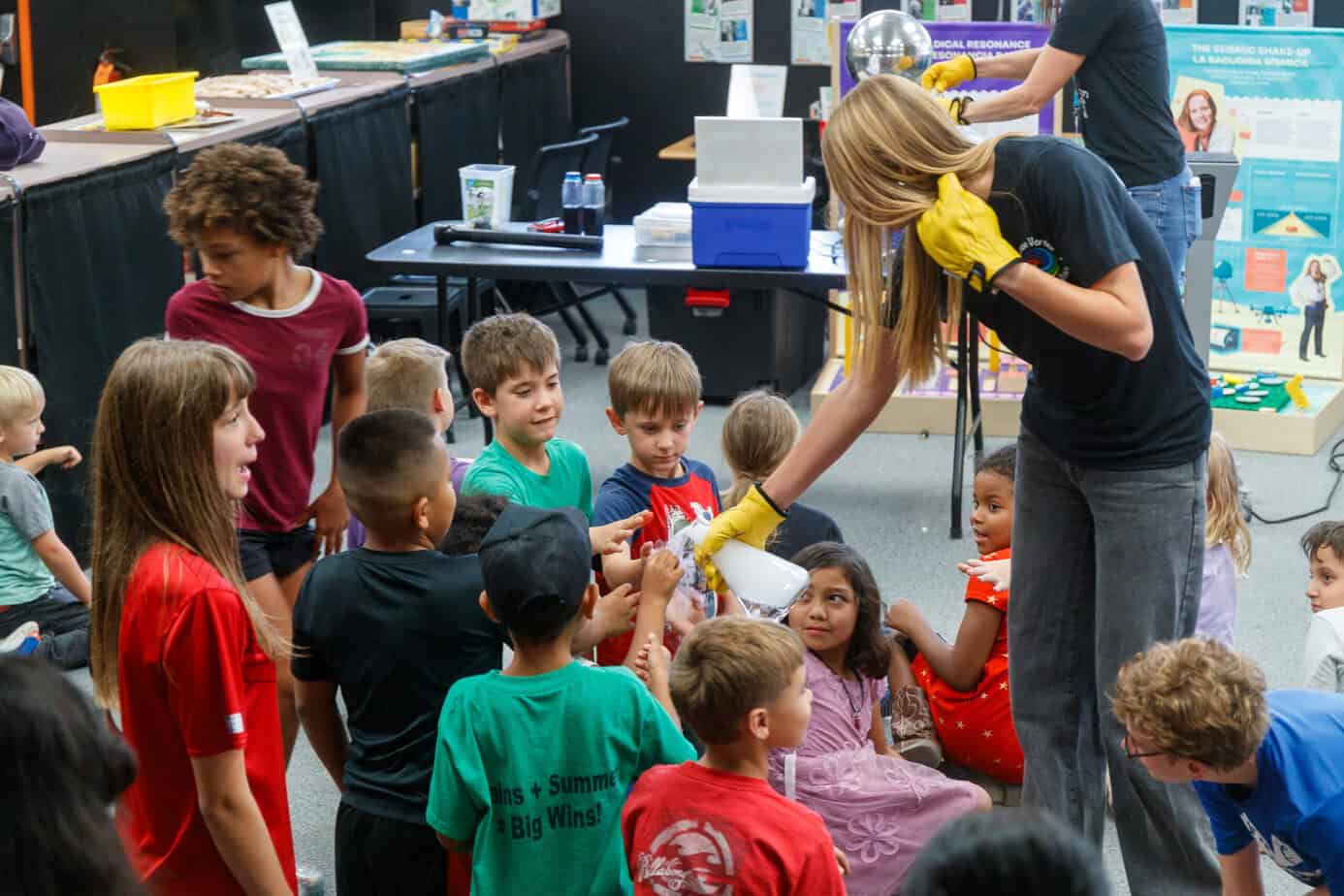
The Science Vortex also has demonstrations, mostly during its camps, on different science concepts.
During the June 24 event, Mica Altringer, Laurie’s daughter, held a lightbulb in one hand and had all the students form a circle and hold hands or touch elbows.
“When we turn the light on, it’s a closed circuit, and when we turn it off, it’s an open circuit,” she said. “So, for this circuit, we need a closed circuit, which means we all need to be touching.”
After the students completed the circuit and made the light bulb turn off, Laurie Altirnger asked for two students on the opposite side of the light bulb to separate, causing the light bulb to turn off.
Other demonstrations included dry ice smoking in water, a Van de Graaff generator showing off static electricity and transferring thermal energy from a flash light.
The 21st Century Program
The six-week-long Camp Innovation, in its sixth year, is run through partnerships with COCSD’s 21st Century Program and the Cottonwood Public Library.
“We don’t just function off of the 21st Century grant, we also use other grants, too,” said Teddy Armstrong, 21st Century Program coordinator. “That is the biggest grant that we use, but in all fairness, we like to just call it our afterschool program. We have about 200 after school programs district wide, that is not including athletics.”
The summer programs include working with the Science Vortex, Wheel Fun, the Cottonwood library and Mingus Union High School’s A Troupe of Ridiculous Thespians’ theater camp.
“We’re out at Oak Creek School, Laurie’s kids go there, and I was working with the principal at the time, ‘why don’t we just try to do our program at the vortex instead of trying to hire teachers who didn’t want their summers off,’” Armstrong said is how it started. “And then the next year we had another school under 21st and we were like, ‘how do we utilize the vortex still while we’re doing this,’ and now we have all four schools.”
Because of grant requirements, Camp Innovation is required to participate in a Summer Reading Program.
“They have a weekly visit with us to check out books, we got [them] all set up with a student card, so they could check out those books,” library Youth Services Supervisor Danielle Ave said. “They’re all coming, they’re utilizing the library.”
The Cottonwood library also hosts separate events related to the summer challenge throughout the rest of July, with bigger events particularly on Wednesdays and Fridays, Ave said.