










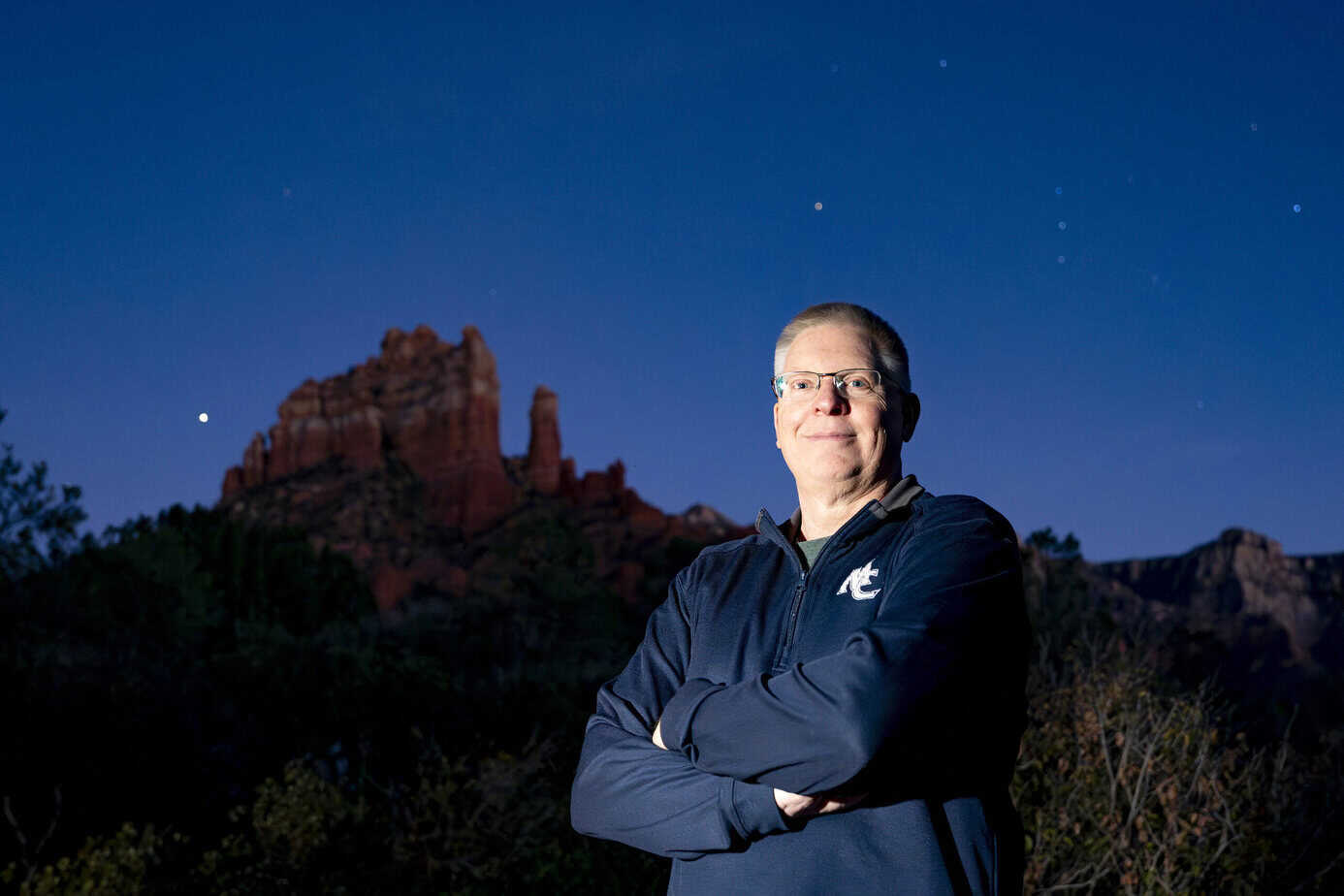
Lowell Observatory Historian and spokesman Kevin Schindler, 61, a Sedona resident for the last 18 months, will be presented with the The Friends of the Flagstaff Library Copper Quill Award in April for his body of writing spanning from his bi-weekly column “The View from Mars Hill” for the Arizona Daily Sun and his several books about the history of Northern Arizona.
“It’s been gratifying to share life and the universe around us through writing,” Schindler said. “I’ve always enjoyed writing, even though I don’t see myself as a creative writer so much as someone who presents the facts and tries to get people excited about the world around them. I think everyone should try to leave the world in a better place, and for me, being able to inform and excite people about the universe is deeply satisfying.”
From Earth to the Stars
Schindler is the son of Donald, a salesman, and Carol, who worked for the license bureau and later the county government. He grew up in Valley City, Ohio, about 20 miles from Cleveland. Schindler said he doesn’t remember getting sales tips from his father about selling the public on science.
“But I do remember him being really proficient at math,” he said. “In his downtime, he’d listen to ball games on his way home, then unwind with a [Louis] L’Amour novel. Years after his passing, my mom gave me his old books. Now and then I find his notes inside where he was adding something up.”
The American West, though, he said he got his first exposure to as part of Mr. Leget’s earth science field trip.
“We went to Colorado. I didn’t get out to Arizona until I was in college for a geology class,” the Buckeye High School Class of 1983 graduate said.
After earning his geology degree from Marietta College in 1987, Schindler spent several years working at Florida museums and historic sites focusing on paleontology before making his way to Lowell Observatory in 1995, where he started as a tour guide.
“We were neighbors,” Schindler said, about his wife, Gretchen. “I would drive home in this van we had that had planets on the side. Like, if I was doing an event in Phoenix, I would just come home, park it there for the night. And so she would see that, and I would give her astronomy posters and stuff like that. So I knew the daughter first and then got to know Gretchen.”
After they met in 1995, they started dating in 1997 and married in 2002.
Copper Quill Award
When he arrived at Lowell, he said couldn’t have identified the Big Dipper. But the lack of formal astronomy background became an asset.
“I kind of learned it on the job with the public,” he said. “I’ve always intentionally thought I’m explaining this for my mother or friends who don’t have the science background [by] making it appropriate for folks who don’t have a Ph.D. in astronomy or physics.”
Thirty years later, at Lowell, he said his enthusiasm has not dimmed, noting that, while some people might have thousands of photos of their cats, he is constantly taking photos of the telescopes.
“I’ve spent so much time in that telescope dome, but it still is fascinating,” Schindler said. “People comment on that a lot with me: ‘Oh, you must love your job.’ And, ‘Oh, you know, you’re pretty much as enthusiastic now as you were back then.’ It’s just, I think, you know, it’s fun to share and it’s fun to see people get inspired themselves.”
Schindler’s work days vary. He promotes the observatory by coordinating with media, arranging interviews with scientists and documenting both past and present research. He gives public presentations, writes extensively about astronomy and helps coordinate annual events like the I Heart Pluto Festival celebrating the anniversary of Pluto’s discovery this year’s festival is from Feb. 12 through 16.
Recently Schindler has been fielding a lot of questions about the work by Qicheng Zhang, Ph.D., and David Schleich, Ph.D., on comet 3I/ATLAS — the third-known interstellar object that is currently hurtling through our solar system.
“Our Lowell Discovery Telescope is able to point a lot lower to the horizon than most big research telescopes, and so Zhang was able to image the comet,” Schindler said. “He got the first ground based images of the comet because …. other telescopes just weren’t able to point down that far. So that comet came from another solar system, and you can tell based on this composition and this motion so that’s kind of interesting. But besides that, it acts pretty much like a typical comet.”
The Copper Quill Award recognizes Schindler’s body of writing to making science accessible.
“I don’t get into techno-jargon much,” Schindler said about his approach.
Schindler’s next book “Robert Goddard, Massachusetts,” will be released in March — a celebration of the centennial of Goddard’s first liquid-fueled rocket launch on March 16, 1926, that’s widely regarded as the first modern rocket launch.
“It’s hard to watch the news,” Schindler said. “But I still think that despite all that, the world and the universe is such an interesting place, and now more than ever is when we need to celebrate that. When it feels like the whole world is under stress with so many different levels, from money to leadership to how we interact with other countries, we need, now more than ever, to be able to stop and look up and feel the awe of looking through a telescope and seeing, ‘Oh, that’s where people walked 50, 60 years ago — and we’re going back there.”
NASA’s Artemis II mission to the moon is scheduled to launch in February.