














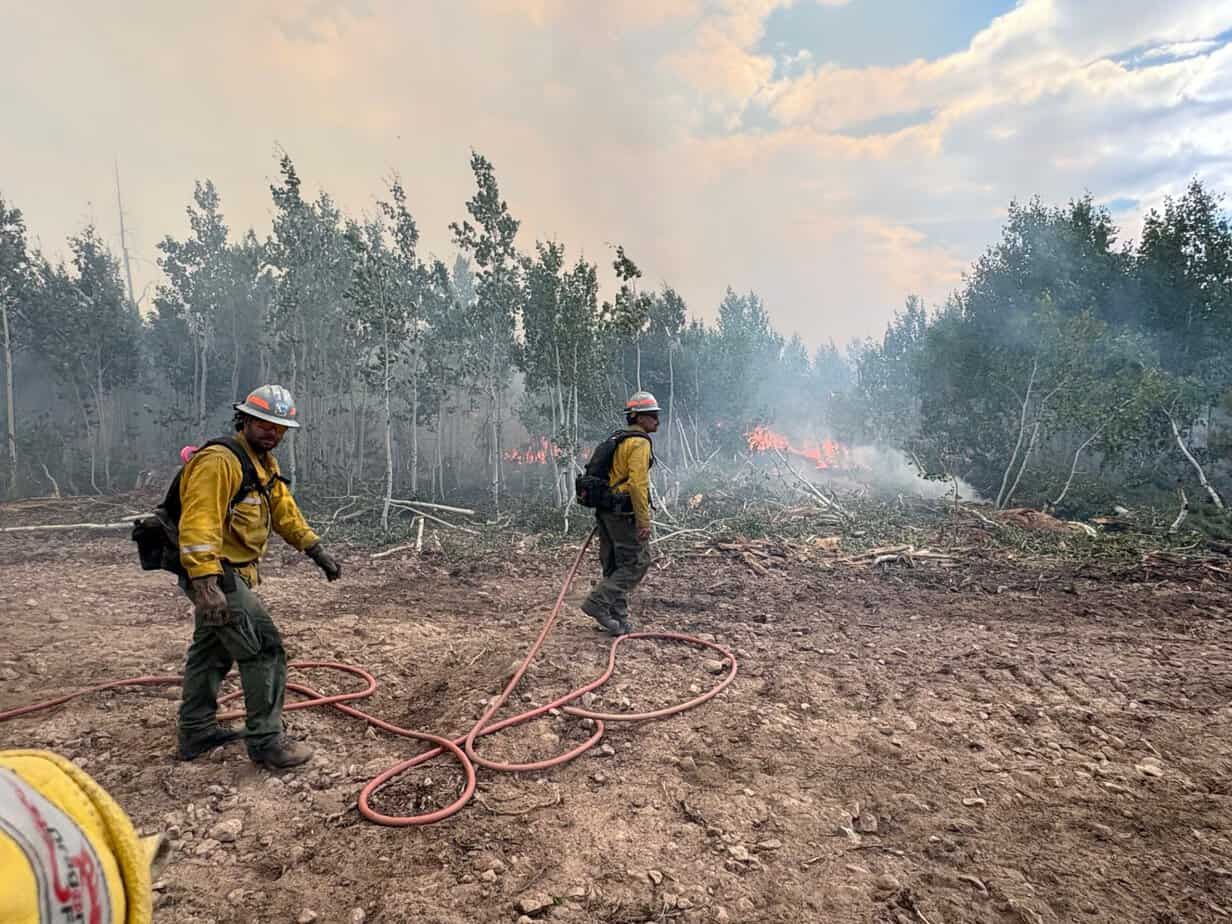
Sedona Fire District crews are among the about 1,125 personnel called out to help combat the Dragon Bravo Fire that has been roaring through over 144,000 acres of the Kaibab National Forest and Grand Canyon National Park’s North Rim since lightning ignited the fire July 4.
“The Dragon Bravo Fire … exhibited extreme and volatile fire behavior the evening of July 12, resulting in a 500-acre expansion,” according to a National Park Service July 13 press release. While no lives have been lost, preliminary assessments estimate 50 to 80 structures were destroyed by the fire. “Fire managers have confirmed the loss of the Grand Canyon Lodge and numerous historic cabins in the developed area.”
SFD Engine 533 composed of a type 3 wildland fire truck with four SFD firefighters first deployed to the Kirkland Fire on the day that fire erupted on Aug. 1, 60 miles west of Prescott. Engine 533 was assigned to the Dragon Bravo Fire on North Rim on Wednesday, Aug. 6, along with a four-person Rapid Extraction Module Support team.
That second team is assigned to provide extraction and care of injured firefighters, which the team has not had to perform, SFD Deputy Fire Marshal Kirk Riddell said on Aug. 11. While 533’s last day of the assignment is Friday, Aug. 15, and the REMS team’s is Tuesday, Aug. 19, the fire is only 44% contained as of Wednesday, Aug. 13, making it likely both teams will be deployed for an additional two weeks after a two-day layover, Riddell said.
“[But] we can swap the crews out with fresh crews,” he added.
Sedona Fire Risk
“We had a small lightning strike fire today which was contained by Station 3 crews east of the [Village of Oak Creek,]” SFD announced on Facebook on Aug. 10. The fire was approximately 5 by 25 feet. U.S. Forest Service personnel went back out to double check this fire for any remaining heat.
“The short rain showers today were a welcome relief, but the vegetation in the area is still very dry,” SFD stated.
SFD is in Stage 2 fire restrictions right now, along with Coconino National Forest and Yavapai County, Riddell said. “Pretty much the entire state is in Stage 2 at this point. So no campfires. You can cook with propane or natural gas, as long as it has a shutoff that’s close by and a closed lid, because that doesn’t give off embers.”
Currently, there is no discussions among any government agency on moving to Stage 3, according to Riddell.
“Stage 3 is an interesting one. That’s typically when the forest shuts down — pretty much close all the gates and lock off the forest and say you can’t go in there anymore,” Riddell said. “There’s not much more that we could do besides what we’re doing now. We’ve pretty much stopped everything. But Stage 3 is typically a Forest Service [matter].”
Summer Heat
SFD has also been feeling the heat with summer calls out to trailheads. Currently SFD crews “are on a trail for a heat related issue just about every day of the week, seven days a week, sometimes twice or three times,” Riddell said, with 12:30 p.m. being when those calls start rolling in.
While the National Weather Service as of publication deadline forecasts the heat this weekend will remain in the lower 90s, the fire risk may be reduced with a 30% chance of thunderstorms.
“If you’re going to the trails, make sure you take plenty of water and stay hydrated,” Riddell said. “Look at the trail you’re going to and plan accordingly. A lot of these trails, like Airport Loop, have no shade. They’re all open sun with no shade, and you don’t realize that until you’re halfway around it. The same thing with Devil’s Bridge — the first mile to get to the trailhead has no shade. So prepare for those things … and remember that if it’s 110º in Phoenix, it’s still 100º up here.”
“We’ve had a couple of campfires in campgrounds that we had to put out,” Riddell said. “But until we get some monsoons and get out of this heat and start heading more toward the fall, we’re going to stay in stage two [restrictions] for a while.”
For more information, call the U.S. Forest Service Fire Restrictions Hotline (928) 226-4607 or visit yavapaiready.gov/fireban.