

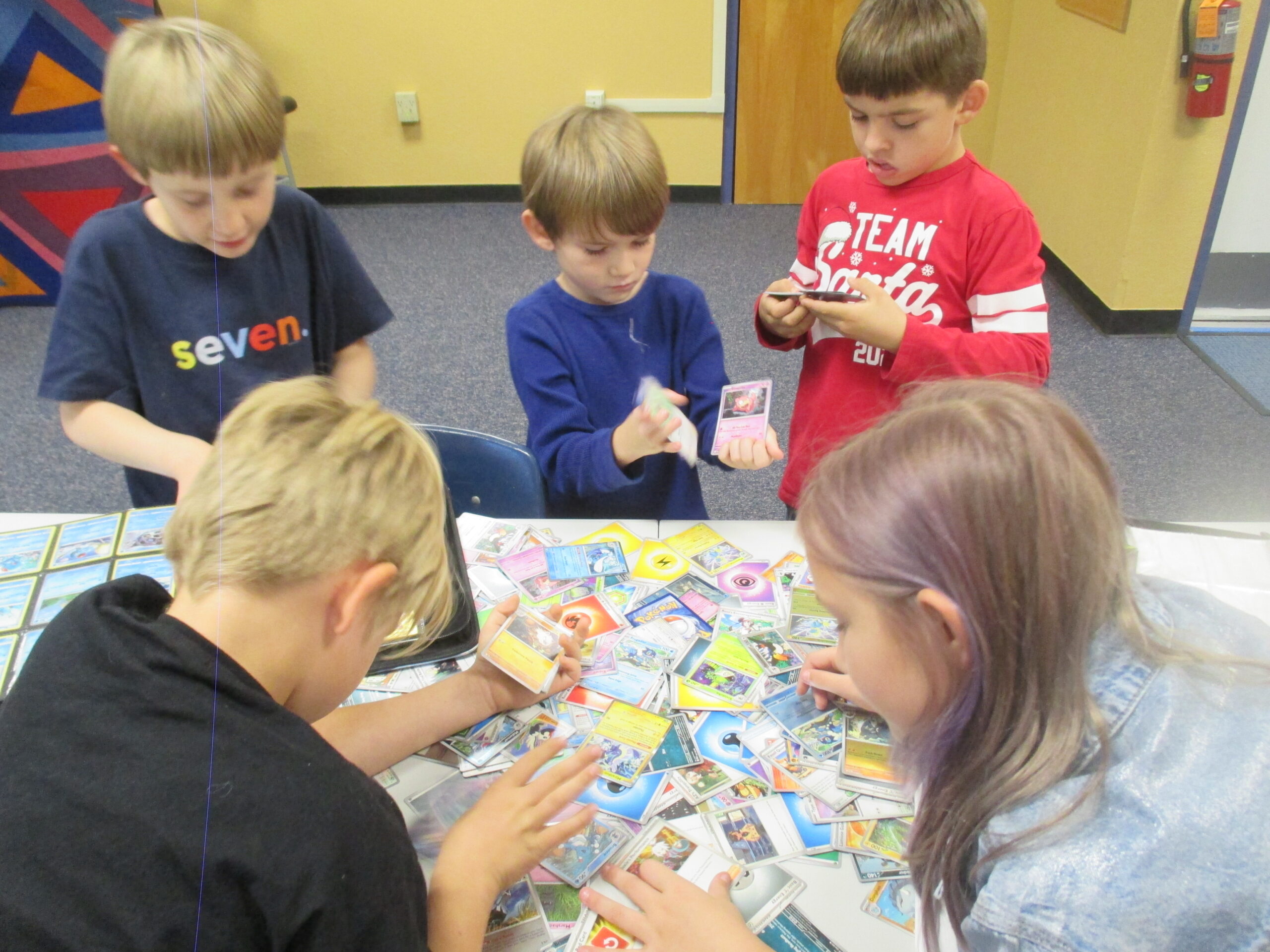
Athena Graham surveys her cards like a general inspecting her troops. The next move she makes will be critical. “I’m going to use Skuntank, and now he’s fainted,” she said, pushing her chosen card forward across the bright green game board.
Nearby, A.J. Carden tells his opponent, “I’m going to get you.” Making a pew-pew sound, he breaks out a power card.
Behind them, at another table, Fox Fiori is showing Charlie Ruckman his collection while they work out a trade.
“If you had a Mew or a Mewtwo, you’d be rich,” Charlie said.
“You know what my goal is?” Fox said. “To get a Mega Shiny Mewtwo.”
Almost an hour ago, Fox spent his first meeting just quietly sifting through a pile of Pokémon cards.
Athena, A.J., Charlie and Fox are just some of the kids taking part in one the fastest growing social clubs at West Sedona School — and it’s only been the third week.
The Pokémon club is becoming one the Sedona Parks and Recreation’s most popular afterschool programs, with spots quickly filling up ever since it began in early October. But its foothold in the Verde Valley has been growing for years.
For the last two years, Cameron Bloniarz has been a volunteer coor dinator with the Sedona Community Library’s Pokémon program. But his love for the franchise goes back even further. As a kid growing up in Cottonwood, “it’s been a part of my life ever since the very beginning,” Bloniarz said. “As soon as I could read, as soon as I could play the games.”
Bloniarz, 28, was born around the time Pokémon was introduced to North America and grew up with the tabletop card game.
Pokémon’s origins go back almost a decade, to 1980s Japan. Pokémon was created by Satoshi Tajiri, a Japanese game designer. In 1989, he learned that one of the features of the yet-to-be released Gameboy would include a Game Link Cable, which would allow players to exchange data between gamepads.
Inspired by his childhood love of collecting insects, Tajiri got the idea of a game where players not only collected virtual creatures, but traded them with friends.
This led to the release of Pokémon Red and Green in 1996 in Japan. Players were immediately hooked on the game’s main goal, “Gotta catch ’em all” and it exploded in popularity in Japan. Some creatures were only available in certain games, leading to gamers eagerly initiating trades between them.
Two years later, Pokémon Red and Blue released in North America, along with an animated television series that dominated the pop culture land scape of the late 1990s. Young Pokémon trainer Ash Ketchum and his team traveled a fictional world challenging other trainers and gym leaders in Pokémon battles.
Bloniarz was just one of millions of kids swept up in the craze that continues to be popular almost 30 years later.
When he got older, Bloniarz began competing in video game tourna ments that took him to Las Vegas, London and Japan, but it was a friend at the Sedona Community Library who reeled him back in.
Jordan Prouty, the teen librarian, was running a similar program along with other activities for Sedona’s youth.
“There’s not a lot of places around the community right now to play Pokémon or to get any information about it,” Bloniarz said. The nearest trading card shops in the Verde Valley are in Cottonwood and Jerome.

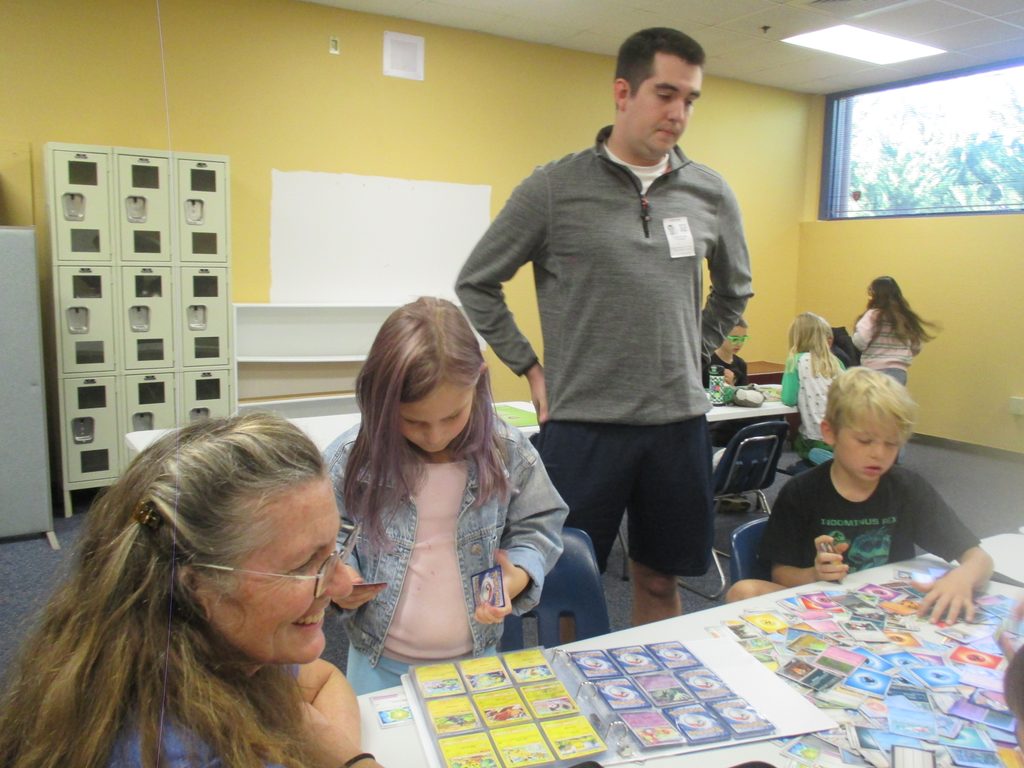
It began with monthly visits to the library to host a free program for kids interested in Pokémon.
“It got popular really fast,” Bloniorz said.
At any given time, there were 30 kids attending every single month.
When Athletics and Aquatics Supervisor Kimberly Sager was coming up with after school programs, she looked to what the kids were really responding to.
“She was like the brain child that said, ‘you know, this would be really good for the kids,’” coordinator Sheila Stubler said. “And she was right.”
At 3:45, on Friday, Oct. 23, the kids signed up for the afterschool program file into one of the rooms at West Sedona School. Once roll call is done, they immediately make a beeline for the pile of Pokémon cards that Bloniarz laid out on one of the tables. Today, he tells them, they can take 10 free cards each.
Each program session costs $5 to join. With only 10 spots available per session, the club’s popularity means that some end up on a waiting list for weeks, though that was recently increased to 15.
The kids swarm the table, cracking open binders and leafing through the rows of cards. Some, such as Aurora Henry, 8, make sure her collection is neatly organized. “That’s what the trainers do,” she said. Her pride and joy are the cards her mom’s friend brought back from Canada.
“I get to trade Pokémon and play with my friends,” said Holden Baird, 7, as he sifts through the pile. He thinks he has “more than 200 or something” cards.
“It’s not so structured, they can play the game if they want to,” Stubler said.
Some of the kids split off and play against each other, supervised by Bloniarz and Stubler, who help out newer players learn the game, while others continue trading cards with the same intensity as Wall Street stockbrokers.
“It’s a very safe and fun way,” Bloniarz said. “A lot of parents don’t want their kids stuck on video games all day, but when I can kind of pitch the game in a way to learn math and things like that, the parents are able to actually see that in action, see the kids learning.
“There’s so many other skills that come from Pokémon too, with trading card games and learning how to build a business and be able to sell and make money with that, being able to do damage calculations inside that game,” he continued. “There’s not really a downside to it.”
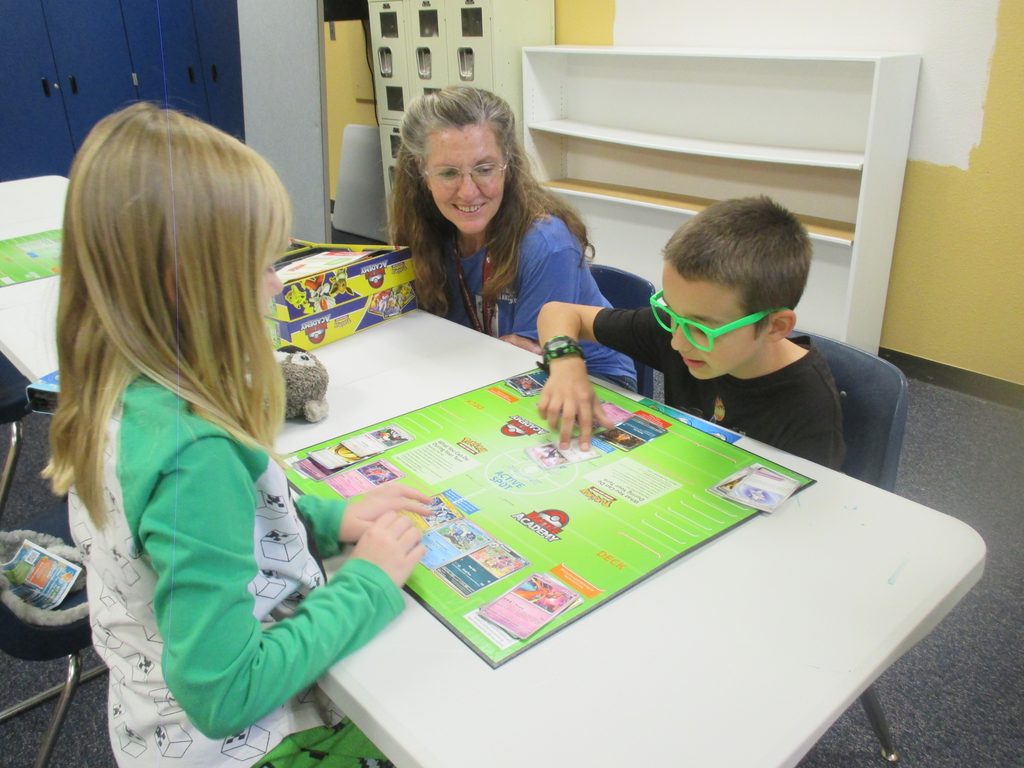
Meanwhile, 8-year-old Athena is battling against another kid. She isn’t sure how she got into Pokémon, only that she “liked it.”
Last Saturday, Oct. 17, Athena was playing against her friends during a Pokémon tournament held at Sedona’s Fest of Fall event that became the highlight of the event.
“I won, like, three battles, but I got two packs in the end,” she said.
“Every kid that showed up stayed for the entire tournament,” Bloniarz said, adding that parents who said they would only stick around for “an hour,” ended up staying for the entire match, which went on for three or four hours.
“I would love for a whole community to bloom from this … the game means so much to me and to be able to see kids with the same exact spark in their eyes that I had for it, I really, really enjoy that,” Bloniarz said


