


AZ Game & Fish says Pocket Fire caused animals to relocate
While Smokey Bear might be sad about recent Pocket Fire damage, he’s not the one making house calls.
“We’ve gotten a few reports of some bears in the Sedona area, and I think the reason that this is happening this summer is due to the fire,” Arizona Game and Fish Public Affairs Community Liaison Stevie Kelso said. “The fire definitely pushed some wildlife around, … including bears.”
Sedona residents have been posting to social media more footage than usual of black bears wandering through their yards. On Nextdoor alone, there were nearly a dozen bear sightings within the last two weeks.

Courtesy of Lee Lutge
Judy Reddington posted a picture online of a black bear lying in the shade near her house on Aug. 4.
“The story of all of these displaced critters has really touched me,” she wrote. “He was so hot and so tired, and they take long frightened runs and there’s no place for them to go. It will take a long time for them to find a new home. I think the bear was after the bird feeder or the little fountain we have.”

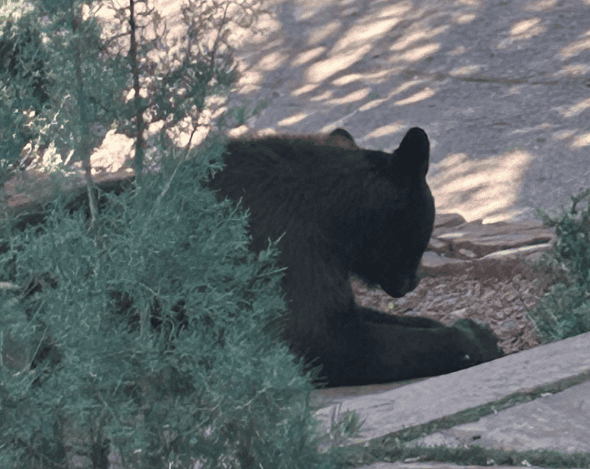
She said the fence stopped him from getting too close to the house and her bird feeder, but it was partially because he seemed so exhausted.
“After his short rest, he got up, looking over his shoulder at the things he could not reach through the fence and loped away,” Reddington said.
Kelso said it’s common for bears to go after bird feeders and places where there might be residual food odors. She said to be mindful of things that could smell good to bears and animals.
“Wait until trash day to put the trash out on the curb,” she said. “If they know a bear’s in the area, take down their bird feeders. Feed pets inside, thatway there’s no food being left out to attract bears. And also don’t feed other wildlife, because if you’re feeding other wildlife, then that could also potentially attract a bear.”
The Pocket Fire displaced all wildlife, not just bears, with increased sightings of deer, javelina and bobcats being reported on social media.


“Mountain lions have been here, too,” Reddington wrote. “The bears in the wild are real homebodies. They have a den and regular habits. Mountain lions have a much larger range, and may be better equipped to deal with being burned out.”
According to the Game & Fish website, black bears are normally solitary, except in family groups, breeding pairs and at feeding sites.
“Black bears are known to move long distances, up to 100 miles, to exploit isolated pockets of food,” according to Game & Fish.
Kyle Numen, a Sedona resident, said he saw a black bear on Aug. 5.
“It was around 4 a.m., so there was just enough moonlight to see that it was a decent sized black bear, not sure if it had a tag or not though,” he wrote. “My backyard is tiny and it was about 5 feet away from my window that was open so I went into fight or flight and just scared it off.”
He didn’t get a photo of the bear, but he did take a picture of a few of his fence posts that were bent and broken after the bear activity.
“We recommend that folks do their best to keep the bears from getting too comfortable in the neighborhood,” Kelso said. “When a bear starts to realize that it can get food from human food sources that’s when it gets comfortable and it sticks around the neighborhood and not when it gets to be not scared of humans and potentially become a problem.”

Courtesy of Jillian Schleicher
Bear Sighting Guide
Arizona Game and Fish Public Affairs Community Liaison Stevie Kelso said there’s a few things to know if you see a bear up close.
“The first thing that you’re going to want to do is make yourself look big,” Kelso said. “Make plenty of noise. You’re going to want to face the bear, make eye contact. Don’t run, because that could trigger it to chase.
“Then give the bear the option to leave. If it doesn’t, you can just slowly back toward a safe area, like a vehicle or a building.”
Reporting a bear sighting isn’t necessary when you’re out hiking or otherwise see a bear in the distance in a bear’s habitat, she said. It only becomes necessary when it’s by humans or could cause an issue with its proximity to humans.
The response from Game & Fish will vary depending on the bear’s activity. Most bear calls let Game & Fish know there’s a bear in the area, but department often doesn’t dispatch anyone for such a general notification call.
“A bear becomes a public safety threat, that’s when Game and Fish would step in and we would either relocate or sometimes we would have to lethally remove it,” Kelso said.
Lethally removing a bear is uncommon but hasn’t happened near Sedona or the Village of Oak Creek in several years.
The number to call for those incidents is 623-236-7201. The line is open 24/7.


